
Decoding the Playmaker: A Social Network Approach to Soccer Analytics
Differentiate the Game Maker in Any Soccer Match Based on Social Network Approach
This paper introduces a dynamic social network approach to identify the "game maker" (playmaker) in soccer matches by modeling players as nodes and ball passes as directed, weighted edges. By applying temporal centrality metrics—degree, closeness, betweenness, and clustering coefficient—to 2018 FIFA World Cup data, the authors distinguish influential players whose contributions are often obscured in draw or low-scoring matches.
TL;DR
Researchers have moved beyond goals and assists to identify the "hidden" engines of soccer teams. By treating a match as a dynamic social network, this study uses temporal centrality metrics to identify the Game Maker—the player who controls the flow—and locates the exact zones where lethal attacks begin. This is particularly vital for analyzing draw matches where individual brilliance isn't reflected on the scoreboard.
Background Positioning
While sports analytics has exploded with the advent of Expected Goals (xG) and tracking data, much of it remains focused on the "Game Changer" (the scorer). This work shifts the focus to the Game Maker, positioning itself as a structural analysis tool that views a team as a living, breathing communication network.
Motivation: Why Centrality Matters
The core problem in soccer scouting is subjectivity. Selecting a "Man of the Match" in a 0-0 draw often feels like guesswork. The authors' insight is that influence is a function of network topology:
- A player with many passes (High Degree) is active.
- A player who connects disparate parts of the field (High Betweenness) is a pivot.
- A player whose neighbors only connect through them (Low Clustering Coefficient) is a unique distributor.
Methodology: The Dynamic Network Framework
The paper segments the match into temporal windows (e.g., 15-minute blocks). This prevents "drowning out" tactical shifts that happen as players tire or strategies change.
1. Zone Division
The pitch is divided into three "communities": Defending, Midfield, and Attacking. Passes that transition between these communities are weighted more heavily as "attacking moves."
2. Identifying the Game Maker
The "Game Maker" isn't just the person with the most passes. The authors look for a specific mathematical profile: High Degree + High Closeness + High Betweenness + Low Clustering Coefficient.
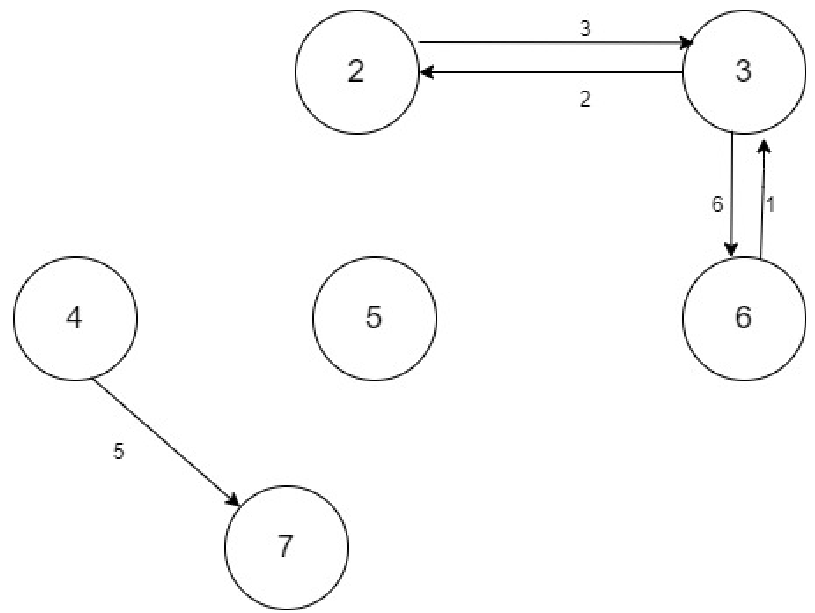 Figure 1: A sample 8-player network showing pass distribution across different zones. Node 5 represents a typical Game Maker profile.
Experiments and Insights
The authors validated their model using the 2018 FIFA World Cup dataset.
Key Findings:
- Stability: In the second halves of matches, the "Game Maker" rarely changes. Teams tend to settle into a rhythm or become dependent on a single pivot.
- The "Pitfall" Player: By looking at low betweenness centrality in the midfield, the model can identify which player is the "weak link" in an offensive chain.
- Community Strength: High-scoring matches (like Portugal vs. Spain 3-3) showed significantly more "cliques" (triangles of players passing to each other) than 0-0 draws, indicating that strong local understanding leads to better scoring opportunities.
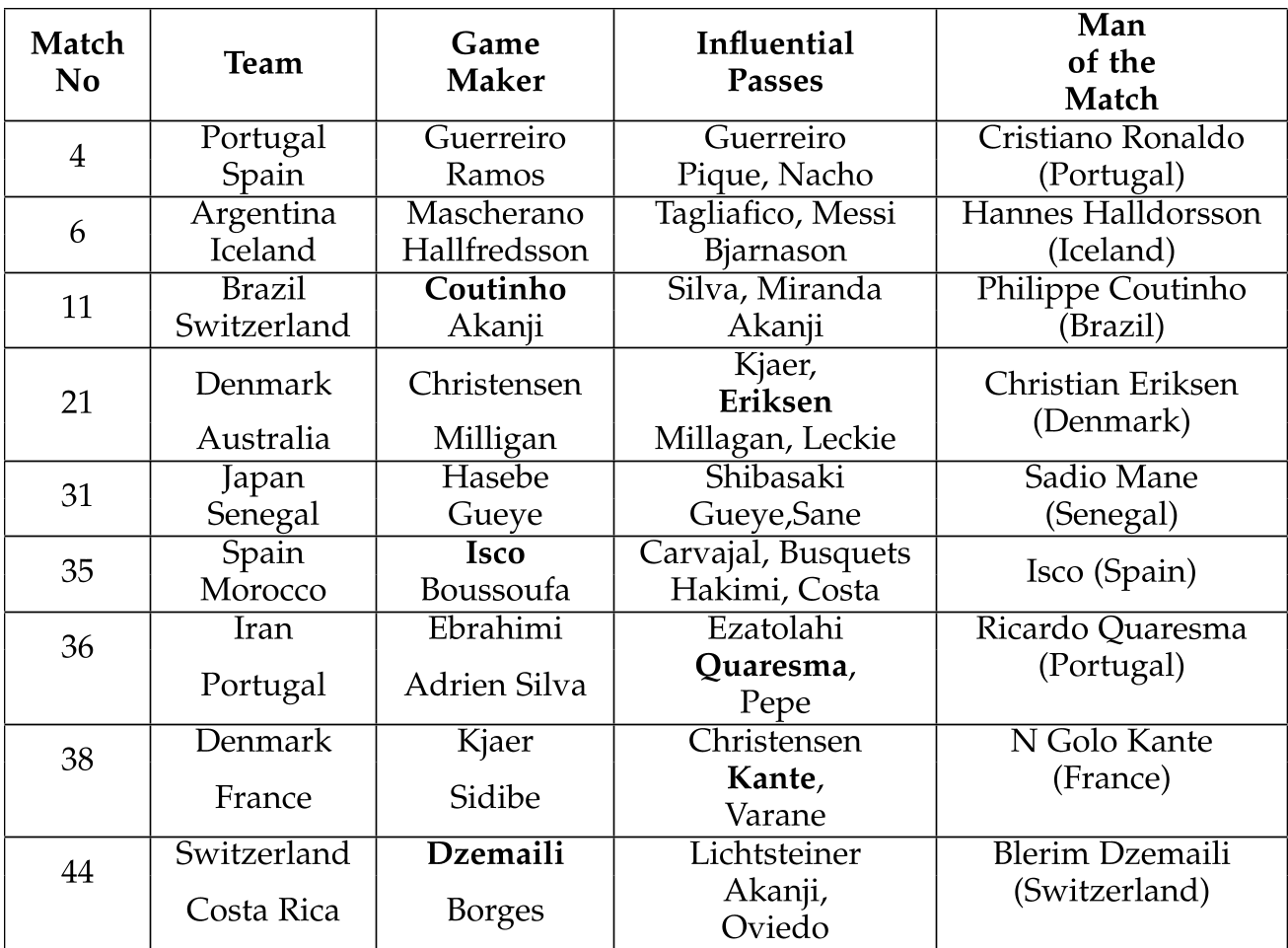 Table 1: Comparison between calculated Game Makers/Influential Passers and the official FIFA Man of the Match awards.
Deep Insight & Conclusion
Takeaway
The value of this work lies in its objectivity. It strips away the "glamour" of a last-minute goal and looks at the structural integrity of a team's passing. It reveals that the most influential player is often a midfielder (like Koke or Mascherano) or a ball-playing defender (like Sergio Ramos).
Limitations
The current model assumes tactical positions are static (e.g., a defender stays a defender), which ignores the fluid "Total Football" style where players swap roles. It also does not yet account for "mispasses" which could be a data point for defensive pressure.
Future Outlook
The integration of Machine Learning with this network approach could allow coaches to predict during a match which substitution would most disrupt the opponent's passing network. It transforms soccer from a game of feet into a game of graph theory.