
The War for Eyeballs: Why "Sticky" Content Fails in Crowded Social Networks
On the diffusion of messages in on-line social networks
The paper investigates message diffusion dynamics in On-line Social Networks (OSNs) by modeling unique factors like information aging and competing message streams. Using mean-field analysis, the authors derive threshold theorems for both single-message virality and topic-based repeated forwarding, achieving SOTA theoretical insights into why most messages fail to go viral.
TL;DR
Being "viral" isn't just about how good your content is—it's about surviving the noise. This paper proves through rigorous mean-field analysis that competing message streams create a "threshold barrier" that traditional epidemic models ignore. To go viral, a message must overcome not just human indifference, but the physical aging of the inbox.
Background: Beyond the Traditional Epidemic Model
In classical contagion theory, if you have a "sticky" enough virus and a connected network, an outbreak is inevitable. However, Twitter and Facebook aren't petri dishes; they are battlefields of attention. The authors argue that information "ages" because new, irrelevant messages push the "tagged" message out of a user's sight.
The core insight is the Space-Time Window: for a message to be forwarded, it must be visible when the user logs in. If your friends post too many cat videos (), your important marketing message () drops to the bottom of the feed (), dying before it's even seen.
Methodology: The Three-State Mean-Field Engine
The researchers move beyond simple SIR (Susceptible-Infected-Recovered) models by introducing a visibility-aware state machine. Users transition between:
- s1: The message is in the inbox and visible.
- s2: The message is "lost" due to competing traffic.
- s3: The message has been read/processed.
The Architecture of Diffusion
By applying mean-field ODEs (Ordinary Differential Equations), the authors approximate the behavior of millions of nodes. They specifically account for Heterogeneous Networks, where "Influentials" (high out-degree) and "Consumers" (high in-degree) interact differently.
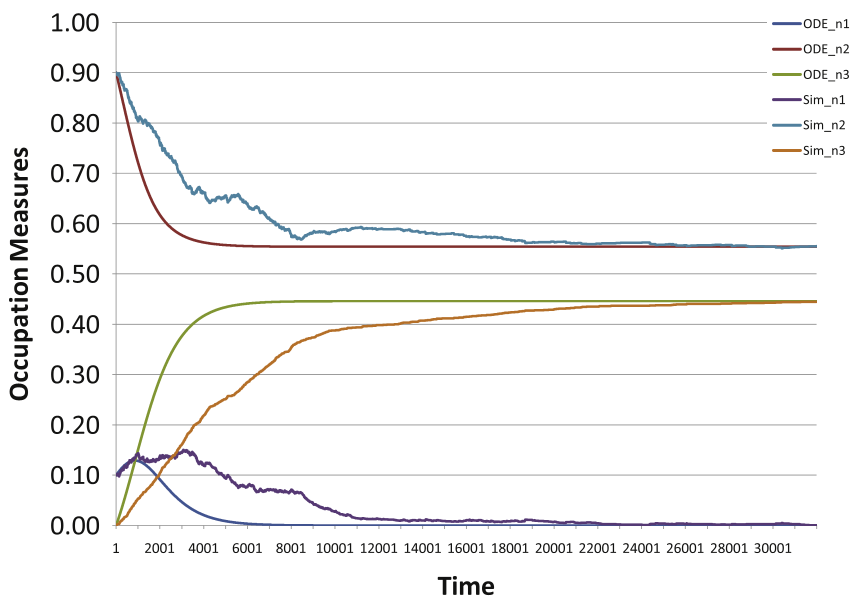 Figure 1: Numerical results showing the tipping point. On the left, high noise (q=0.8) kills the message. On the right, lower noise (q=0.3) allows for an outbreak.
The "Threshold Theorem" for Virality
The most striking contribution is the derivation of the viral threshold: Where:
- : Average connections (degree).
- : Stickiness (probability of forwarding).
- : Visibility (probability of reading).
- : Competing message rate.
Why this matters: Unlike traditional models where the threshold is just based on and , here the denominator is heavily penalized by . In simple terms: The more your audience's other friends post, the higher your content quality must be to survive.
Experiments: Proving the Noise Effect
The authors ran simulations on networks of 2000 to 5000 nodes. The results (Fig 2 & 3) show a sharp "Phase Transition." If the competing traffic crosses a certain limit, the reach of the message collapses to nearly zero, regardless of the network's connectivity.
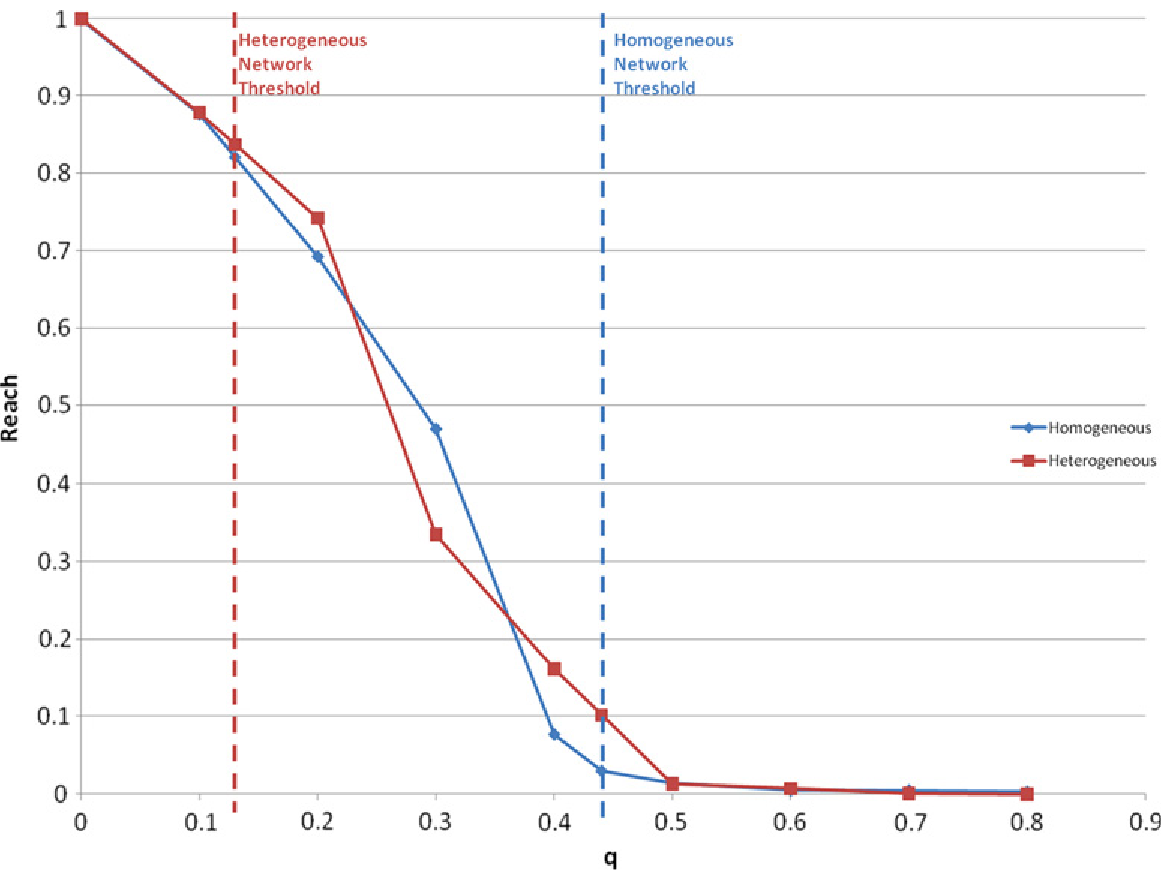 Figure 2: The precipitous drop in message reach as the generation rate of competing messages (q) increases.
Critical Insight: Strategic Implications
Based on these findings, the paper identifies three levers for a successful campaign:
- Stickiness (): The "Art" of the message.
- Timing (): The "Science" of visibility. Posting when your target audience is active but their other contacts are "quiet" maximizes and minimizes effective .
- Seed Selection: Choosing initiators based on degree correlations (e.g., targeting nodes that bridge specific clusters).
Conclusion & Limitations
This work provides a rigorous mathematical explanation for why virality is a "low-incidence" event. While it successfully models the competition for space, it treats and as constants. Future research could explore Dynamic Response Probability, where a user's willingness to forward decreases the more "noise" they are exposed to (saturation effect).
Ultimately, this paper is a wake-up call for digital marketers: in the attention economy, your greatest enemy isn't your competitor's product—it's the sheer volume of everyone else's status updates.