
Beyond Monopolies: The Complexity of Competing Products in Social Networks
Diffusion in Social Networks with Competing Products
This paper introduces a novel threshold-based diffusion model for social networks featuring multiple competing products. It provides structural characterizations of the graphs required for products to reach or necessarily occupy the entire network, while establishing polynomial-time algorithms for verifying these properties and determining the uniqueness of outcomes.
TL;DR
Most mathematical models of social influence assume we are only deciding whether or not to buy one specific product. Apt and Markakis break this mold by introducing a threshold model where multiple products compete for the same users. They prove that while it's easy to see if a product can take over the world, it is computationally "nightmarish" (NP-hard) to calculate the minimum guaranteed spread in a competitive market.
Background: Why Single-Product Models Fail
Traditional models like the Linear Threshold Model (LTM) treat adoption as a binary state. However, the real world is a battleground of alternatives. If you are choosing a mobile carrier, you don't just "adopt" telephony; you choose between AT&T, Verizon, or T-Mobile. This choice is influenced by which networks your friends are on to reduce costs or improve connectivity.
The core challenge here is Ambivalence. In a multi-product world, a node might satisfy the threshold for two different products simultaneously. The order in which people make decisions suddenly changes everything, leading to multiple possible "final states" of the network.
Methodology: The Geometry of Influence
The authors introduce the concept of a -well-structured graph.
The -Well-Structured Insight
A network is considered -well-structured if you can layer the nodes into "levels" such that every node in level has enough input from nodes in levels to to exceed its adoption threshold.
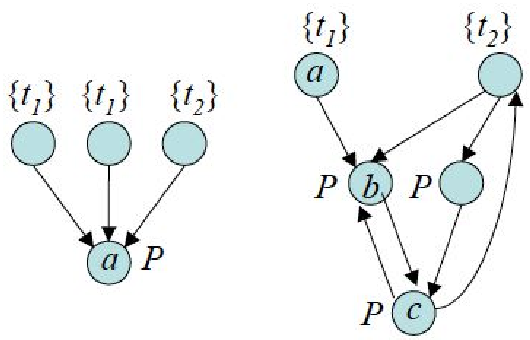 Figure 1: Illustration of a social network where nodes have set choices (e.g., ) and specific thresholds.
This structural property allows the authors to prove two critical theorems:
- Reachability: A product can occupy the entire network if and only if the graph is -well-structured.
- Unavoidability: A product must occupy the whole network if it is the only choice for "root" nodes (those with no neighbors) and the structure ensures no other product can gain a foothold.
The "Complexity Gap": Optimism vs. Pessimism
The most striking part of this research is the disparity in computational complexity between finding the Maximum Adoption and Minimum Adoption.
- MAX-ADOPTION (The Optimist's View): If we want to know the maximum number of people we can reach, we can use a "Fast Reduction" algorithm. We simply let everyone who can adopt our product do so immediately. This is solvable in time.
- MIN-ADOPTION (The Pessimist's View): If we want to know the absolute minimum number of people we will reach regardless of how competitors act, the problem becomes NP-hard. In fact, it's not even roughly approximable.
The Partition Reduction
The authors proved the hardness of MIN-ADOPTION by reducing it from the PARTITION problem. They designed a gadget where a product's spread depends on whether a specific set of nodes can perfectly balance their influence.
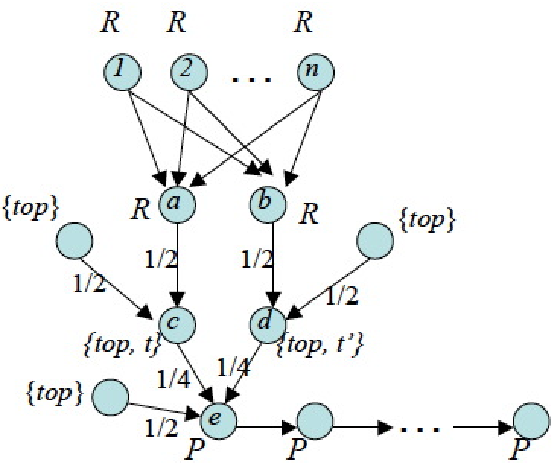 Figure 2: The gadget used to prove NP-hardness. If a partition exists, the product "top" is blocked; otherwise, it surges through the network.
Critical Insight & Conclusion
This paper serves as a cautionary tale for algorithmic marketing. In a vacuum, your product might look like it's destined for SOTA-level adoption. However, in a competitive social graph, the existence of even one alternative can lead to "path dependency," where the specific sequence of early adoptions determines the ultimate winner.
Takeaway for Researchers: The transition from (single product) to (competing products) doesn't just add a variable; it fundamentally changes the complexity class of the underlying search problems. While influence maximization is already hard, influence guarantee is even harder.
Limitations: The model assumes once a product is adopted, the consumer never switches back or moves to a third option. Future work incorporating "churn" or "re-adoption" would bridge the gap between this theoretical threshold model and the dynamic reality of modern SaaS marketplaces.