
Digital Democracy: Episode IV—A New Hope: Building the Corporation for Public Software
Digital Democracy: Episode IV-A New Hope*: How a Corporation for Public Soware Could Transform Digital Engagement for Government and Civil Society
Gastil and Davies propose the establishment of a "Corporation for Public Software" (CPS), a government-authorized but independent non-profit entity designed to fund and maintain digital democratic infrastructure. This initiative aims to transition digital engagement into a "fourth stage" of Public Software, mirroring the success of the Corporation for Public Broadcasting (CPB) to foster deliberative democracy.
TL;DR
Twenty years of "Civic Tech" have failed to produce a truly deliberative digital commons, largely because our "public squares" are actually private malls owned by Silicon Valley. Professors John Gastil and Todd Davies argue for a radical institutional shift: the creation of a Corporation for Public Software (CPS). Modeled after the Corporation for Public Broadcasting (CPB), this entity would provide stable funding for non-commercial, interoperable software designed for governance and civil society, effectively reclaiming our digital identities from surveillance capitalism.
The Motivation: Why Social Media Broke Democracy
The "Social Media Era" promised a global village but delivered "Surveillance Capitalism." The authors argue that platforms like Facebook are fundamentally misaligned with democratic values because their Attention Model necessitates polarization to drive ad revenue.
The fundamental problem is one of Infrastructure vs. Innovation. While there is no shortage of brilliant "civic tech" ideas, they often die in the "Valley of Death" because:
- Unstable Funding: Non-profits can't afford the billion-dollar engineering budgets required to maintain contemporary UX standards.
- Network Dominance: Private platforms hold software patents and data monopolies that act as barriers to entry.
- Identity Crisis: Commercial platforms favor anonymity or "ad-ready" profiles, whereas democracy requires a Verified Civic Identity.
Methodology: The "Democracy Machine" and the CPS Model
To counter the economic gravity of Big Tech, Gastil and Davies propose a "Public Software" stage. The centerpiece of this vision is the Democracy Machine.
The Integrated Civic Commons
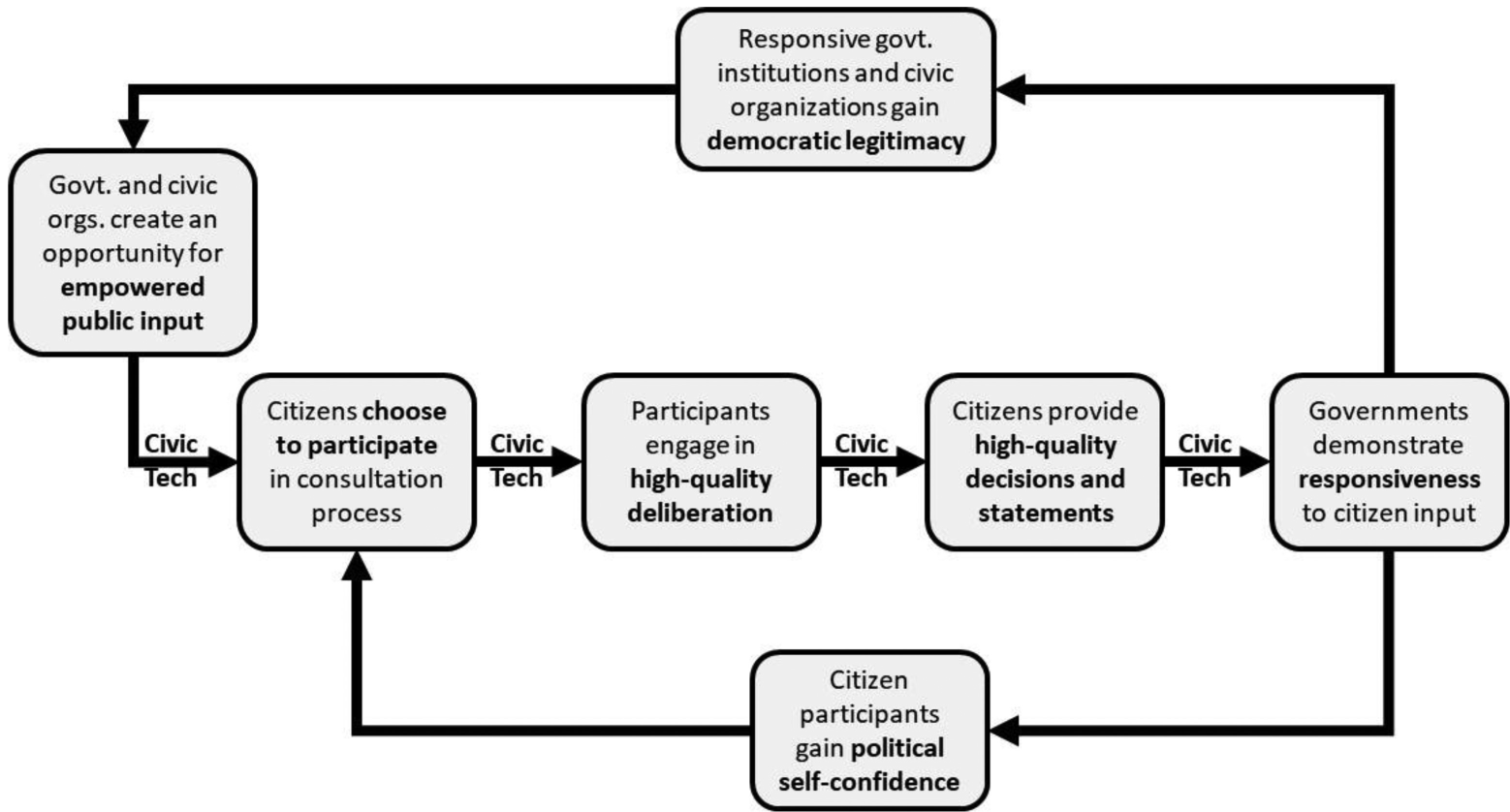
Instead of building a single "Mega-App," the authors envision an interlinked system where data flows across various specialized services. A unique civic identifier would allow a citizen to move seamlessly from a municipal waste-reporting app to a deliberative survey on urban planning, and finally to a neighborhood voting platform.
The Six-Actor Framework
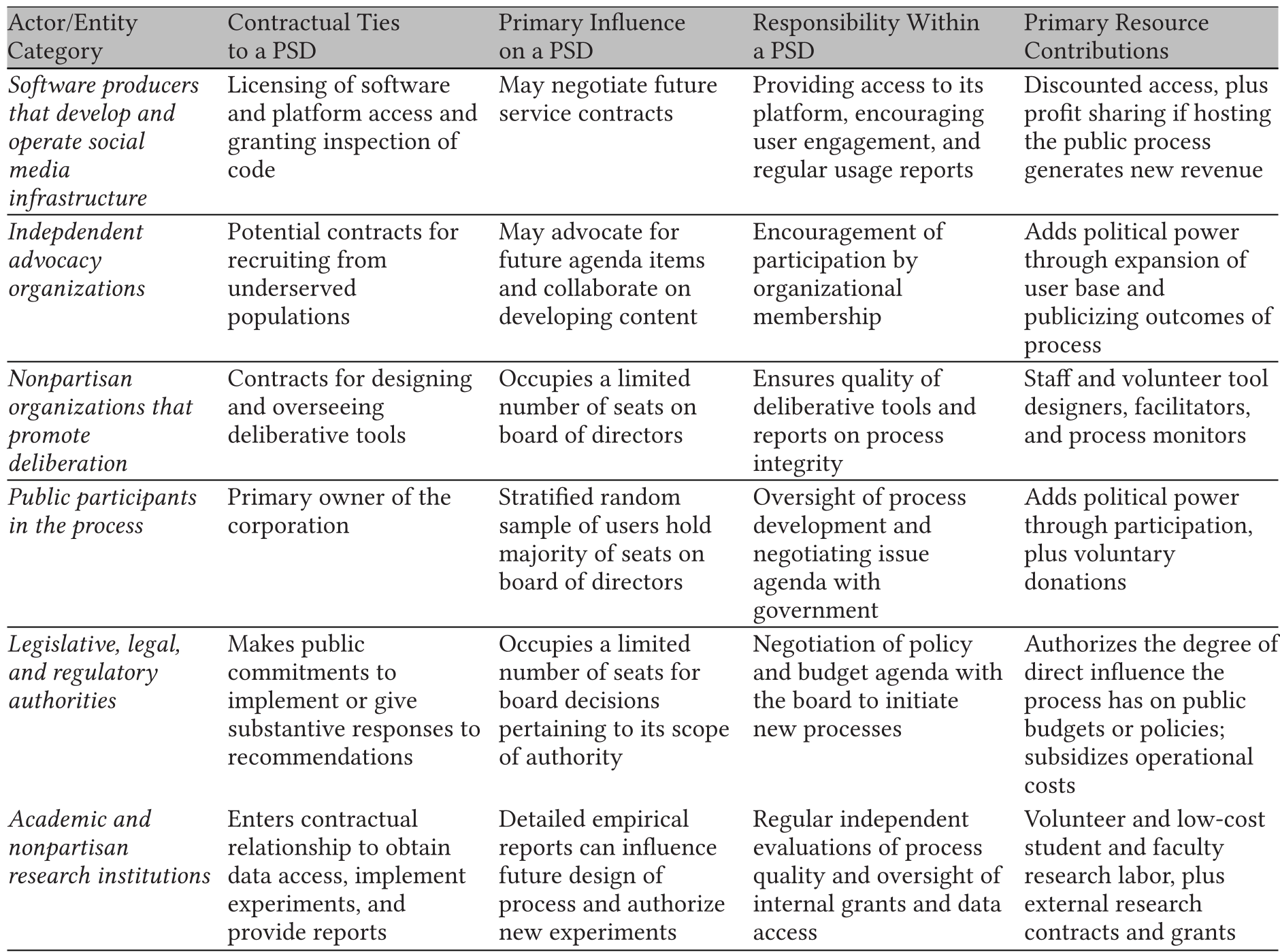
The success of this ecosystem relies on a delicate balance of incentives across six categories of actors. The authors use Hirschman’s theory of "Exit, Voice, and Loyalty" to ensure the system remains democratic:
- Software Producers: Provide the "pipes" at reduced costs to forestall regulation.
- Advocacy Groups: Drive agenda setting and mobilize participation.
- Non-partisan Groups: Ensure the quality of deliberation (facilitation).
- The Public: Provide "effective participation" and oversight.
- Government: Grants the system "Real Influence" by committing to act on results.
- Researchers: Provide independent audits and performance evaluations.
Lessons from the Field: Deme and Consul
The paper isn't purely theoretical. It reflects on the Deme platform (led by Davies since 2003), which sought to provide a "Platform for Online Deliberation." The hard lesson from Deme was that maintaining usable web applications today requires a "Public Service Distributor" (PSD) model because university-based boutique software cannot keep up with security threats and user UX expectations.
Conversely, the success of Consul (the open-source software behind DecideMadrid) shows that when a government invests significantly in digital infrastructure, citizens engage. Over 100 cities globally have adopted Consul, proving that there is a hunger for non-commercial spaces.
Critical Insights & The Path Forward
The authors propose that the CPS would act as a stable "anchor" for funding, allowing for:
- Gamified Civic Participation: Using "in-game currency" to empower marginalized census blocks or reward "constructive disagreement" rather than rage-clicks.
- Privacy-First Data: Nuanced access control where users, not corporations, own their data.
Conclusion: Embracing the Paradox
The proposal for a Public Corporation is a paradox: it uses government authority to create a space that must eventually be independent enough to challenge that same government. However, as the authors note, the history of public broadcasting proves that such an "independent but funded" model is not only possible but is often the most trusted component of a nation's media landscape.
If we don't build a Corporation for Public Software, digital democracy will remain an "Episode IV"—a hope waiting for a sequel that never arrives.