
Digital Breadcrumbs: Unveiling Social and Spatial Trails in Mobile Forensics
Digital evidence discovery of networked multimedia smart devices based on social networking activities
This paper presents a digital forensic framework for "Networked Multimedia Smart Devices," focusing on extracting volatile evidence from social networking and GPS activities. By utilizing RAM imaging and data string searching, the authors successfully recovered historical GPS trajectories and multiple Facebook user credentials from a live PDA system.
TL;DR
As cybercrime migrates to mobile platforms, the "smoking gun" is no longer just on the hard drive—it's in the volatile memory (RAM). This paper introduces a systematic framework for extracting sensitive social networking data and GPS trajectories from networked smart devices before they lose power. By capturing RAM images "live," investigators can unmask previous Facebook users and reconstruct physical movements with surgical precision.
The Volatility Crisis in Mobile Investigation
In the era of Ubiquitous Computing, mobile devices are extensions of our physical presence. However, there is a technical catch: Volatiles. Many applications, especially those dealing with Mobile Social Network Services (MSNS), store session data and location logs in the Random Access Memory (RAM).
The core problem identified by Chu et al. is that standard shut-down procedures—the traditional "pull the plug" forensic approach—destroy this evidence. Once the battery drains or the device is turned off, the digital trails of who was logged in and where they went vanish forever.
Methodology: The Live Acquisition Framework
The researchers propose a transition from "Logical/Physical Acquisition" of storage to "Volatile Memory Acquisition." Their approach follows a rigorous 6-phase case review:
- Bit-Stream Imaging: Using tools like Paraben’s PDA Seizure to capture the entirety of the RAM while the device is still powered on.
- String Mining: Searching for specific application identifiers. For instance, the "Papago" GPS suite leaves unique registration codes in memory.
- Spatial Reconstruction: Extracting proprietary
*.TR7track files and converting them into*.GPXor*.KMZfor mapping on Google Earth. - Social Discovery: Using targeted keyword queries like
guest@facebookandm[1].comto scrape email addresses and session markers from the memory dump.
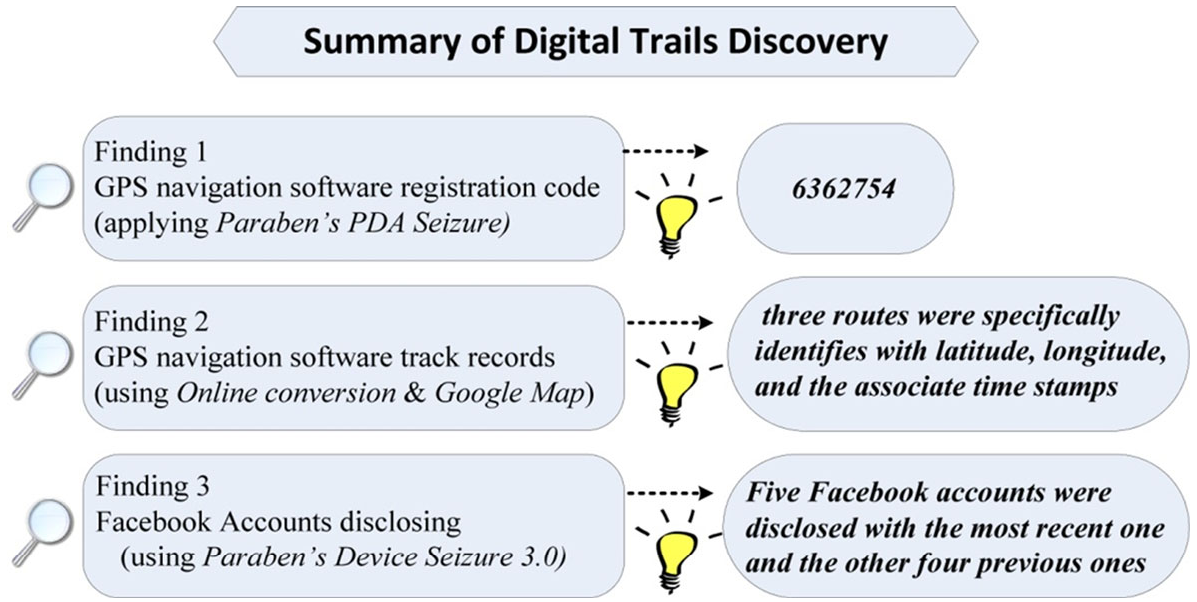 Fig 1: Summary of the collected digital evidences and the corresponding discovery results.
Key Findings: More than Just "Current" Data
The most striking result of this study is the ability to recover historical data. Even after a user logs out, the RAM may still contain remnants of their activity.
1. The Power of GPS Trajectories
The team successfully reconstructed three distinct journeys. By mapping coordinates and UTC timestamps, they could verify the exact time a suspect arrived at a specific geographic location. This provides an objective "Digital Witness" that is difficult to refute in court.
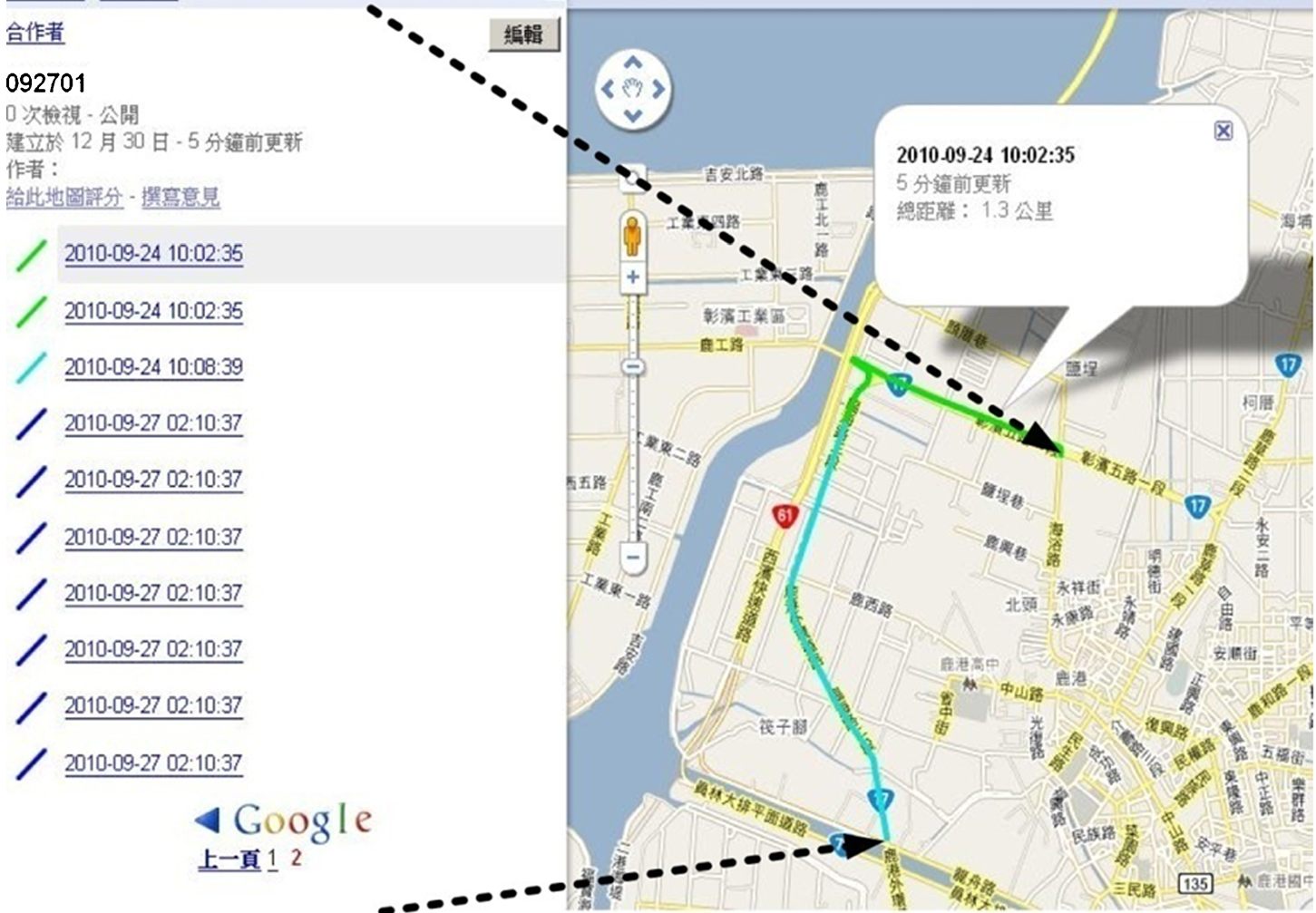 Fig 2: A reconstructed travel route showing start/end points and temporal data.
2. De-masking Social Identity
By searching for memory strings, the investigators didn't just find the current user. They identified four previous Facebook accounts (e.g., deangarnett@yahoo.com.tw, rran456@yahoo.com.tw). This reveals the device's history of use by multiple individuals, which is vital for establishing "Attribution" in criminal cases.
Critical Insight: Why This Matters Today
While this paper was published in 2013, its "Live Forensic" principle is more relevant than ever. Modern smartphones use heavy encryption; once a device is locked or rebooted (BFU - Before First Unlock), the data becomes virtually inaccessible. This research emphasizes that the Volatile State is the only window of opportunity for investigators to see the "plaintext" digital life of a suspect.
Conclusion & Future Outlook
Chu et al. provide a foundational blueprint for MSNS forensics. However, the field faces new hurdles:
- Encryption: Secure enclaves and memory encryption make RAM dumping harder on modern SOCs.
- Privacy: The ability to scrape historical users from RAM raises significant legal and ethical questions about the scope of a search warrant.
The takeaway for forensic practitioners is clear: Never let the battery die. The most incriminating evidence is often the most fragile.