
Cloud Forensic Triage: Overcoming the Big Data Crisis in Digital Investigations
16249_Digital forensics in social networks and the cloud- Process, approaches, methods, tools, and challen
This paper introduces the concept of Digital Forensic Triage in Cloud Environments, focusing on optimizing the acquisition and analysis of evidence from platforms like Amazon EC2 and S3. It explores the shift from traditional exhaustive forensics to a time-constrained, resource-efficient methodology tailored for the scale of modern cloud services.
TL;DR
Digital forensics is hitting a "wall of data." As organizations migrate to Amazon EC2 and S3, investigators can no longer afford the luxury of full bit-stream imaging. This paper advocates for Digital Forensic Triage, a methodology that prioritizes high-value artifacts under strict time and resource constraints, proving that in the cloud, speed is just as vital as integrity.
The Motivation: Why Traditional Forensics is Breaking
For decades, the "Golden Rule" of forensics was to clone everything. But in a multi-tenant cloud environment with petabytes of data, this approach is physically and legally impossible.
- Volume: Downloading a 30GB VM image over a standard connection for every investigation is inefficient.
- Jurisdiction: Data stored in different AWS regions may be subject to varying legal constraints, making full access difficult.
- Volatility: Cloud instances are ephemeral; if you don't find the evidence fast, the instance might be terminated.
Methodology: The Shift to Forensic Triage
The core insight of the authors is the transition to Forensic Triage. Instead of a "blind" copy, triage is a partial examination conducted under pressure.
The Forensic Cloud Model
The authors propose a Forensics-as-a-Service (FaaS) framework. This involves deploying forensic tools directly within the cloud environment (the "Forensic Cloud") to minimize data transfer across the WAN.
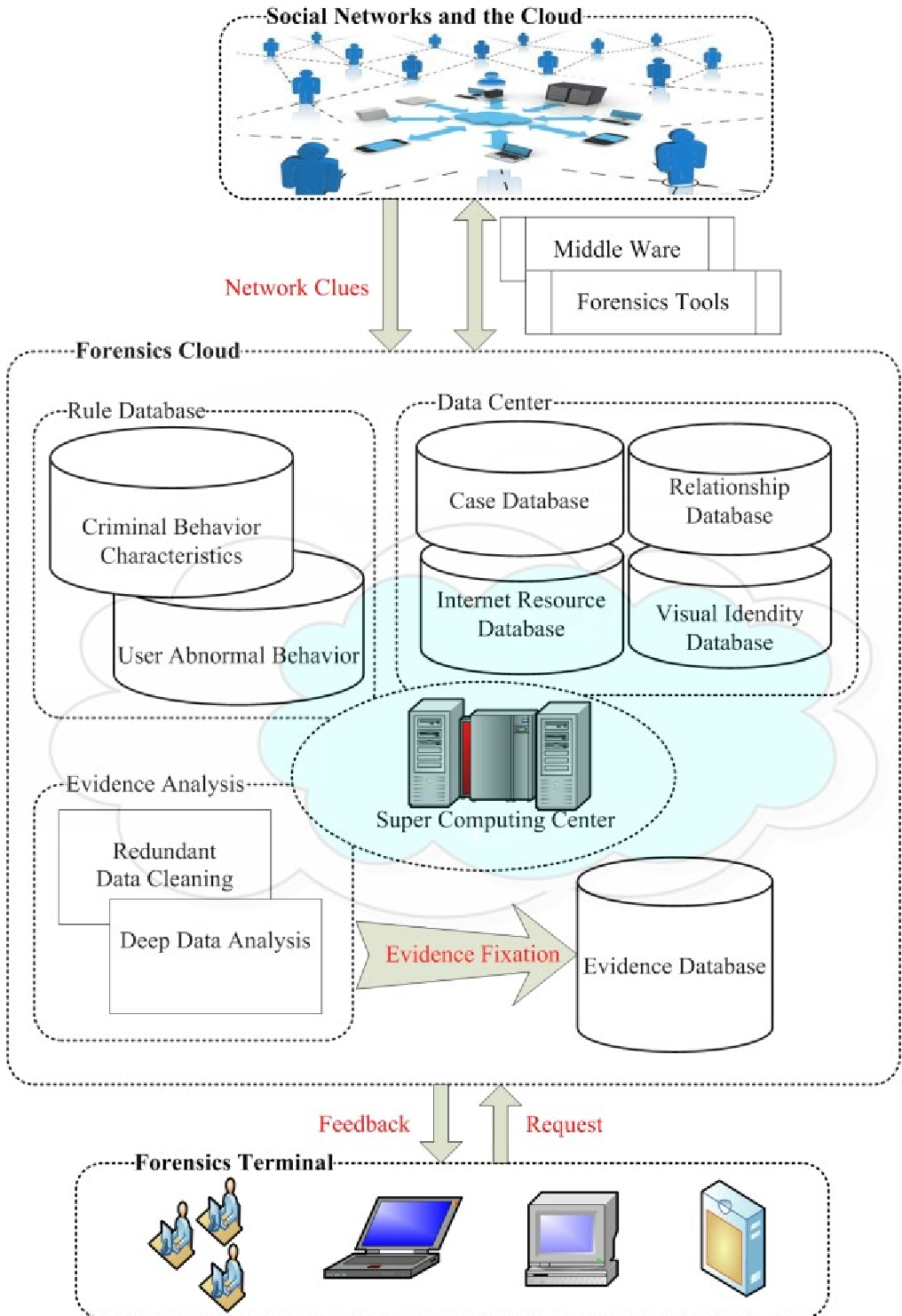
The figure above illustrates the intersection of cloud infrastructure (EC2, S3) and the specialized forensic layer required to extract meaningful data like Hbase logs or browser history.
Technical Implementation
The research highlights the use of specialized software such as Magnet Forensics' IEF and Guidance EnCase. The methodology focuses on:
- Targeted Acquisition: Extracting only specific file types or registry hives.
- In-place Analysis: Running keyword searches across Apache Hbase instances without moving the raw data.
Experimental Results: Triage vs. Traditional Imaging
In a test case involving an Amazon EC2 virtual machine with 30GB of data, the authors compared traditional imaging against triage-based extraction.
- Efficiency: Triage methods allowed for the identification of critical artifacts (like internet evidence or system logs) in a fraction of the time required for a full 30GB download.
- Scalability: The Forensics-as-a-Service approach proved that performing analysis "closer" to the data source significantly reduces latent time in investigation cycles.
Critical Analysis & Conclusion
The paper makes it clear: Triage is the future of cloud investigation. We are moving away from the era of "Deep Forensics" as a first step and moving toward a "Triage-First" model.
Limitations
While effective, triage risks missing "hidden" data located in unallocated space if the triage scope is too narrow. Furthermore, the legal admissibility of "partial" images is still a maturing area of digital law.
Final Thoughts
This work serves as a blueprint for modern incident response teams. By adopting a triage-based mindset, investigators can act faster, save on egress costs, and handle the overwhelming "noise" of cloud-scale data.