
SLBIF: Transforming Social Media Noise into R&D Gold for SMEs
Digital Innovation and Transformation
The paper introduces the Semantic Learning-Based Innovation Framework (SLBIF), a specialized open-innovation model designed for SMEs to leverage social media analytics. By integrating deep learning, specifically a sparse autoencoder and Cross-Language Latent Dirichlet Allocation (CL-LDA), the framework automates the extraction and refinement of innovation ideas from vast streams of customer data.
TL;DR
Innovation is no longer the exclusive playground of corporate giants with massive R&D budgets. The Semantic Learning-Based Innovation Framework (SLBIF) provides a deep-leaning-powered roadmap for SMEs to extract, refine, and diffuse product ideas using nothing but social media data. By combining Sparse Autoencoders with social network analysis, it automates the discovery of unmet customer needs and identifies the key influencers who can make a product go viral.
The "Gut Feeling" Gap in SME Innovation
For most Small- and Medium-sized Enterprises (SMEs), innovation is hampered by a chronic shortage of labor, finance, and infrastructure. Traditionally, these firms rely on the "gut feelings" of owners or simple customer surveys. However, in the era of "Big Data," the problem isn't a lack of feedback—it's an information overload.
Social media platforms like Twitter, Facebook, and Weibo are repositories of raw consumer desire, yet most SMEs use them only for marketing. The SLBIF addresses this by providing a systematic, analytical way to perform In-bound Open Innovation without the heavy price tag of a dedicated research lab.
Methodology: The Three-Stage Engine
The SLBIF operates through a rigorous three-stage pipeline that bridges the gap between raw data and market success.
1. Idea Selection: The Deep Learning Filter
The first hurdle is finding the "signal" in the "noise." The framework uses a sophisticated AI pipeline:
- Labeling & Ranking: Human "Innovation Agents" label a small sample (approx. 500 posts) to define what is "innovation-feasible."
- Sparse Autoencoder (Denoising): An unsupervised neural network learns the perfect representation of posts, reducing dimensionality and noise.
- CL-LDA (Cross-Language Latent Dirichlet Allocation): This identifies the latent semantic topics within the selected posts, uncovering specific features (e.g., "camera shot quality" or "battery life") that consumers are actually demanding.
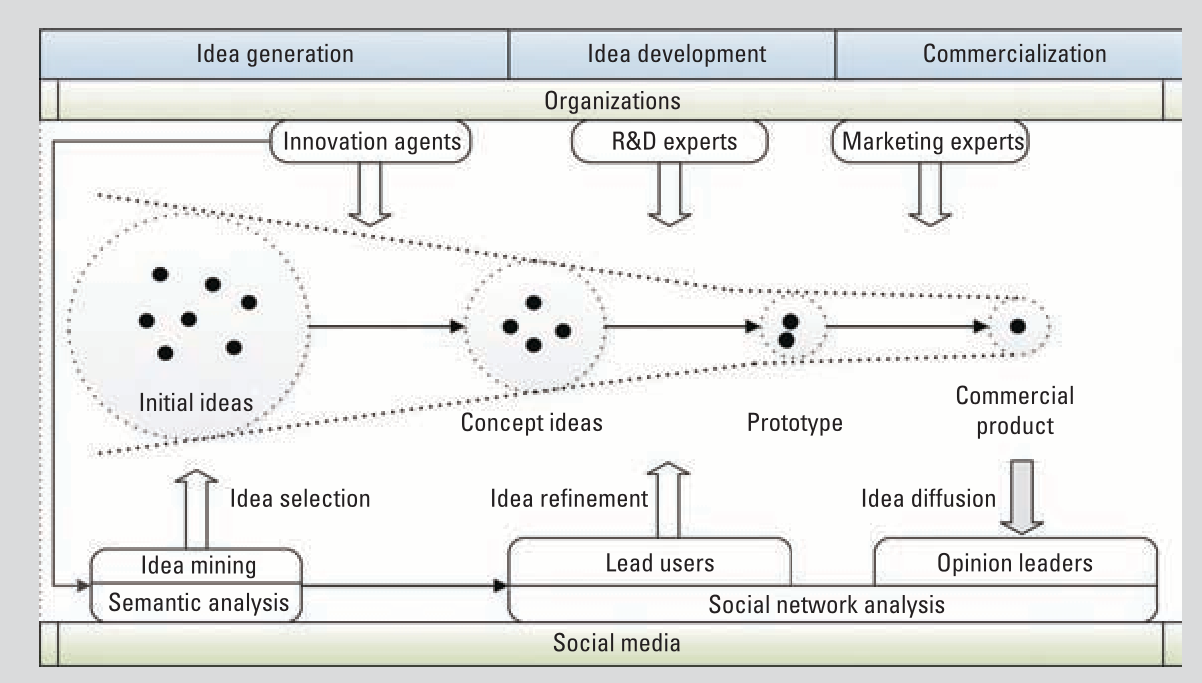 The SLBIF conceptual framework, moving from Idea Selection to Diffusion.
2. Idea Refinement: The Power of Lead Users
Once an idea is identified, it must be refined into a prototype. SLBIF leverages Lead Users—individuals who experience needs months before the general public. By using social network analysis (SNA), SMEs can identify these technical experts who can provide high-fidelity feedback, significantly reducing the risk of product failure.
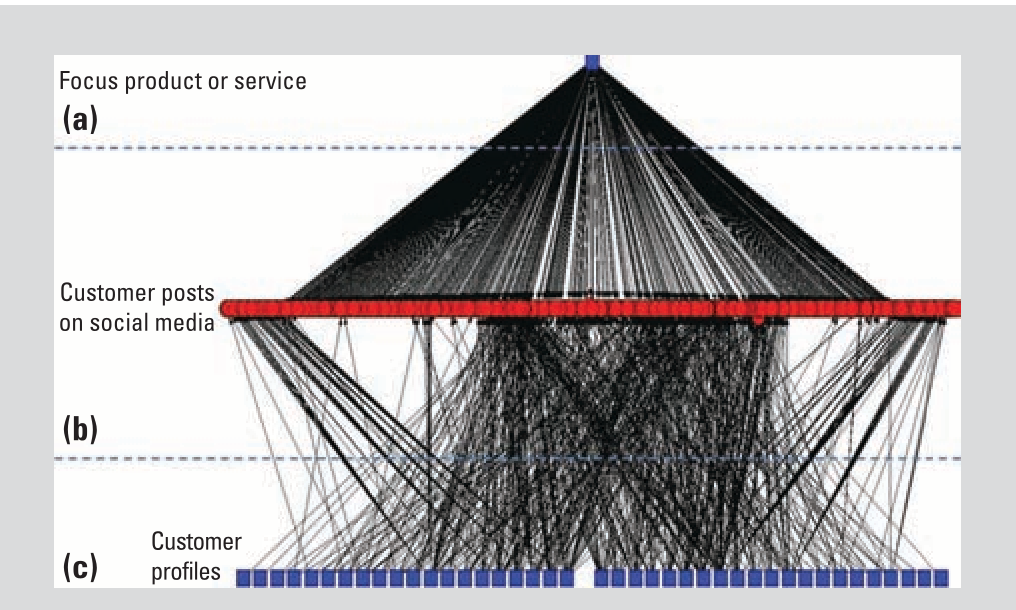 The Three-Mode Multiplex Social Network used to identify innovation-relevant profiles.
3. Idea Diffusion: Scaling with Opinion Leaders
An innovation is only successful if it is adopted. The final stage uses SNA to identify Opinion Leaders—the "Alpha Pups" or influential bloggers who possess high network centrality. Engaging these leaders allows SMEs to achieve massive sales growth (up to 85% as seen in HP’s case) with minimal advertising spend.
Evidence of Impact
The paper highlights several industry benchmarks that validate this semantic approach:
- 3M: Lead-user-integrated projects generated 8x higher sales projections than traditional projects.
- HP: Identified 31 tech bloggers who drove an 85% increase in sales for a stalled notebook series.
- Barclays & Expedia: Uses similar semantic analysis to process 80,000+ monthly comments, turning negative feedback into service innovations.
Critical Insight: Beyond Content Analysis
The brilliance of SLBIF lies in its Multiplex Social Network approach. Instead of just looking at what was said (Sentiment), it looks at who said it (Network Position) and how it spreads (Influence). This holistic view ensures that SMEs don't just listen to the loudest voices, but to the most valuable ones.
Conclusion & Future Outlook
The SLBIF is a foundational step in bringing Advanced Social Media Analytics to the SME sector. While the manual labeling of 500 posts remains a minor bottleneck, the shift toward deep learning significantly lowers the barrier to entry for high-tech innovation. Future iterations of this framework will likely integrate Large Language Models (LLMs) to further automate the "Idea Selection" stage, potentially removing the need for human labeling entirely.
Takeaway: If you are an SME, your next big product isn't in a lab—it's already being described by a customer on social media. You just need the right algorithm to find it.