
Twitter Speaks: Revolutionizing Digital Marketing through Real-Time Sentiment Mining
Digital Marketing with Social Media: What Twitter Says!
The paper presents a sentiment analysis system designed for digital marketing that extracts and classifies opinions from Twitter using a hybrid approach. It combines Natural Language Processing (NLP) with Naive Bayes classifiers and incorporates Geographical Information Systems (GIS) for spatio-temporal data visualization of consumer preferences.
TL;DR
This paper introduces a robust framework for digital marketing that transforms raw, chaotic Twitter data into structured consumer insights. By merging Natural Language Processing (NLP), Naive Bayes networks, and Geographical Information Systems (GIS), the authors provide a system that not only understands what people are saying about a product but also where their sentiments are most intense.
Background Positioning
In the landscape of data science, this work sits at the intersection of Opinion Mining and Social Geography. While many researchers focus solely on the "Text" aspect of NLP, this paper bridges the gap between linguistic sentiment and spatial distribution, providing a practical toolkit for CMOs and marketing researchers to replace outdated, expensive paper surveys with real-time digital intelligence.
Problem & Motivation: The Noise in the Crowd
Traditional market research is dying. It is too slow for the digital age and fails to capture the "raw" reaction of a consumer at the moment of interaction. Social media, specifically Twitter, offers a "virtual paper money" of information. However, the data is a mess—filled with:
- Cryptic expressions: Short-form text under 280 characters.
- Informational noise: Hyperlinks, hashtags, and symbols.
- Lack of Structure: Unstructured text that ignores traditional grammar.
The authors' intuition was that a domain-specific dictionary (focused on products like smartphones) combined with a robust probabilistic model like Naive Bayes could filter this noise more effectively than generalized sentiment tools.
Methodology: From Raw Tweets to Geographical Insights
The proposed approach is a structured pipeline consisting of three major phases:
1. Data Ingestion & Dictionary Creation
The system uses the Tweepy library to tap into the Twitter Streaming API. Crucially, the authors built a specialized dictionary of social media terms, labeling them with scores. This acts as the inductive bias for the machine learning model.
2. The Classification Engine (Naive Bayes + NLP)
The engine performs two critical tasks:
- Refinement: Tokenizing the 280-character limit and filtering out "noise" using Regular Expressions.
- Polarity Scoring: Instead of a simple Positive/Negative binary, the system uses a granular 7-point scale:
- Strong Positive (0.6 to 1) → Positive → Weak Positive → Neutral → Weak Negative → Negative → Strong Negative (-1 to -0.6).
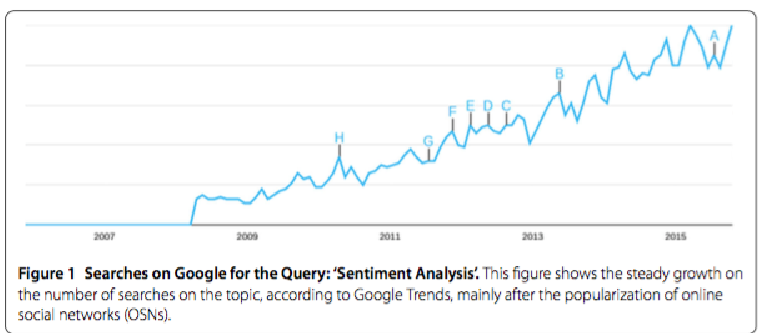 Scale of interest in Sentiment Analysis as shown by Google Trends (Figure 1).
3. Spatio-Temporal Visualization
By leveraging the geo-coordinates (latitude/longitude) of tweets, the system maps sentiments onto a GIS. This allows marketers to see, for example, if the iPhone X is being received differently in London versus New York, enabling hyper-local hyper-targeted ad campaigns.
Experiments & Results: The iPhone X Case Study
The authors tested their system on 400 real-time tweets targeting the iPhone X.
- Accuracy through Hybridization: By combining lexicon analysis with Naive Bayes, the system outperformed standalone unsupervised methods.
- Visual Evidence: The integration of Matplotlib allowed for the generation of density maps that reveal hidden patterns in consumer behavior across different regions.
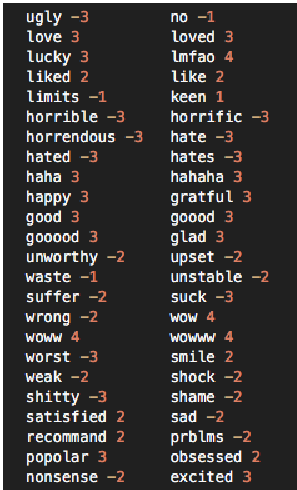 A sample from the dictionary showing polarity scores for specific terms (Figure 3).
Critical Analysis & Conclusion
Takeaways
This paper serves as a blueprint for Agile Marketing. It proves that even with relatively small datasets (400 tweets), specific domain-tuned dictionaries can provide highly relevant insights that generalized models might miss.
Limitations
- Sarcasm & Slang: The current model struggles with linguistic nuances like sarcasm, which is rampant on Twitter.
- Cultural Variance: Sentiment is often culture-dependent. A "strong positive" word in one region might be a "weak positive" in another.
Future Outlook
The authors suggest moving toward Vader (a more advanced lexicon) and incorporating Deep Learning (CNNs) to better handle the complexities of human language. For industry professionals, the future lies in the integration of this sentiment data into automated bidding systems for digital advertising.
Final Thought: If data is the new oil, sentiment analysis coupled with GIS is the refinery that turns raw social noise into high-octane marketing fuel.