
Graph-Based Topic Discovery: Navigating Semantic Hierarchies in Social Networks
Digital Social Network Mining for Topic Discovery
This paper introduces a hierarchical dictionary-based approach for topic discovery in digital social networks. By mapping keywords to a directed graph of topics and subtopics, the method calculates the probability of thematic relevance, achieving an 88% accuracy rate in classifying information exchange across platforms like Email and IM.
Executive Summary
TL;DR: This paper presents a methodology for extracting and classifying topics from digital social network communications by mapping keywords to a hierarchical graph. By utilizing a structured dictionary and a custom weighting formula based on link stability, the researchers achieved an 88% accuracy rate in identifying the core themes of information exchange.
Background: Positioned in the era of early-to-mid-2000s web mining, this work transitions social network analysis from purely structural metrics (who talks to whom) to semantic understanding (what are they talking about?), serving as a precursor to modern targeted advertising systems.
Problem & Motivation: Beyond Structural Links
Early social network analysis (SNA) was obsessed with the G(V, E) model—nodes and edges. While metrics like Betweenness and Closeness were great for finding influencers, they ignored the "meat" of the interaction: the content.
The authors identified that raw keyword extraction is insufficient because:
- Ambiguity: Keywords need context (e.g., "Apple" as a fruit vs. "Apple" as a company).
- Noise: General words dilute the meaningful topics.
- Scaling: Manual classification is impossible for the exploding scale of Digital Social Networks (DSNs).
Their insight was to create a bridge between raw text and conceptual hierarchies using a directed graph.
Methodology: The Hierarchical Weighted Graph
The core of the method is a predefined hierarchical dictionary. Imagine a root node "Commerce" branching into "E-commerce," then "Advertising," and finally into specific technical keywords.
1. The Mathematical Framework
The authors define a set of topics and words organized into levels (). To handle the messiness of real-world data, they introduce:
- Filtering Set: A "stop-word" list to prune generic terms.
- Dynamic Set: A mechanism to capture unknown words, allowing the system to learn or flag new terminology.
2. Weighting Strategy: Stability and Distance
Not all paths in a graph are equal. The authors calculate the relationship between a source keyword and a destination topic using two factors:
- Link Stability (): The more paths that exist between a word and a topic, the stronger the conceptual link.
- Distance (): The further a keyword is from a topic in the hierarchy, the weaker the probability of relation.
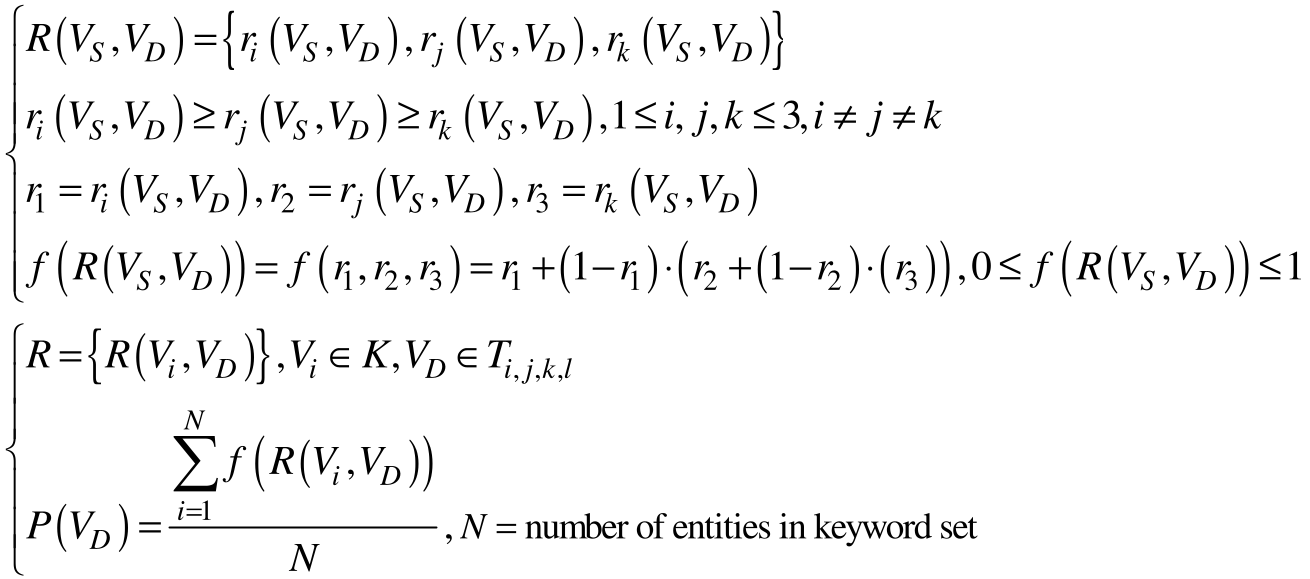 Figure: The formula used to aggregate multiple paths into a single probability score.
Experiments & Results: Real-World Testing
The researchers built a dictionary of 25 root topics and 5,200 words, then processed an email archive spanning 2002 to 2007.
Key Findings:
- High Precision: On 100 random contexts, the top-ranked topics were manually verified as correct in 88% of cases.
- The Spelling Hurdle: The system identified 400 "unknown" words. Analysis showed these weren't new concepts, but mostly spelling errors or personal names.
- Distribution Visualization: The experiment revealed clear clusters of interest within the network, effectively mapping the "digital zeitgeist" of the user group.
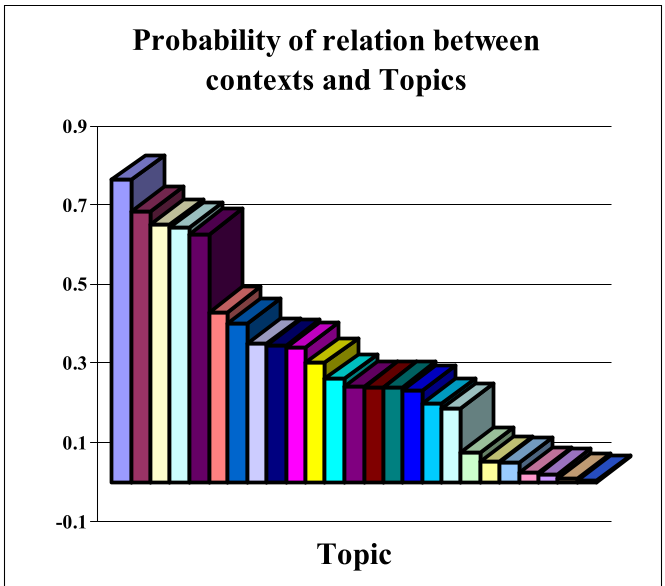 Fig. 1: Result of Mining shows the 25 topics and the probability of relation between context.
Critical Analysis & Conclusion
Takeaway
This work demonstrates that hierarchical dictionaries provide a surprisingly high confidence level when coupled with graph-based probability models. It proves that domain-specific structure (the dictionary) can act as a powerful inductive bias for topic discovery.
Limitations
- Manual Dictionary Maintenance: The model relies on a predefined dictionary. In a fast-evolving web, keeping this dictionary updated is a significant bottleneck.
- Robustness to Noise: While the filtering set helps, the model struggles with the "long tail" of misspelled words and slang.
- Language Dependency: The current implementation is heavily tied to the specific linguistic structure of the dictionary words.
Future Outlook
The authors anticipate integrating this into semantic advertisement systems. Looking back from today’s perspective, this methodology provided the logical scaffolding that modern Knowledge Graphs and RAG (Retrieval-Augmented Generation) systems use to ground language models in structured reality.