
Deciphering the Digital Society: How Data Mining Reveals the DNA of a Scholarly Journal
Researching Digital Society: Using Data-Mining to Identify Relevant Themes from an Open Access Journal
This paper presents a computational case study of the "eJournal of e-Democracy and Open Government" (JeDEM) from 2009–2020. Using K-means clustering and Latent Dirichlet Allocation (LDA), the authors identify three major thematic clusters—Citizen Engagement, Disruptive Technology, and Smart Governance—to map the evolution of digital society research.
TL;DR
How do academic fields evolve? This research applies data mining and LDA topic modeling to 11 years of publications from the eJournal of e-Democracy and Open Government (JeDEM). By bridging the gap between computational analysis and editorial intuition, the authors identify how specific events—like policy shifts or journal indexing—steer the direction of global research.
Contextual Positioning
In the landscape of "Meta-Research," this paper serves as a methodological bridge. It is not just a bibliometric study; it is a strategic toolkit for journal editors. It moves past simply asking "what was published" to "why did the research agenda shift at this specific timestamp?"
The Core Challenge: The Blind Spots of Editorial Strategy
Editors often operate on "gut feeling" when crafting Calls for Papers (CfPs). However, the academic landscape is influenced by a complex web of:
- Societal Issues: Changes in political directives (e.g., the 2009 US Open Government Directive).
- Institutional Pressures: The "Publish or Perish" culture and the weight of indexing systems like Scopus.
- Technological Hype: The transition from basic e-participation to "Smart Governance."
Without empirical data, editors might miss emerging sub-topics or fail to recognize regional biases in their author base.
Methodology: From Raw Text to Thematic Clusters
The authors utilized a robust text-mining pipeline to process a decade of scholarly output:
- Pre-processing: Normalization, stemming, and stop-word removal from titles and abstracts.
- Clustering: Using the K-means algorithm and Cosine similarity, they grouped semantically related papers.
- Topic Modeling: Implementing Latent Dirichlet Allocation (LDA), they performed a "deep dive" into each cluster to find hidden sub-topics.
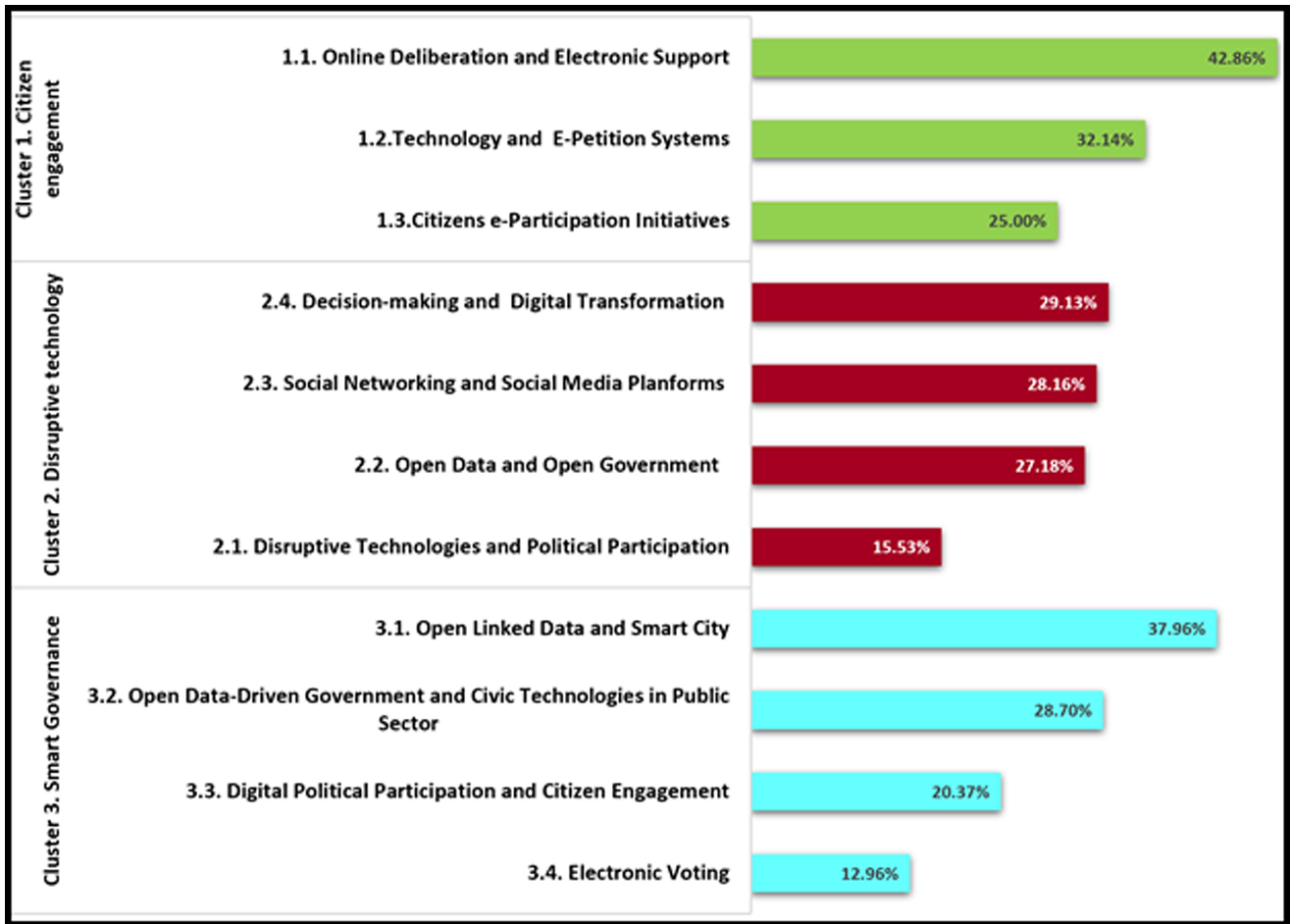 Figure 1: Visualization of Sub-topics extracted via LDA, showing the transformation of "Open Data" into "Linked Open Data."
Key Insights: Mapping the "Scientific Turns"
The study revealed three distinct eras of the journal, which the authors call "Thematic Clusters":
- Cluster 1: Citizen Engagement (2009-2010): Focused on e-petitions and participatory platforms.
- Cluster 2: Disruptive Technology (2011-2015): A massive shift toward social media, open data, and digital transformation.
- Cluster 3: Smart Governance (2016-Present): The evolution toward smart cities, co-creation, and data-driven government.
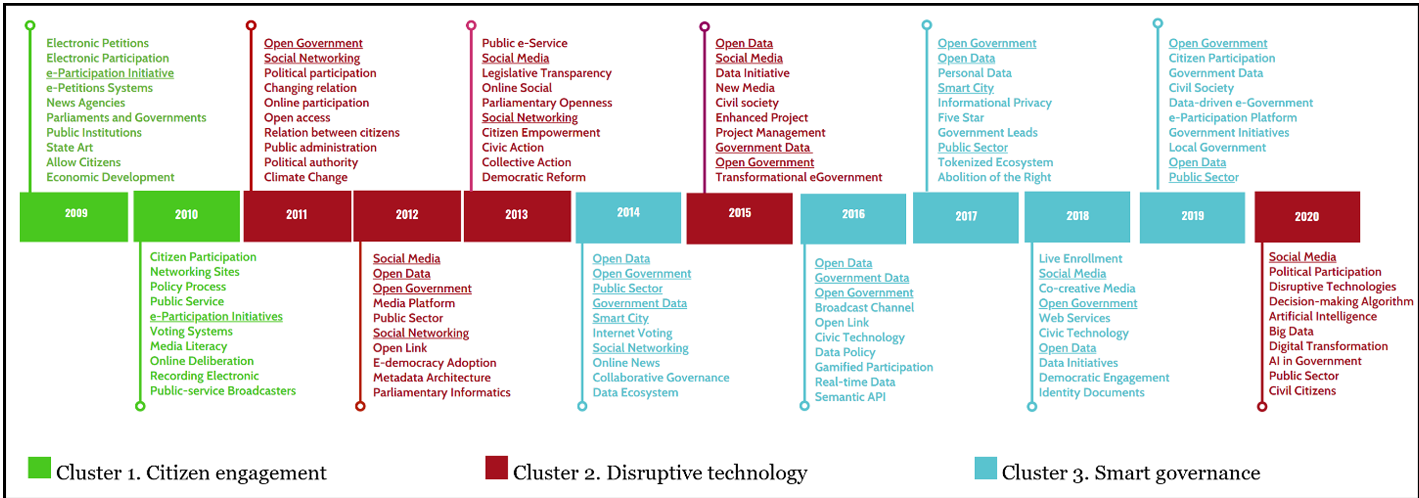 Figure 2: The evolution of keywords over time, highlighting the 2011 pivot to Open Government and the 2014 emergence of "Smart" contexts.
The "Scopus Effect" and Regional Shifts
The data confirmed that human management has a heavy hand in data patterns. For instance:
- Regional Influx: Strategic CfPs focusing on Asian experiences in 2013/2015 led to a measurable increase in diverse geographical representation.
- Quantitative Surges: A dramatic rise in publications in 2019 was directly attributed to the journal being indexed in Scopus, which attracts authors seeking high-impact metrics.
Critical Analysis: Reflections for the Future
The real value of this paper lies in its reflexivity. The authors (who are also editors) were surprised by certain results—such as the persistent dominance of "e-petitions" which they hadn't perceived as being quite so prominent.
Limitations: As a single-journal case study, the results are specific to the "Digital Society" niche. Furthermore, qualitative interpretation of clusters still relies on human labeling, which introduces subjective bias.
Future Outlook: The authors propose extending this to "Open Science" metrics—analyzing whether researchers are actually making their underlying data available, not just their articles.
Conclusion
This study proves that journals are not static repositories; they are dynamic entities shaped by policy, technology, and strategic management. For editors and researchers alike, data mining provides the "navigation system" needed to traverse the ever-changing terrain of global academia.