
Beyond the Glass Wall: How Culture and Architecture Limit EdTech Efficacy
The Impact of Digital Technology on Female Students’ Learning Experience in Partition-Rooms: Conditioned by Social Context
This study investigates the impact of gender-segregated "partition-rooms" on the learning experience of female students in Saudi Arabia. Using a mixed-methods approach, the authors explore how physical barriers and socio-cultural norms affect academic performance, technology efficacy, and student satisfaction, specifically identifying a phenomenon termed "social impairment" where cultural privacy concerns limit the use of educational technology.
TL;DR
In a unique study of gender-segregated "partition-rooms" in Saudi Arabia, researchers have uncovered a provocative phenomenon: Social Impairment. While digital technology is intended to bridge the gap between male instructors and female students, socio-cultural norms regarding facial privacy actually lead students to avoid using their devices. The very light from a laptop screen acts as a "cultural exposure" risk, revealing the student's face in a darkened room, thereby undermining the efficacy of the education.
Contextual Positioning
This work moves beyond standard SOTA (State-of-the-Art) assessments of "blended learning." Rather than focusing on bandwidth or software features, it conducts a socio-technical autopsy of the learning environment. It positions itself as a critical evaluation of how Inductive Bias in architectural design (the partition-room) fails to account for the Socio-Cultural Context of the learners.
The Problem: The Technology-Privacy Paradox
In Saudi Arabian higher education, male instructors often teach female students via partition-rooms. The design is simple: a one-way mirror where students see the instructor, but the instructor sees only a dark reflection.
The authors identify two core pain points:
- Physical Disagreement: Dimmed lights make note-taking difficult, and glass partitions muffle audio communication.
- Social Displacement: The lack of eye contact and restricted accessibility (office hours via phone only) reduces the "sense of belonging" to the class.
Methodology: Listening to the Silence
The researchers combined statistical rigor (Pearson Chi-square tests) with Focus Group insights to solve a mask-wearing mystery.
The "Dark Room" Architecture
The partition-room is split into a lit "male side" and a dark "female side."
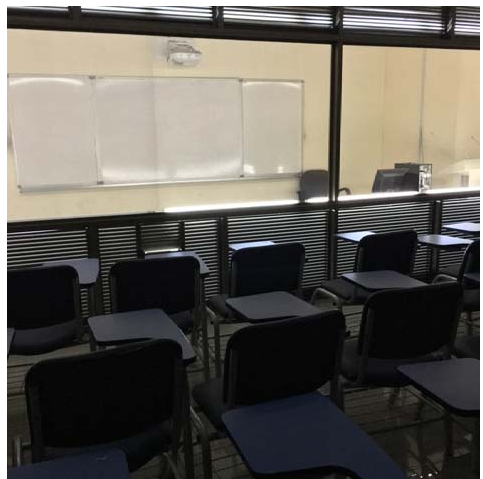 Fig 2. Schematic of the partition-room architecture illustrating the physical divide.
While the instructor uses a smartboard and microphone, the students are left in shadow.
The Core Insight: Social Impairment
The most striking finding was not that the technology failed, but that students refused to use it.
- The Glow Factor: In a darkened room, a laptop screen acts as a spotlight. Students reported that using a laptop would illuminate their faces, making them visible to the male instructor through the one-way mirror.
- Strategic Downsizing: To preserve their privacy, students opted for smartphones over laptops—not because they were more effective for learning, but because the smaller screens emitted less light.
Results & SOTA Comparison
The study found that while GPA remained relatively high (mean 4.2), the Perceived Learning and Student Satisfaction were significantly lower in partition-rooms compared to regular classrooms.
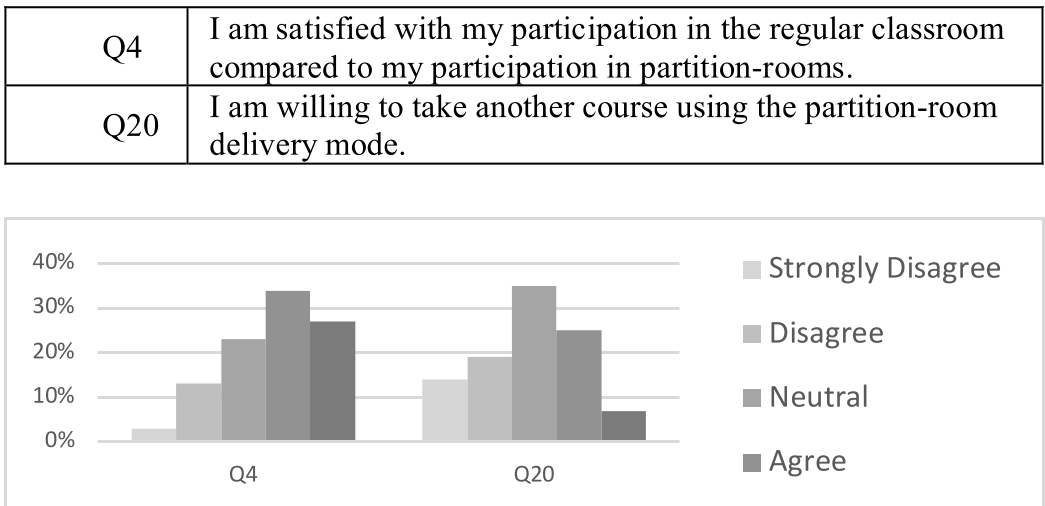 Fig 6. Quantitative data showing a clear preference for regular classrooms over partition-rooms.
| Variable | Correlation with Partition-room (Social) | Significance (p) |
|---|---|---|
| Student Satisfaction | 72.654 | 0.000 |
| Perceived Learning | 38.480 | 0.000 |
| Technology Efficacy | 30.832 | 0.002 |
Critical Analysis & Future Outlook
Takeaway: This paper serves as a vital reminder for EdTech developers. We often assume that "more tech" equals "better access." However, in this context, the technology became a source of anxiety.
Limitations: The study is localized to one university in Saudi Arabia and focuses on Computer Science majors who are already tech-savvy. The "high GPA" results might be skewed by the fact that these were sophomore students taking introductory courses.
Future Work: The authors suggest that future classroom tech must be "culturally aware." This could mean developing low-emission displays or specialized audio-visual bridges that maintain privacy while restoring the instructor-student connection. For the industry, the lesson is clear: Understand the room before you install the tech.