
The "Half Free-Rider" Secret: Why Social Networks Don't Collapse Under Lurkers
Effect of Direct Reciprocity on Continuing Prosperity of Social Networking Services
This paper introduces the Reciprocity Rewards Game (RRG) and Reciprocity Meta-Rewards Game (RMRG), expanding traditional Public Goods (PG) models to analyze Social Networking Services (SNS). By incorporating direct reciprocity into an evolutionary game theoretic framework, the study demonstrates how selective interaction maintains thriving digital communities, outperforming baseline models on Watts-Strogatz and Facebook networks.
TL;DR
Why do people keep posting on Facebook or Twitter when most users just "lurk" (free-ride)? This paper argues that direct reciprocity—the "you comment on mine, I comment on yours" loop—is the engine of SNS prosperity. By introducing the Reciprocity Rewards Game (RRG), the authors show that users survive as "Half Free-Riders": they ignore the crowd but stay hyper-active within a small circle of 3-4 close reciprocal friends.
The Motivation: The Paradox of Digital Effort
Social Networking Services (SNS) are essentially Public Goods. Creating content takes time and effort (cost), while reading it is free (reward). In classic game theory, the rational choice is to be a "free-rider"—to consume everything and contribute nothing.
Previous models (like the Rewards Game) tried to solve this by suggesting that "comments" act as a reward. However, they lacked a crucial human element: Reciprocity. Without it, models showed that people eventually stop commenting because it's too expensive, causing the whole network to go silent.
Methodology: Separating Friends from Strangers
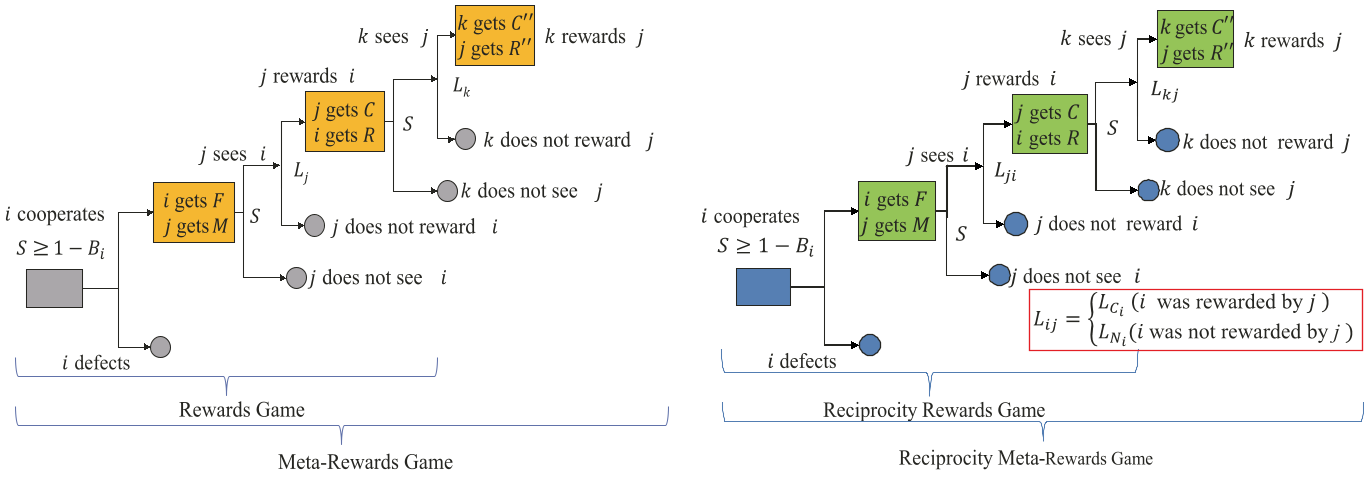
The authors' core "aha!" moment was splitting a user's strategy into two distinct behaviors based on memory ():
- Reciprocal Comment Rate (): How often you comment on people who recently interacted with you.
- Normal Comment Rate (): How often you comment on strangers.
They simulated this using a Genetic Algorithm (GA), where agents "evolve" their strategies over generations based on their "fitness" (Total Rewards - Total Costs).
The "Half Free-Rider" Insight
The most fascinating finding is the emergence of the Half Free-Rider.
- The "Free-Rider" side: You read articles from the general public ( remains low) to save cost.
- The "Cooperator" side: You aggressively reward a small group of reciprocal peers ( remains high) to ensure they keep rewarding you.
This balance prevents the "tragedy of the commons." By limiting cooperation to a few "close friends," the cumulative cost remains manageable while the rewards (incentive to post) stay high.
Experiments: Real Networks vs. Ideal Math
The researchers tested RRG across different architectures. The results were telling:
- Complete Graphs (Everyone knows everyone): Cooperation is unstable. Because there are too many potential interactions, the "signal" of reciprocity gets lost in the noise, and the system often collapses.
- WS Networks (Small-World): In networks with high clustering coefficients (like real human societies), cooperation thrives.
- Facebook Network: Using real data from 4,039 nodes, the model showed that the hierarchical community structure of real SNS is perfect for maintaining these reciprocal clusters.
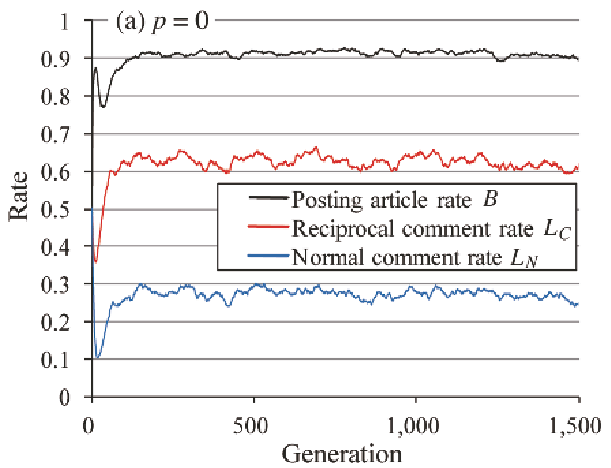 Above: As the re-wiring probability increases (making the network more "random"), the posting article rate becomes more volatile and eventually drops.
Critical Analysis & Conclusion
The Takeaway
For SNS designers, the message is clear: Engagement isn't about the masses; it's about the niches. Features that highlight interactions between "close friends" (like "Friend" lists or algorithmic prioritization of frequent interactors) are not just "nice to have"—they are mathematically necessary to prevent the community from dying out.
Limitations
The model treats all "rewards" and "costs" as linear. In reality, a "Like" button has a near-zero cost, whereas a thoughtful comment has a high cost but provides a much higher psychological reward. Future research should distinguish between these levels of signaling.
Final Thought
The internet didn't turn us into total egoists; it turned us into efficient reciprocators. We are willing to work for the community, but only for the parts of the community that work for us.