
SRDR: Bridging Social Proximity and Contextual Needs for Accurate Recommendations
A Directed Recommendation Algorithm for User Requests Based on Social Networks
The paper introduces the Social Requests Directed Recommendation (SRDR) algorithm, a multi-dimensional recommendation framework designed for social networks. It integrates user profiles, social relationships, and dynamic context (posts) to provide targeted feedback for user requests, achieving an 11% improvement in satisfaction over traditional keyword searches.
TL;DR
The Social Requests Directed Recommendation (SRDR) algorithm shifts the recommendation paradigm from "what is being searched" to "who is searching and who can help." By combining static profile data, social graph distance, and dynamic post context, SRDR provides a personalized recommendation engine that significantly outperforms standard keyword searches in user satisfaction.
Contextual Motivation: Beyond the Search Bar
In traditional social platforms, finding help or resources often relies on proactive keyword searches. However, these methods suffer from a lack of Social Intuition. A search for "borrowing a camera" yields the same results for a stranger as it does for a best friend, ignoring the inherent trust and convenience of social circles. The authors argue that a recommendation is only as good as its social relevance.
Methodology: The Three Pillars of SRDR
The SRDR algorithm decomposes a user's request into three distinct mathematical dimensions:
1. SRDR-FR (Friends Relationship)
This module quantifies the "intimacy" between users. It constructs a friendship matrix and a group relationship matrix.
- The Logic: It uses a modified Dijkstra algorithm on the reciprocal of social weights to find the "shortest distance" (highest intimacy) between two nodes in the social graph.
- The Formula: where is the shortest path weight.
2. SRDR-UP (User Profile Matching)
This handles static data. By calculating the intersection of interest vectors between the requester and potential providers, the system identifies baseline compatibility.
3. SRDR-C (Context Matching)
Dynamic data, such as "call-for-help" posts, are analyzed for concept similarity. This ensures that even if two people are close friends, they are only matched if their current context (need vs. offering) aligns.
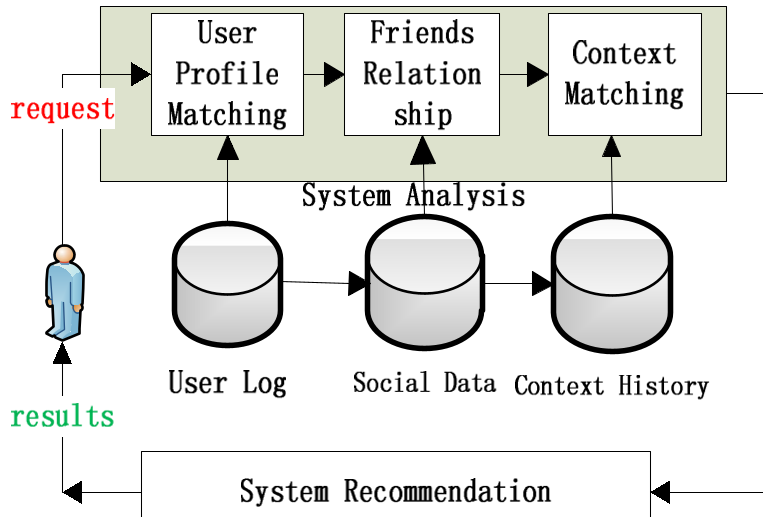 Figure 1: The logical flow of data from the "YOU" platform databases into the SRDR core.
Experimental Validation: The "YOU" Platform
The authors built "YOU," a mutual assistance platform, to collect real-world data at Beijing University of Posts and Telecommunications.
Key Comparison:
- SRDR: Holistic matching.
- Google Site Search: Pure keyword matching.
- Random: Baseline control.
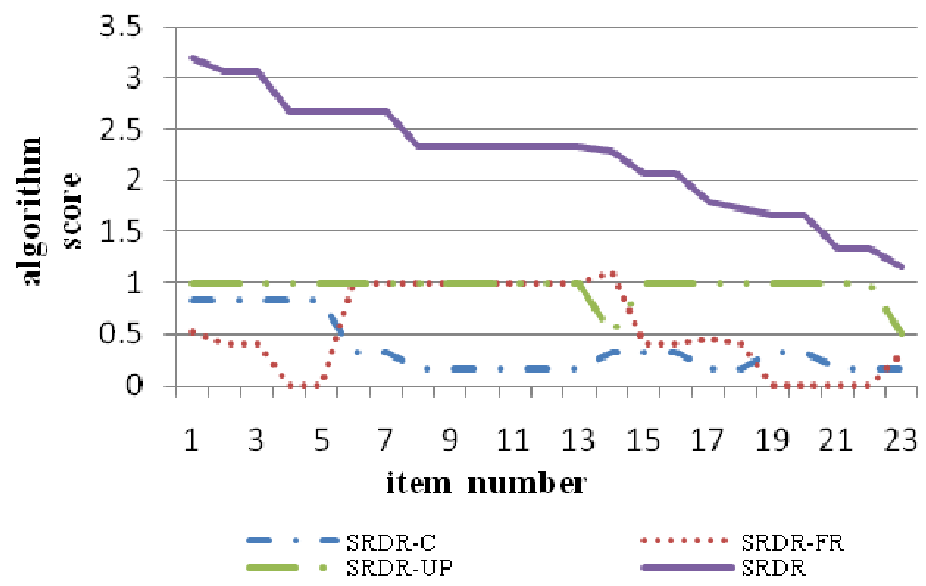 Figure 2: Analysis of a single request. Notice how the SRDR curve (top) represents a synthesis of the underlying Profile, Context, and Relationship scores.
Results and Insights
The study employed Fuzzy Set Theory to quantify subjective user feedback. By converting qualitative ratings (Very Good to Very Bad) into Triangular Fuzzy Numbers, the researchers proved that SRDR's core satisfaction value (5.528) is substantially higher than keyword-based alternatives.
| Metric | SRDR | Google Search |
|---|---|---|
| "Very Good" Ratio | 31.2% | 20.8% |
| Satisfaction (Good+) | 38.4% | 32.8% |
| "Very Bad" Ratio | 20.0% | 34.4% |
The higher "Very Good" ratio suggests that SRDR successfully identifies the specific individuals within a social circle who are most likely to satisfy a request, a feat keyword search cannot replicate because it lacks access to the private "social graph."
Critical Analysis & Conclusion
While SRDR shows a clear advantage in small-to-medium social environments (like a campus), its current form faces challenges:
- Scalability: The complexity of Dijkstra-based matrix operations may struggle with millions of nodes.
- Cold Start: For new users with no friends or groups, the algorithm relies heavily on the moving parts of
SRDR-C.
Takeaway: SRDR proves that the "Social Link" is a powerful weight in recommendation. Future AI-driven recommenders should continue to treat social proximity as a primary feature, not just a metadata tag, to improve the reliability and "humanness" of automated suggestions.