
The Face of Crisis: Decoding Emotions in Disaster-Related Public Speeches
Disaster-Related Public Speeches: The Role of Emotions
This paper explores the role of nonverbal emotional communication in disaster management by analyzing the facial expressions of political authorities during crises. Using the Emotient facial action coding engine, the study quantifies metrics like Attention, Engagement, and Sentiment in public speeches to evaluate the effectiveness of crisis communication.
TL;DR
In the middle of a disaster, what a leader looks like may be as important as what they say. This study analyzes the facial expressions of political figures (like Chris Christie and Michael Bloomberg) during major catastrophes using AI. It reveals that "emotional engagement" varies wildly among leaders and that negative nonverbal cues—like anger or contempt—can inadvertently distance the public during critical safety broadcasts.
Background: Beyond the Written Word
When a hurricane or flood strikes, information is the most valuable currency. While disaster management technology has traditionally focused on text analytics (social media monitoring) and acoustic quality, human beings are evolutionary "fusion" engines: we naturally combine verbal data with nonverbal signals like tone and facial micro-expressions.
The motivation for this research, conducted under Project Slándáil, is to move away from "posed" laboratory emotions. Most AI models are trained on actors "acting" sad or angry. In reality, a mayor facing a city-wide flood exhibits nuanced, spontaneous, and often suppressed emotions. Understanding these "naturalistic" behaviors is key to improving how authorities communicate life-saving instructions.
Methodology: The Science of the "Micro-Expression"
The researchers leveraged FACS (Facial Action Coding System), a framework where every facial muscle movement is categorized as an Action Unit (AU). For example, a "Brow Lowerer" (AU4) combined with an "Upper Lid Raiser" (AU5) typically signals anger or fear.
The study utilized the Emotient engine (now a part of Apple’s ecosystem) to process footage of four authorities:
- Ray Nagin (Hurricane Katrina)
- Chris Christie (Hurricane Sandy)
- Michael Bloomberg (2012 Snow Storm)
- Bill de Blasio (2014 Snow Storm)
The system converted these muscle movements into three Key Performance Indicators (KPIs):
- Attention: Focus based on head pose and gaze.
- Engagement: The total volume of emotion displayed.
- Sentiment: The overall valence (from -100 for negative to +100 for positive).
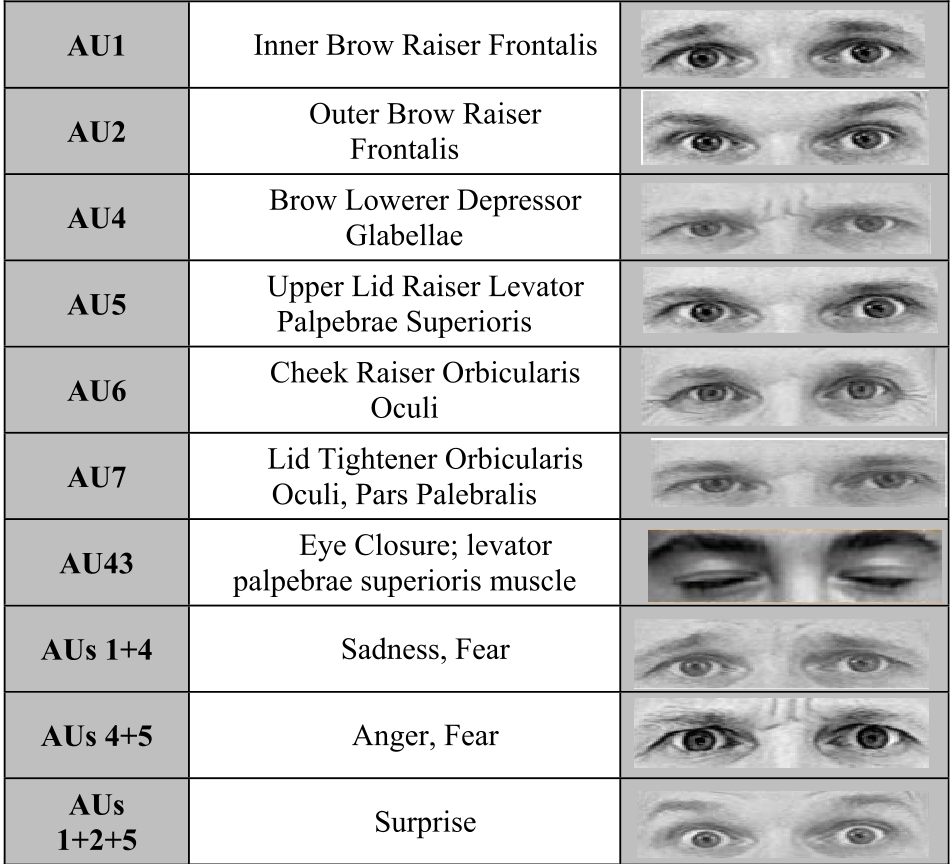 Table 1: Mapping Action Units (AUs) to specific emotional states like Sadness, Fear, and Anger.
Experimental Insights: "Wooden" vs. "Engaged"
The results provided a fascinating behavioral profile of crisis leadership.
- The Power of Gaze: Governor Chris Christie and Mayor Bloomberg showed the highest Attention (61% and 54% respectively), largely because they maintained direct eye contact with the camera/audience.
- The "Wooden" Leader: Mayor Ray Nagin exhibited the lowest Engagement (6%). This "wooden" appearance can be interpreted by the public as either stoic or emotionally detached.
- The Sentiment Paradox: While Christie and Bloomberg were highly engaged, their sentiment scores were lower (more negative). The system detected high levels of anger and contempt. While these leaders were clearly "in the zone," such aggressive nonverbal cues might actually prevent the public from fully trusting or empathizing with the message.
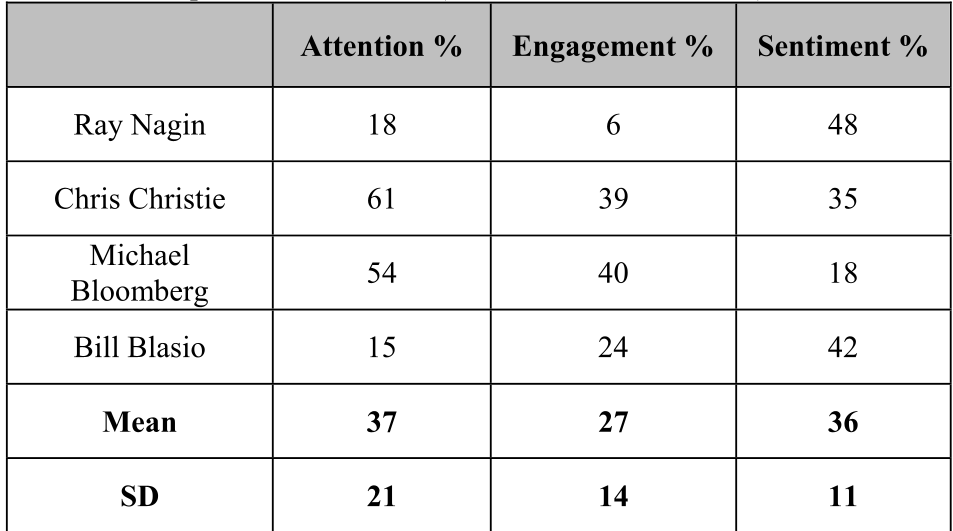 Table 2: Comparison of Attention, Engagement, and Sentiment across the four subjects.
Critical Analysis & Future Outlook
This study marks a significant shift from purely textual disaster response to Visual Analytics.
Takeaway: Effective disaster communication is a performance. Authorities are surrounded by specialists who vet their words, but little training is provided for their facial expressions. If a leader appears too "neutral" (like de Blasio or Nagin), they may seem indifferent. If they appear too "angry" (like Christie), they may cause defensive reactions in the audience.
Limitations: The study is exploratory and based on a small sample size (4 individuals). Furthermore, "Sentiment" as calculated by AI may not account for cultural or individual baseline differences (e.g., a naturally "stern" face being misread as contempt).
Future Work: The next step for Project Slándáil is to develop "Empathy Training" for emergency operatives, using these AI tools to provide real-time feedback on how to project trust and authority simultaneously. This fusion of AI and psychology could fundamentally change how we receive warnings in the next global crisis.