
Beyond Links: Fusing Content and Interaction Context for Deeper Community Discovery
Using content and interactions for discovering communities in social networks
The paper introduces a suite of generative Bayesian models (TUCM, TURCM-1, TURCM-2, and Full TURCM) for discovering topically meaningful communities in social networks. By integrating semantic content, social graph topology, and the "nature" of user interactions (e.g., retweets vs. broadcasts), the authors achieve superior community detection and state-of-the-art results on Twitter and Enron datasets.
TL;DR
Researchers from IBM Research India have developed a new framework to identify communities in social networks by looking at what people say, who they talk to, and how they interact. By moving beyond simple graph edges and incorporating interaction types (like retweets or replies), their model—specifically the Topic User Community Model (TUCM)—outperforms traditional benchmarks in both accuracy and speed.
The "Graph vs. Content" Dilemma
In the early days of social network analysis, "community" was defined by structure: "Who follows whom?" Later, topic modeling (LDA) allowed us to group people by interest: "Who talks about the same stuff?"
However, both have flaws:
- Structure Only: Fails to capture why people are connected (e.g., a shared interest in stocks vs. just being high-school friends).
- Content Only: Groups disparate people who share interests but don't actually interact.
- The Interaction Gap: Not all links are equal. A "reply" in an email is a stronger signal of community than a passive "broadcast" tweet.
Methodology: The Generative Intuition
The authors propose that a person's community membership is a latent variable that dictates three things simultaneously:
- Topical Interest: The subjects they discuss.
- Social Connection: The people they link to.
- Interaction Strength: The mode of communication (Broadcast, Reply, Forward).
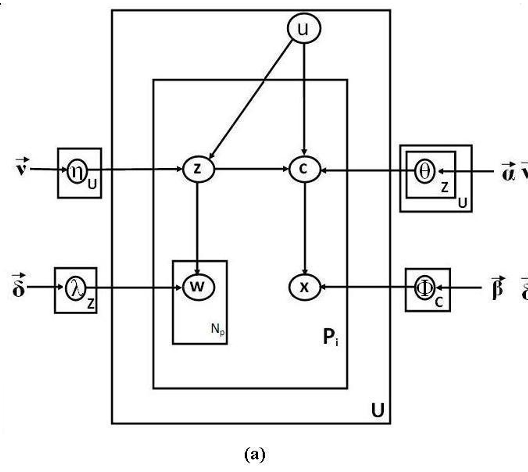
They introduced several variants, but the most efficient is the TUCM, shown below:
Why it scales: The Mixture of Unigrams
Instead of assigning a topic to every single word (which is computationally expensive), TUCM assumes a single post usually covers a single topic. This "unigram" approach significantly reduces the search space for the Gibbs Sampler, allowing the model to process thousands of nodes much faster than previous models like CART or CUT.
Experiments & Real-World Results
The authors tested their models on two vastly different datasets:
- Twitter: High noise, short posts, heavy "broadcast" behavior.
- Enron Email Corpus: Richer content, directed messages, formal links.
Performance: Modularity and Perplexity
The "Full TURCM" model (which relaxes the single-topic-per-post constraint) usually provided the best quality, but even the standard TUCM beat the baselines.
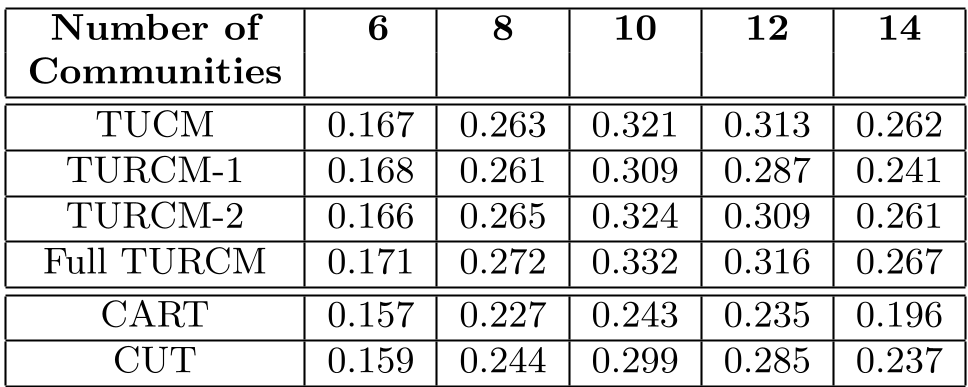
The models proved adept at identifying specific community roles. For instance, in the Enron dataset, the model correctly identified "Management," "Engineering," and "Analyst" communities based solely on common terms and email interaction patterns.
Scalability
One of the standout results is the runtime efficiency. As the number of nodes grows, the speed-up of TUCM over the CART model increases dramatically (reaching 1.99x speed-up at 5,000 nodes).
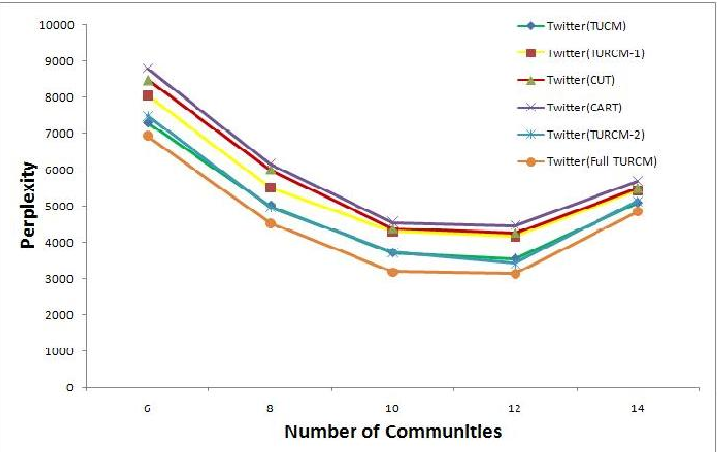
Critical Insight & Future Outlook
The core contribution of this work is the formalization of Interaction Type as a first-class citizen in community discovery. It acknowledges that a retweet is fundamentally different from a direct reply.
Limitations: The model still relies on pre-defined hyperparameters (number of topics and communities ). While the authors use modularity to find the "optimum" (around , for their datasets), a truly non-parametric approach that discovers these numbers automatically would be the next logical step.
Future Work: Integrating this Bayesian approach with modern Graph Neural Networks (GNNs) could allow for inductive community discovery, where the model can predict the community of a new user without re-running the entire Gibbs Sampler.