
From Data to Decisions: Discovered Dispatching Rules for Job Shop Scheduling
Discovering Dispathcing Rules for Job Shop Schdeuling Using Data Mining
This paper presents a data mining-based approach to Job Shop Scheduling (JSS) by employing the C4.5 Decision Tree algorithm to discover optimal dispatching rules. By transforming scheduling data into pairwise job comparisons, the method successfully induces human-readable "If-Then" rules that minimize makespan across various benchmark problem instances.
TL;DR
Researchers have developed a way to turn the chaotic complexity of Job Shop Scheduling (JSS) into a set of simple, transparent "If-Then" rules. By applying Decision Tree (C4.5) algorithms to production data, the system learns to predict the best sequence of jobs. It achieves results comparable to Genetic Algorithms but with the added benefit of being instantly interpretable by human operators.
The "Black Box" Motivation
In a typical manufacturing plant, scheduling is a nightmare. With just 6 jobs and 2 machines, you are already looking at over 500,000 possible sequences. While Genetic Algorithms (GA) and Tabu Search can find near-perfect schedules, they operate as "black boxes." If a shop-floor manager asks why Job A is scheduled before Job B, these algorithms can't give a straight answer.
The authors argue that we need explainable heuristics. Their insight was to treat scheduling not as a search problem, but as a classification problem: given two jobs waiting at a machine, which one should go first?
Methodology: Engineering the Logic
The core of the approach is the transformation of raw production constraints into a structured dataset for machine learning.
1. Data Transformation
For every machine, the researchers created a "Flat File." Instead of looking at the whole schedule, they performed pairwise comparisons. If Machine 1 has 6 jobs, they create 15 unique pairs.
- Predictors: Processing time (Pr), Number of subsequent machines (Nm), and Release time (R).
- Target: A binary "Yes/No" indicating if Job 1 should precede Job 2.
2. The Decision Tree Induction
Using the Iterative Dichotomiser 3 (ID3) lineage (specifically C4.5), the model calculates Information Gain to find the most decisive attribute.
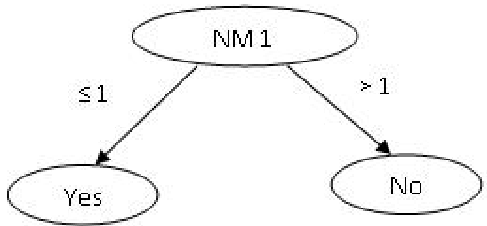 In the figure above, the tree for Machine M1 reveals a strikingly simple rule: if a job has fewer than or equal to one machine left to visit, prioritize it.
3. Data Engineering
The authors found that raw data wasn't enough. By adding "Difference Attributes" (e.g., ), they significantly increased the accuracy and reduced the complexity (size) of the resulting trees.
Experimental Battleground: The 6x6 Benchmark
The method was tested against the famous Muth & Thompson 6x6 benchmark.
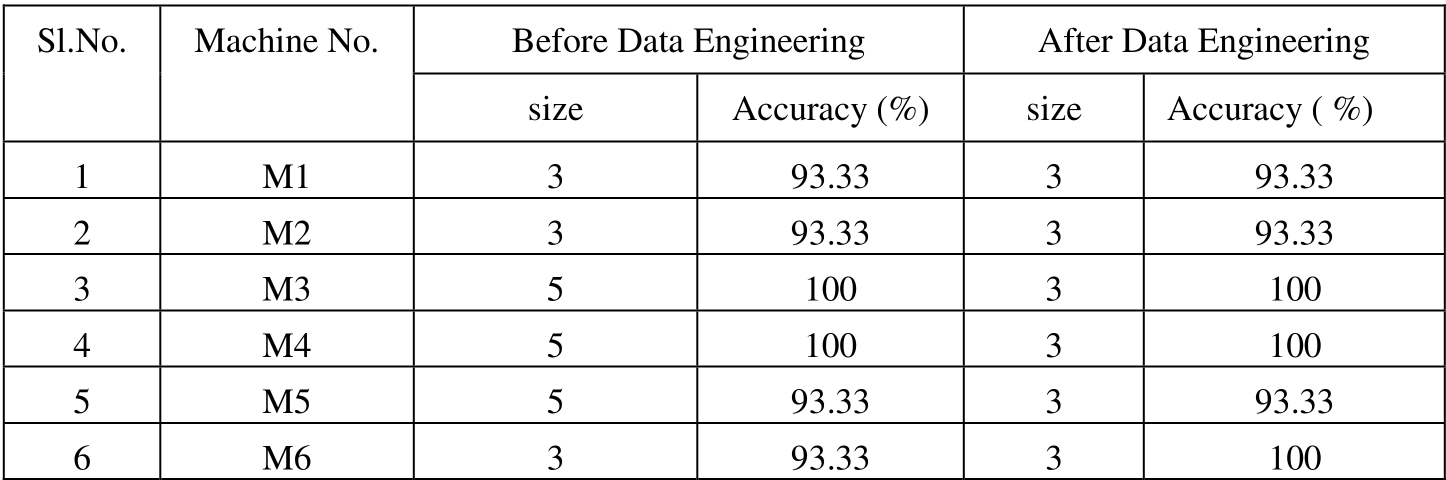
Key Findings:
- High Precision: After Data Engineering, the trees reached 100% accuracy in predicting the dispatching sequence for several machines (M3, M4, M6).
- Makespan Efficiency: The algorithm produced a total makespan of 60 units. While the optimal theoretical limit is 55, the Data Mining approach reached this in a single pass, whereas Genetic Algorithms require hundreds of iterations to reach the same goal.
Critical Insight & Future Outlook
While the makespan is slightly higher (9.09% in the worst case) than iterative meta-heuristics, the computational efficiency and interpretability are the real winners.
Limitations: The current model uses a static dataset. In a real-world "Dynamic Job Shop," rules might need to be re-mined as machine health or priority orders change.
The Takeaway: This work proves that we don't always need "heavier" AI. Sometimes, mining the underlying logic of a problem into a simple Decision Tree is more valuable for industry than a complex, uninterpretable optimization model.