
Unmasking Team Success: Decoding Social Interaction in Virtual Communities
Discovering Group Interaction Patterns in a Teachers Professional Community
2008-07-01
Summary
Problem
Method
Results
Takeaways
Abstract
The paper explores "Discovering Group Interaction Patterns in a Teachers Professional Community" by integrating Social Network Analysis (SNA), graph theory, and data mining. Using the SCTNet cyber community as a case study, the authors identify structural patterns and roles that correlate with virtual team performance.
## TL;DR
This study moves beyond looking at *what* teams produce to analyzing *how* they interact. By applying Social Network Analysis (SNA) and Decision Trees to a Taiwanese teacher community (SCTNet), researchers found that high-performing teams maintain consistent interaction density and rely on public "knowledge memory" tools rather than private emails.
## The Problem: The "Black Box" of Virtual Collaboration
In virtual professional communities, managers often observe a wide spectrum of results: Some groups are "energetic," while others remain "still." The friction lies in the lack of real-time indicators for group health. Conventional wisdom suggests that more communication equals better results, but this paper argues that the **quality, structure, and channel** of that communication are what truly matter.
## Methodology: Measuring the "Pulse" of a Group
The authors didn't just count messages; they looked at the **topology** of the network using several key metrics:
* **Centrality (Degree, Betweenness, Closeness)**: Identifying who acts as a bridge or a hub.
* **Prestige**: Measuring who is "sought after" for information.
* **Subgroups (SCC)**: Finding tightly knit clusters within the team.
### Structural Visualization
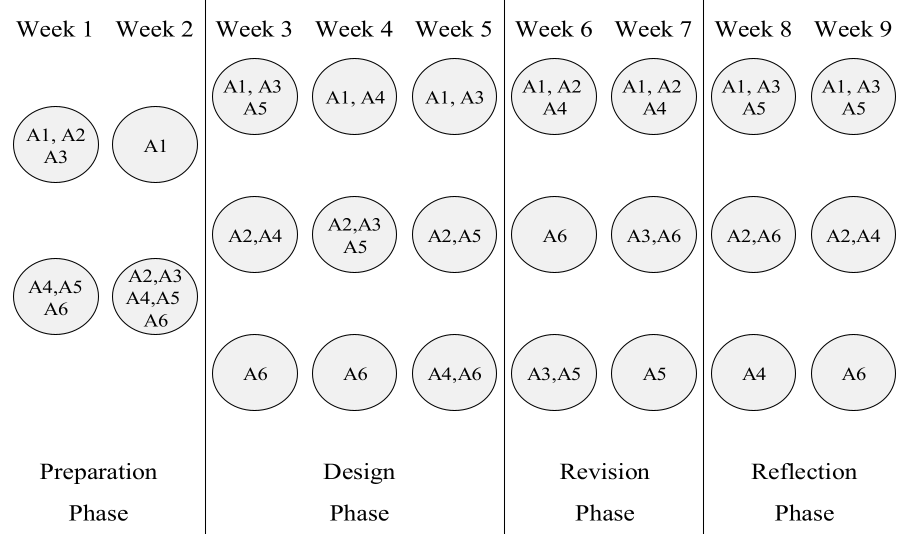
The researchers tracked six teams (A1-A6) over nine weeks. They utilized K-means clustering to see how teams grouped together based on their interaction patterns.
## Key Insights: Why Some Teams Win
### 1. Density Matters (Especially in the Home Stretch)
The study found a strong correlation between **Network Density** and performance. High-performing teams (Set G) kept their density high or medium throughout the lifecycle. Conversely, low-performing teams often started strong but "fizzled out" in the later, critical design phases.
### 2. The Fallacy of Private Messages
One of the most surprising findings was the role of communication channels. High-performing teams gravitated toward **Discussion Boards** and **File Sharing**. Meanwhile, struggling teams over-indexed on **Email and Online Messaging (IM)**.
* **Reason**: IM and Email are "transient." They lack group memory. Discussion boards allow for "asynchronous permanence," building a shared knowledge base that members can reference repeatedly.
### 3. Leader vs. Participant Roles
Leaders in successful teams acted as "transmitters" (high outdegree), while participants focused on "receiving" and "integrating" (high indegree). If participants ignored the leader's input (low indegree), the team performance suffered.
## Predicting Success with Machine Learning
Using IBM's Intelligent Miner, the authors generated a Decision Tree to predict performance labels (B = Low, G = High).
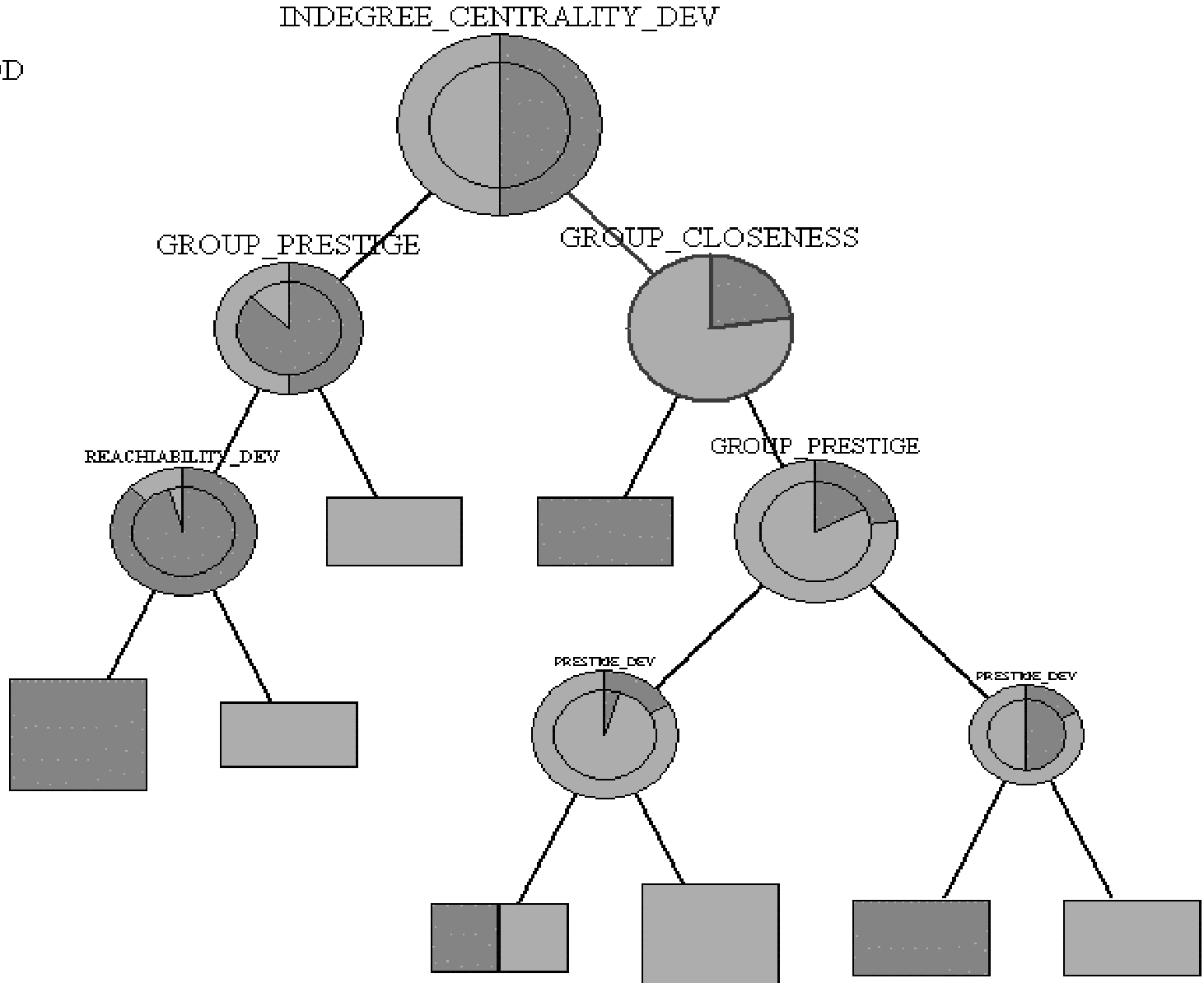
The critical features in the tree are:
1. **Indegree Centrality Deviation**: High deviation (some people receive much more info than others) combined with high closeness is a hallmark of "G" class performance.
2. **Prestige**: How information flows toward key members is a significant predictor of the final grade.
## Critical Analysis & Takeaways
* **Contribution**: The paper successfully bridges the gap between abstract graph theory and practical community management.
* **Limitations**: The sample size is small (6 teams). While the rules generated are 100% pure for this dataset, their generalizability to different cultures or industries needs further validation.
* **Actionable Advice**: If you are managing a virtual project, **discourage** back-channel emails for task-related work. **Encourage** the use of forums and shared folders to build "Collective Memory."
As AI-driven agents begin to enter these communities, SNA metrics will become even more vital to ensure that human-AI interaction patterns remain healthy and productive.