
Uncovering the Structural DNA of Social Networks: Approximate Motif Counting at Scale
Discovering Motifs in Real-World Social Networks
This paper presents a framework for analyzing large-scale social networks by discovering network motifs, specifically focusing on the approximate counting of simple paths using the Color Coding technique. The authors implement and adapt the Gonen & Shavitt algorithm, testing it on a massive real-world dataset from the Irish forum "boards.ie" spanning a decade of user interactions.
TL;DR
Counting specific patterns (motifs) in massive graphs is a notorious computational bottleneck due to its #P-hard complexity. This paper implements an optimized "Color Coding" algorithm to approximately count simple paths in a real-world dataset of 36 million posts from the Irish community boards.ie. By comparing social data to synthetic models, the authors reveal that social networks act as "Preferential Attachment" engines where a few prolific users dominate the local structural patterns.
Problem & Motivation: The #P-Hard Wall
In network science, motifs are the small, recurring subgraphs (like triangles or paths) that define the functional properties of a system. However, as networks grow into the millions of nodes, exact counting becomes impossible.
The authors identify a critical gap: while theory exists for approximate counting (such as Larry Stockmeyer’s 1983 theorem), these methods are rarely applied to massive, messy, real-world social data. Prior work was often stuck in the "toy model" phase or restricted to synthetic graphs.
Methodology: The Power of Color Coding
The core of the study is the Color Coding technique. Instead of searching for every possible path, the algorithm assigns random colors to nodes. It then only looks for "colorful" paths (where every node has a unique color). By repeating this process a sufficient number of times and applying the "median of means" estimator, we can estimate the true count within a specific error margin () and confidence ().
Key Algorithmic Refinement
The authors discovered a "glitch" in the original Gonen & Shavitt pseudocode regarding path directionality. They proposed a modified formula to ensure paths aren't double-counted when a node is in the middle of a path:

To handle the scale of boards.ie, they utilized:
- Bitwise Representation: Using 32-bit integers to represent sets of colors, allowing set operations to be handled by ultra-fast CPU bitwise logic.
- Python Stack: Leveraging
NetworkXandNumPyfor graph management and numerical operations.
Experiments: Real-World Forum Analysis
The researchers parsed a decade of RDF data to build a graph where nodes are users and edges are shared thread participation.
Finding 1: The Exponential Growth of Paths
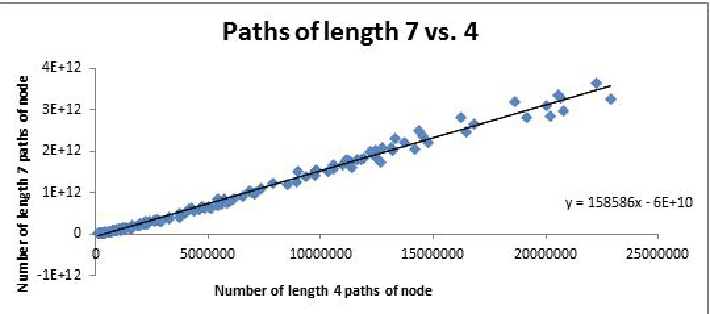
As path length increases, the mean count per node grows exponentially. Interestingly, the standard deviation is nearly as large as the mean, suggesting a highly skewed distribution where "Average Joe" has few paths, but "Power Users" have millions.
Finding 2: Social Reality vs. Mathematical Models
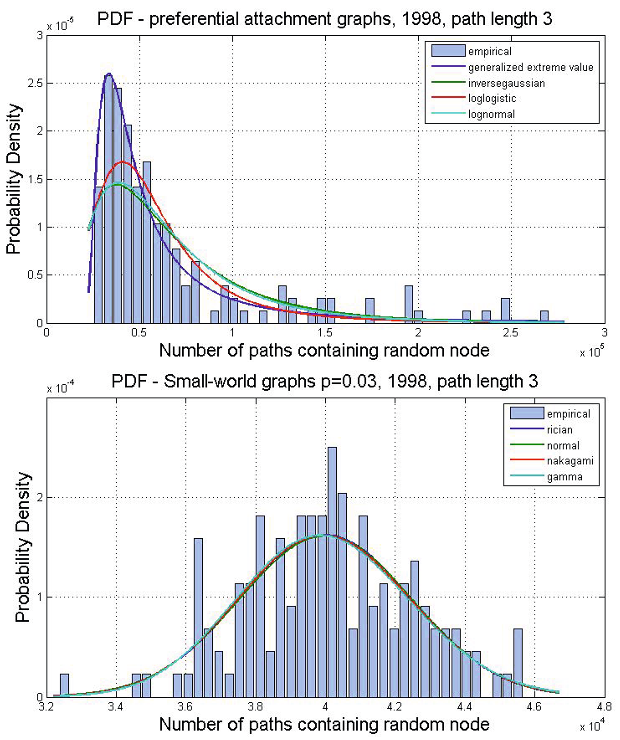
The study compared the boards.ie data against three popular graph models:
- Random (Erdős–Rényi)
- Small-World (Watts-Strogatz)
- Preferential Attachment (Barabási–Albert)
The results were striking: the social network's motif distribution closely matched the Preferential Attachment model. This suggests that "popularity" is the driving force—new users are much more likely to interact with established, prolific "hubs" than with other newcomers.
Deep Insights & Conclusion
Takeaway: The study proves that approximate counting isn't just a theoretical curiosity; it’s a robust tool for "Social Forensic Architecture." By looking at the distribution of length-3 paths, we can distinguish between a natural community and a mathematically "random" crowd.
Limitations:
- Language Overhead: While Python was sufficient for these tests, the authors noted performance bottlenecks, suggesting that future tools should be ported to C or C++ for even larger contexts.
- Static View: The current model treats the 10-year data as one snapshot. In reality, friendships and interests evolve, suggesting a need for "dynamic motif counting" in future research.
Future Outlook: The ability to count motifs efficiently opens doors to identifying spam rings (triangles), community cliques (complete subgraphs), and influence centers in modern social media ecosystems.