
Discovering Related Users: Why Your Commute is the Ultimate Social Fingerprint
Discovering Related Users in Location-based Social Networks
This paper introduces two novel similarity metrics for K-Nearest Neighbor (KNN) recommendation in Location-Based Social Networks (LBSNs). By leveraging temporal windows and trajectory analysis (DTW/Hausdorff), the methods significantly improve recommendation diversity and novelty, particularly for tourist users.
TL;DR
Current Point-of-Interest (POI) recommenders are great at telling you where everyone else goes, but they often fail to understand how you move. This paper explores a return to Nearest Neighbor (KNN) algorithms, replacing standard similarity with Spatio-Temporal Trajectory analysis. The result? Recommendations that are more diverse, more novel, and surprisingly better at predicting your actual social circle—especially if you are a tourist.
The Motivation: The "Check-in" is Not Enough
Most Location-Based Social Networks (LBSNs) like Foursquare treat your data as a bag of check-ins. If you and I both visited the Eiffel Tower, we are "similar." But what if I visited at 9 AM on a Tuesday and you visited at 11 PM on a Saturday three years later? Are we really similar?
The authors argue that the sequential and geographical properties of our movement—our trajectories—are the true indicators of relationship. By neglecting the trail left by users, traditional Collaborative Filtering (CF) misses the nuance of mobility.
Methodology: Redefining "Similarity"
The researchers propose two distinct ways to find your "neighbors" in a city:
- Temporal Windowing (Ad-hoc Similarity): Users are only considered similar if they visit the same venue within a specific time delta (). This captures "shared experiences" rather than just "shared interests."
- Trajectory Similarity (TS-DTW & TS-Haus): Check-ins are grouped into 8-hour windows to form "trajectories." The system then uses Dynamic Time Warping (DTW) and Hausdorff distance to calculate how geometrically similar two paths are.
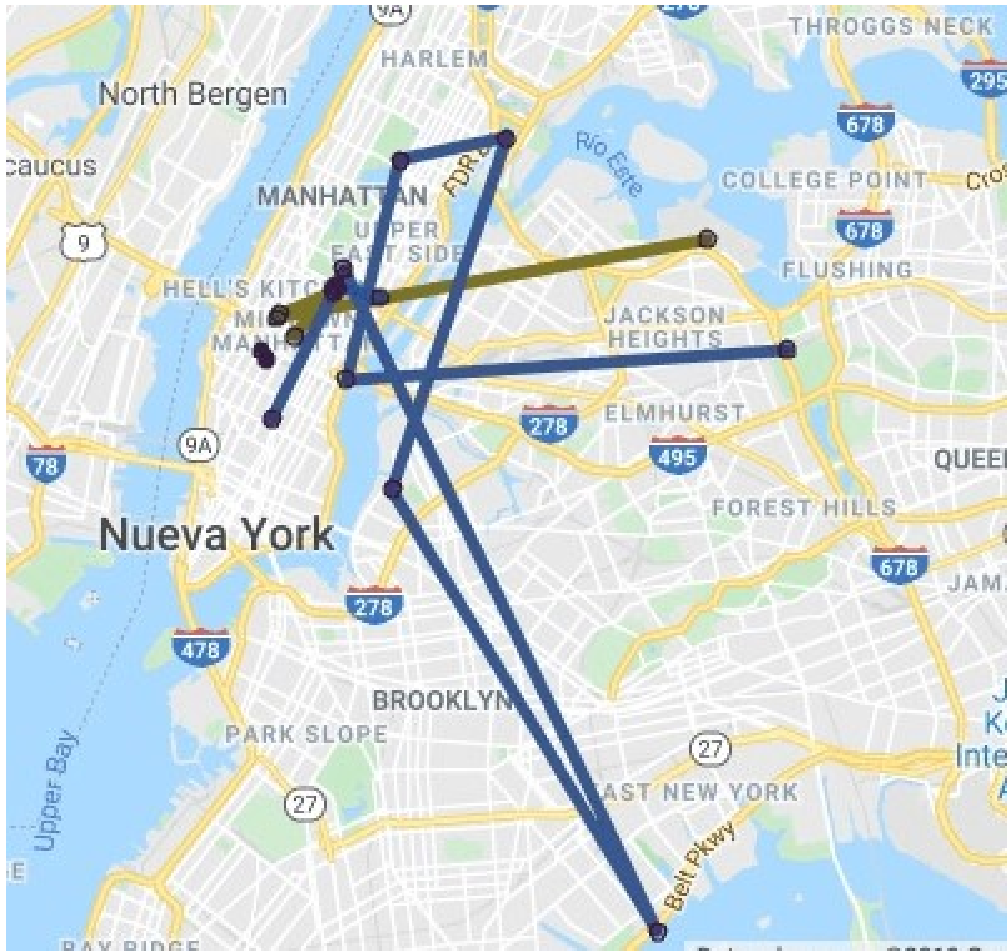 Figure 1: Visual comparison of user trajectories. Users might share a single point in Manhattan, but their overall paths reveal a deeper level of behavioral alignment.
Experiments: Accuracy isn't Everything
The study used a massive Foursquare dataset from Tokyo (328K check-ins). They compared their KNN-based approach against heavyweights like BPR (Bayesian Personalized Ranking) and IRenMF.
Key Findings:
- The Tourist Advantage: For tourists, trajectory-based methods outperformed standard User-based CF in Feature Agreement (FA). This means the system was better at predicting the category of place a tourist would visit next (e.g., a "Ramen Shop" vs. a "Museum").
- Discovery vs. Accuracy: While Matrix Factorization (IRenMF) won on ranking accuracy (NDCG), the trajectory methods provided much higher Aggregate Diversity (AD) and Novelty (EPC). They didn't just recommend the most popular spots; they found the "long tail" venues relevant to the user's specific path.
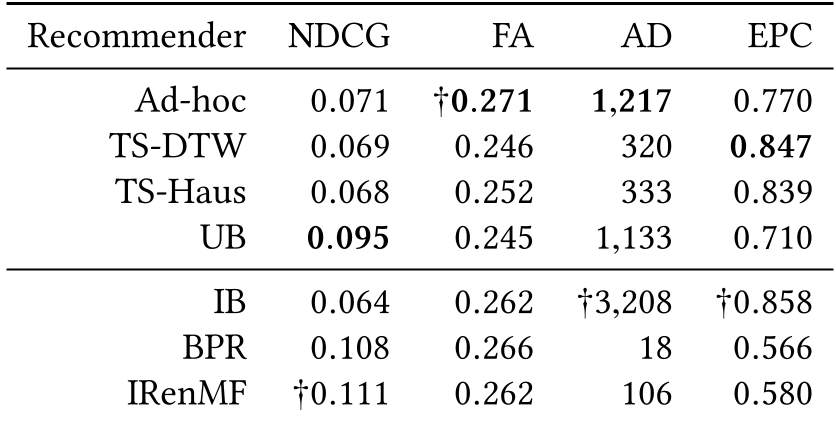 Table 1: While IRenMF leads in accuracy, Ad-hoc and Trajectory methods (TS-DTW) show significantly higher category agreement and diversity.
Deep Insight: Your Social Network is Your Trajectory
Perhaps the most fascinating find is the Social Network Analysis. The authors compared the "neighbors" found by their algorithm with actual Twitter followers. The result? The trajectory-based methods (TS-Haus) found neighbors that were much more likely to be the user's actual social connections than standard CF. This suggests that who we follow online is intrinsically linked to how we navigate the physical world.
Conclusion & Future Look
This work proves that "old-school" KNN algorithms still have a place in the era of Deep Learning, provided we feed them the right Inductive Bias—in this case, spatio-temporal trajectories.
Future Outlook: The next step is scaling this. DTW and Hausdorff distances are computationally expensive. Moving towards "co-movement pattern mining" (like Flock or Convoy algorithms) could allow these systems to run in real-world, high-granularity GPS environments, perhaps even powering the next generation of smart city personal assistants.
Critique: The paper is a solid short-paper contribution. However, the computational overhead of DTW on a global scale remains a bottleneck that the authors acknowledge but haven't yet solved.