
Beyond Static Links: Discovering Dynamic Social Communities via TART and Kohonen Networks
Discovering Communities of Users on Social Networks Based on Topic Model Combined with Kohonen Network
This paper proposes a hybrid community discovery model that combines a Temporal-Author-Recipient-Topic (TART) model with Kohonen Networks (Self-Organizing Maps). It successfully classifies social network users into discrete communities based on their evolving topical interests in Vietnamese higher education contexts.
TL;DR
Understanding online communities requires more than just looking at "who follows whom." This paper introduces a framework that combines Temporal Topic Modeling (TART) with Kohonen Networks (SOM) to discover communities based on what users talk about and when they talk about it. Tested on Vietnamese higher education social data, it achieves a high 74% accuracy in tracking community evolution.
The Evolution Problem: Why Static Analysis Fails
Most community detection algorithms treat social networks as static graphs. However, human interest is fickle. A group of students might form a tight-knit community during "Examination" month but dissolve or merge into an "Employment" community two months later.
Previous works like CART (Community-Author-Recipient-Topic) focused on the relationship between users and topics but ignored the Temporal Factor. The authors argue that without considering "Time," we cannot capture the true "elasticity" of social groups—the phenomenon where users join or leave communities as their interests shift.
Methodology: The TART + Kohonen Pipeline
The authors propose a three-stage workflow to bridge the gap between raw text and visual community structures.
1. The TART Model (Temporal-Author-Recipient-Topic)
Before clustering, the system must understand the content. The TART model extracts words and labels topics while tracking four critical matrices:
- Topic x Word: What defines a topic?
- Author/Recipient x Topic: Who is talking to whom about what?
- Topic x Temporal: When is this topic relevant?
2. Neural Clustering via Kohonen Network (SOM)
The output of TART is a set of "Interested Topic Vectors." Because these vectors are high-dimensional and complex, the authors use a Kohonen Network.
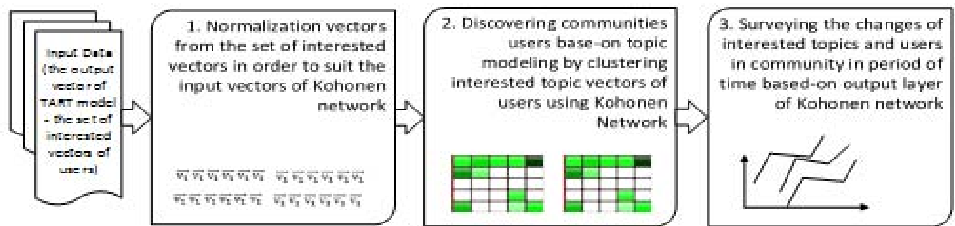
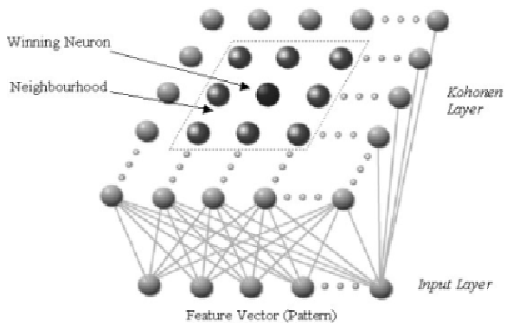
The SOM acts as a self-organizing mechanism that maps these vectors onto a 2D grid. Each "neuron" on the grid represents a potential community. Users with similar topic-time interest profiles are pulled toward the same winning neuron.
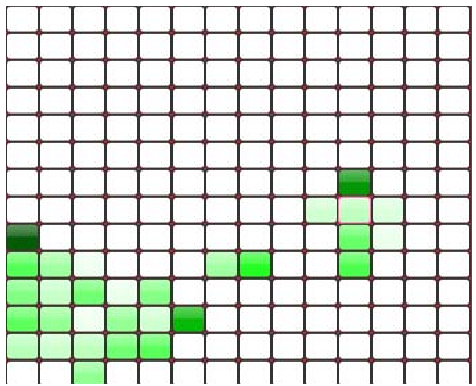
3. Visualizing "Winning Neurons"
The model uses the Mexican Hat function to update neighborhood weights, ensuring that similar communities are located near each other on the map.
Experimental Insights: Tracking the "Elasticity"
The model was tested on a dataset involving Vietnamese messages related to higher education. One of the most striking results is the visualization of topic shifts.
- The Admission Peak: The community interested in "Admission" peaked significantly in April 2009 (56 users) but virtually disappeared by July.
- Stable Communities: Topics like "International Cooperation" remained relatively stable, showing a consistent core community.
- User Movement: By tracking specific users (e.g., User 1 and User 116), the authors demonstrated how individuals transition between different communities (C2, C3, C5, etc.) as their probability of interest in "Learning and Examination" changes.
Critical Analysis & Takeaways
The marriage of probabilistic topic modeling and competitive learning (SOM) is a powerful "Inductive Bias" for social science. It moves away from the rigid "once a member, always a member" logic of traditional graph clustering.
Key Strengths:
- Visual Intuition: The 2D SOM grid makes it easy for researchers to "see" community density via color intensity.
- Temporal Precision: It captures the "life cycle" of a community, which is vital for targeted marketing or educational intervention.
Limitations:
- Non-overlapping Constraint: The authors assume a user belongs to only one community at a specific time. In reality, users often participate in multiple overlapping circles simultaneously.
- Language Specificity: While the model is general, the results are heavily tied to the quality of the Vietnamese NLP preprocessing.
Conclusion
This work provides a solid foundation for Influence Spreading research. By understanding how communities form around temporal topics, we can better predict how information—or misinformation—might migrate from one group to another as the academic calendar or social trends evolve.