
Discovery Engine: Transforming Clinical Trials into Personalized Cure Recommendations
Discovery and Clinical Decision Support for Personalized Healthcare
The paper introduces Discovery Engine (DE), a novel personalized Clinical Decision Support System (CDSS) that identifies patient-specific relevant features for diagnosis and treatment. By employing a Clinical Decision-Dependent Feature Selection (CDFS) algorithm and "transfer rewards" from medical literature, it achieves SOTA results in breast cancer chemotherapy recommendations and diagnosis.
TL;DR
Researchers have developed the Discovery Engine (DE), a system that sifts through massive medical literature and Electronic Health Records (EHR) to provide personalized treatment plans. Unlike traditional models that treat all patients as "average," DE discovers which specific patient traits (like age or tumor grade) matter for each specific drug, improving treatment recommendation accuracy by up to 16.6%.
Background: Precision Medicine's "Curse of Dimensionality"
Modern clinicians are overwhelmed by high-dimensional data. However, not every feature in a patient's record is relevant to every treatment. A feature vital for a chemotherapy regimen like CEF might be irrelevant for AC. Standard Machine Learning (ML) models often fail here because:
- Noise: Irrelevant features dilute the signal.
- Missing Counterfactuals: We know what happened with the treatment given, but we never know what would have happened if a different drug were used.
Methodology: The Discovery Engine Architecture
The DE approach consists of two primary innovations: CDFS and Transfer Rewards.
1. Clinical Decision-Dependent Feature Selection (CDFS)
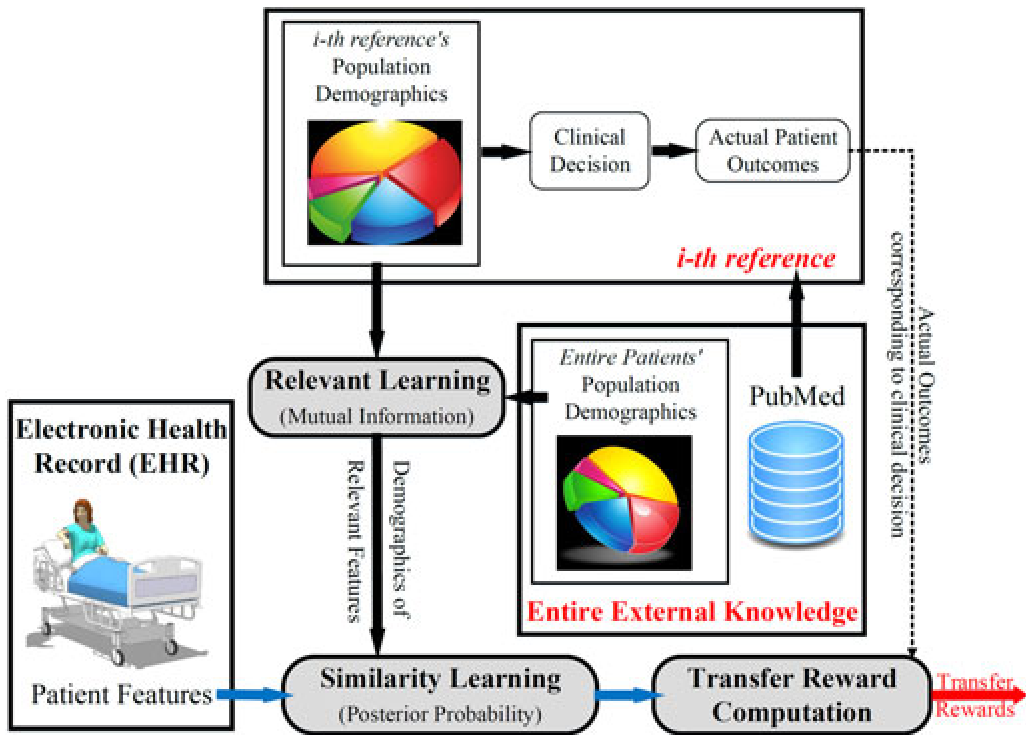
Traditional feature selection finds a single subset of features for the whole model. CDFS is different—it recognizes that every "Action" (treatment) has its own "Relevance." It uses a sequential approach to calculate a Utility Function, balancing the relevance of a feature against its redundancy compared to already selected features.

2. Transfer Rewards: Learning from the Past
Since individual patient outcome data is scarce, DE uses Transfer Rewards. It maps a new patient to population demographics found in thousands of published clinical trials. By calculating the "Similarity" (using Bayes' Rule) between a patient and these reference studies, DE estimates a proxy reward for treatments that the patient hasn't even tried yet.
Experiments and Results
The authors tested DE on two critical tasks: Breast Cancer Treatment and Diagnosis.
Personalized Chemotherapy
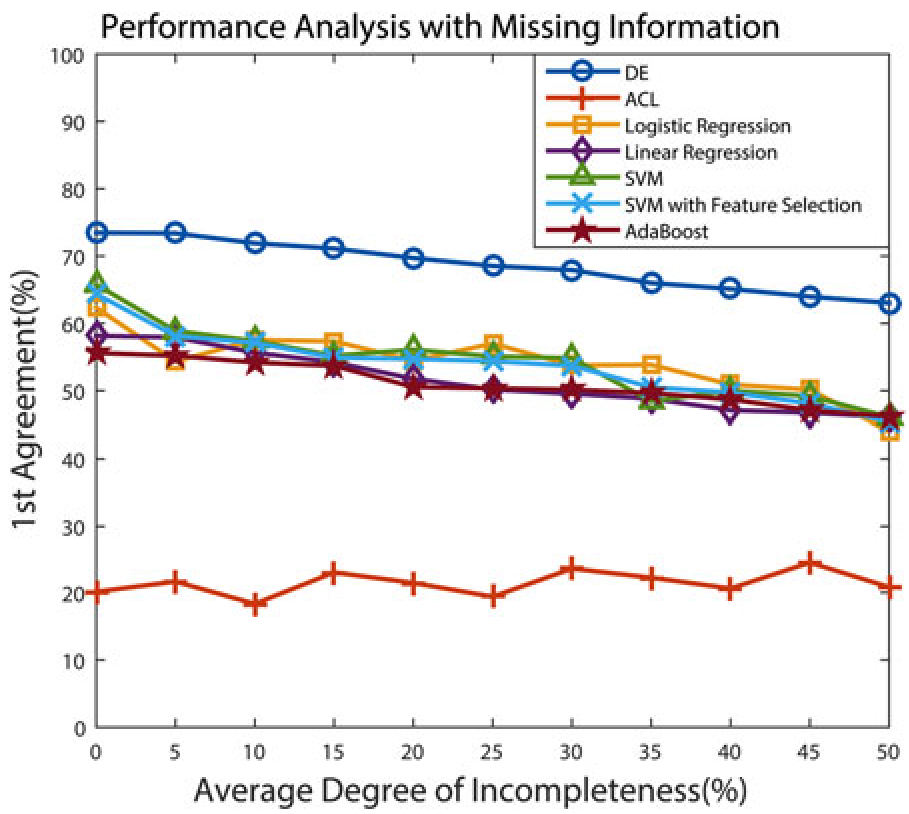
When matching 10,000 patients to six chemotherapy regimens (AC, ACT, AT, CAF, CEF, CMF), DE outperformed benchmarks like SVM and Logistic Regression.
- Performance: 73.4% success rate in matching the top treatment.
- Robustness: Even when 50% of patient data was missing, DE’s performance remained superior to other models with full data access.
Diagnostic Accuracy
Using the Wisconsin Breast Cancer Database, DE focused on minimizing the False Positive Rate (FPR). At a strict clinical threshold of <2% False Negatives, DE achieved an FPR of only 2.62%, significantly lower than SVM’s 6.82%.
Deep Insight: Why It Works
The "aha!" moment of this paper is its Action-Specific Insight. By discovering that features like Prior Chemotherapy are only relevant for specific regimens like AT or ACT, the model avoids the pitfall of "averaging" out important nuances. This mirrors a human expert's intuition: a doctor doesn't look at every single test result with equal weight for every disease; they look for specific "red flags" relevant to the treatment at hand.
Critical Analysis & Conclusion
Takeaway: The Discovery Engine successfully bridges the gap between static Clinical Practice Guidelines (CPGs) and the dynamic reality of individual patient care.
Limitations:
- The current model treats patient data as static; it does decide on the best next step but hasn't yet mastered the sequence of treatments over years of a chronic condition.
- The reliance on published literature assumes those studies are free of reporting bias.
Future Outlook: The next frontier for DE will likely involve Temporal Discovery—understanding how the relevance of certain biomarkers changes as a patient progresses through different stages of a disease.