
Beyond Simple Counts: Discovering Core-Nodes in Event-Based Social Networks
Discovery of Core-Nodes in Event-Based Social Networks
This paper introduces a formal framework for Event-Based Social Networks (EBSN), a bipartite graph model that treats both actors and events as distinct nodes. The authors propose the "Core-Node" discovery algorithm, which identifies influential entities by synthesizing two metrics—Activity and Importance—demonstrated through a large-scale analysis of the DBLP bibliographic dataset.
TL;DR
Most ranking algorithms in social networks are reductive—they look at who you know or how much you do. This paper argues that not all events are created equal. By modeling social structures as Event-Based Social Networks (EBSN), the authors introduce a dual-metric approach (Activity vs. Importance) to find "Core-Nodes"—the true powerhouses of a domain who are both prolific and influential.
The "Static Trap" in Social Network Analysis
In the world of Graph Theory, we often represent people as nodes and their relationships as edges. However, in reality, relationships are usually the result of events: a publication, a meeting, or a transaction.
The authors identify a critical gap: existing methods either treat networks as static snapshots or aggregate temporal data so heavily that the "sequential influence" of events is lost. If an author publishes ten papers in obscure journals (High Activity) but another publishes one groundbreaking paper in Nature (High Importance), traditional participation-based ranking fails to distinguish their true value.
Methodology: The EBSN Architecture
The core innovation lies in the Bipartite Directed Graph structure. Instead of Author-to-Author links, the model uses:
- Actor-Nodes (): Entities like people or organizations.
- Event-Nodes (): Temporal occurrences (e.g., a paper being published in 2005).
- lbAE (Link Between Actor and Event): Represents participation.
- lbEE (Link Between Event and Event): Represents influence/causality (e.g., Paper A cites Paper B).
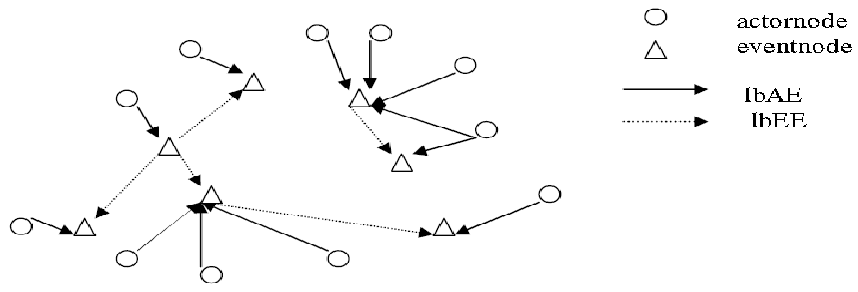 Figure 1: The bipartite structure showing how Actors () interact via Events ().
Defining the "Core-Node"
The authors propose a rigorous mathematical definition for a Core-Node. An actor qualifies only if:
- Activity Value > Average: They participate in more events than the mean.
- Importance Value > Average: The total influence of the events they participate in exceeds the mean.
Experimental Results: The DBLP Case Study
The researchers tested their theory on the DBLP dataset (658,132 authors). The most fascinating insight was the divergence between Activity and Importance.
As shown in the ranking tables below, the leaders in "Activity" (paper count) were rarely the leaders in "Importance" (weighted citation impact). For instance, in 1998, P.S. Yu led in activity, but H. Garcia-Molina led in Importance.
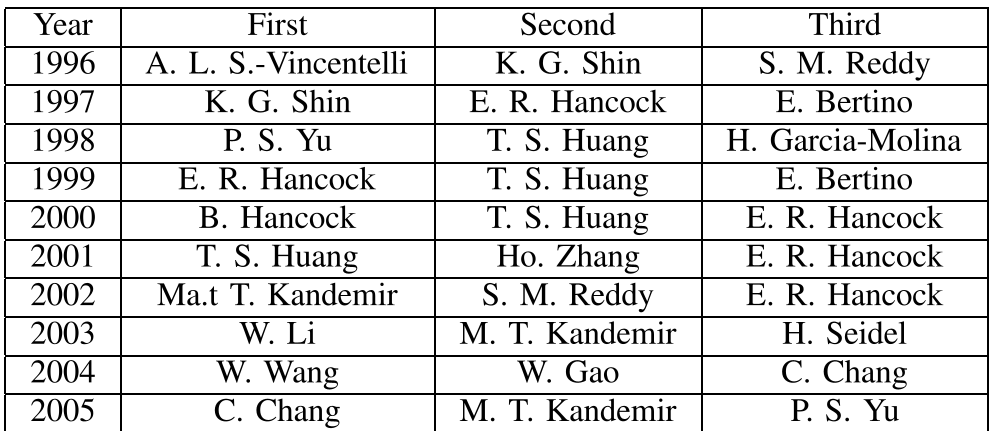 Table 1: Actor-Node ranking reveals the shifting landscape of academic influence.
Visualizing Trends: Developing vs. Developed
By plotting these values over time using stacked area charts, the authors could categorize actors into "Developing periods" (rising area) and "Developed periods" (stable/declining area). This provides a temporal "Pulse" of a researcher's career.
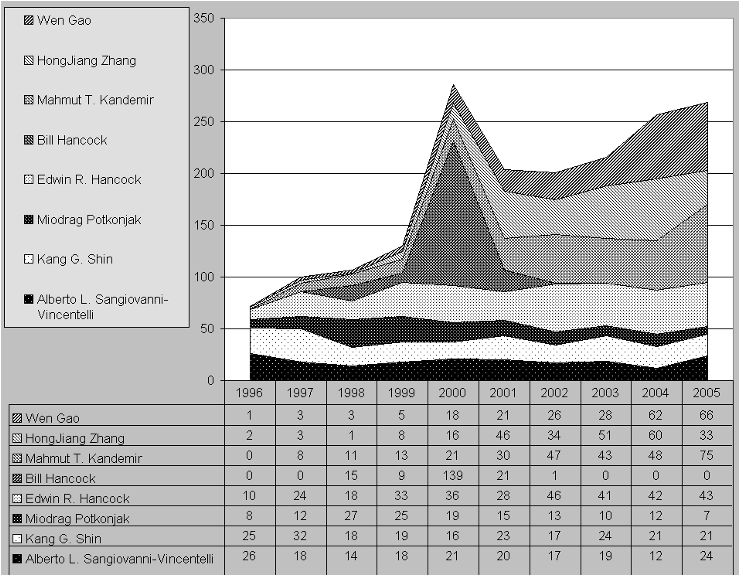 Figure 3: Tracking the Top Active authors' career trajectories.
Critical Insight: Why This Matters
This work shifts the focus from who you are to what you achieve. By quantifying the influence of the event itself (Equation 5 in the paper), the model creates a feedback loop: influential actors make events important, and important events boost an actor's status.
Limitations & Future Work: While the DBLP case study is robust, the model currently relies on manual coefficient settings (). Future versions could benefit from automated weight learning. Additionally, the bipartite structure could be extended to "Three-mode" networks involving location or categorical metadata.
Conclusion
The EBSN framework provides a mathematically sound way to navigate the "noise" of high-activity networks. Whether identifying top researchers or detecting influential accounts in a social media firehose, the ability to find Core-Nodes—the intersection of doing much and doing well—is a vital tool for modern data mining.