
Designing Fluid Governance: Topological Audits for Logistics Organizations
Discovery and diagnosis of the organization for the governance of information logistics and transport business systems
The paper introduces a specialized software framework for the "Discovery and Diagnosis" of organizational structures in logistics and transport. It combines Algebraic Topology (Simplicial Analysis) and Social Network Analysis (SNA) to assess business process maturity and organizational compliance, leveraging NoSQL graph databases (Neo4j) for data persistence.
TL;DR
In the high-stakes world of information logistics, organizational "drift"—the gap between management’s chart and actual workflow—is a silent killer of efficiency. This paper presents a software solution that uses Algebraic Topology and Social Network Analysis (SNA) to "diagnose" a company's health. By treating employees and processes as vertices in a simplicial complex, the authors provide a mathematical framework for organizational redesign, proving its value through a real-world automotive production case study.
Problem & Motivation: The Gap Between Theory and Practice
Most companies operate through two structures: the one printed in the employee handbook (the formal hierarchy) and the one that actually gets work done (the informal collaboration network). In the logistics and transport sector, non-compliance with top-management strategy leads to congestion and wasted resources.
The authors argue that traditional audits are too static. They seek to answer:
- Is the actual organizational structure consistent with the strategy?
- How can we mathematically prove which department is a bottleneck?
- What is the "eccentricity" of a role—how isolated or integrated is an employee within a process?
Methodology: The Math Behind the Organization
The researchers developed the Structural Engine, a prototype that integrates data collection, transformation (SETL), and dual-mode analysis.
1. Topo-Scopy (The Structural View)
Using Simplicial Analysis, the system projects the organization into a multidimensional space. Unlike a simple graph (which only shows pairs), a simplicial complex captures group dynamics (multiple performers working on the same activity).
- Eccentricity: Measures how "unshared" a component's activities are.
- Entropy: Quantifies the disorder or uncertainty in the structure.
2. SNA-Scopy (The Relational View)
This module uses standard social network metrics like Betweenness Centrality to identify "gatekeepers"—units that control the flow of information between other units.
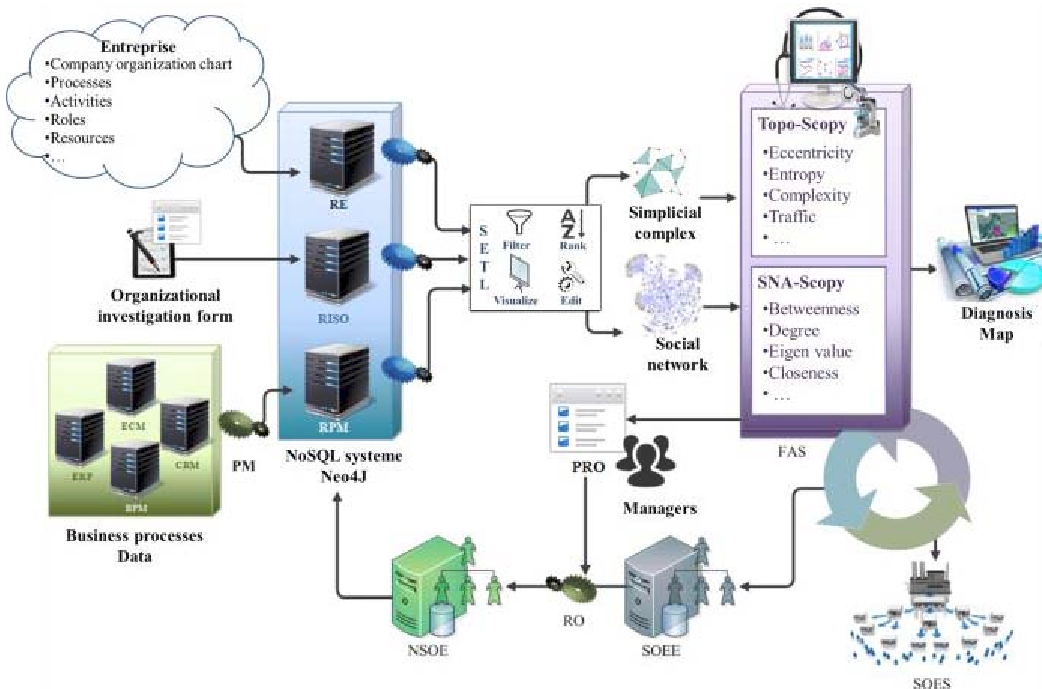 Fig 1: The six-step diagnostic process, from data collection in Neo4j to organizational redesign.
Experiments & Results: The Automotive Case Study
The authors tested their prototype on a production company. By querying a Neo4j graph database using Cypher, they extracted process relationships and generated incidence matrices.
Key Findings:
- The Bottleneck: The "Logistics and Supply" department showed the highest centrality values (Betweenness = 0.305). This unit was the primary "bridge" for the entire company, making it a high-risk point for congestion.
- High Complexity: The topological complexity of Business Process 1 was calculated as , with an entropy of 0.520, suggesting a significant need for better-structured communication.
 Table 1: Centrality metrics identifying the Supply and Logistics unit as the organization's nerve center.
Organizational Redesign: Mathematical Reengineering
Based on the diagnosis, the authors proposed a strategic overhaul. Because the "Logistics and Supply" unit was over-requested, they recommended moving it from a sub-department to its own standalone Directorate.
This move was designed to:
- Reduce the "Complexity" metric of the overall structure.
- Align the operational reality with the top-management's goal of service quality.
- Distribute the load of collaborative relationships more evenly across the management layer.
Critical Insight & Conclusion
This paper elevates organizational auditing from a "consultant's opinion" to a computable science. By using NoSQL graph databases and discrete algebraic topology, it provides a scalable way to monitor corporate health.
Limitations: While the mathematical framework is robust, the paper assumes that the initial data collection (from ERP/BPM systems) is perfectly accurate—a rare occurrence in messy real-world environments. Future work should focus on how to handle "noisy" or incomplete organizational data.
Takeaway: For the modern CTO or COO, this research suggests that the most efficient way to fix a "broken" company isn't just hiring more people—it's optimizing the simplicial connectivity of the existing ones.