
Decoding Information Flow: How Disseminators and Receptors Shape Social Media
Discovery of information disseminators and receptors on online social media
This paper introduces a computational framework to identify two pivotal roles in social media information flow: "disseminators" (distributors) and "receptors" (consumers). Using Non-negative Matrix Factorization (NMF) on stacked activity graphs from Digg.com, it successfully quantifies user influence based on reachability and temporal persistence.
TL;DR
In the digital age, information doesn't just "spread"—it is actively propelled by specific users. This paper presents a novel framework to identify Information Disseminators and Information Receptors using a stacked graph representation and matrix factorization. By testing this on two months of Digg.com data, the research proves that these roles are not just theoretical but are highly predictive of future social activity.
Background: Beyond Simple Centrality
In 2010, at the height of platforms like Digg and the rise of Twitter, researchers began to realize that being "popular" wasn't the same as being "influential." Early Social Network Analysis (SNA) relied heavily on static metrics like Degree Centrality. However, this paper argues that social media is a "multi-dimensional activity-based" environment where roles evolve over time through specific actions: Diggs (likes), comments, replies, and story uploads.
The Problem: The Dual Nature of Influence
The core insight of the author, Munmun De Choudhury, is that information dissipation is a two-sided coin:
- Distribution (Disseminators): The ability to trigger others into action.
- Consumption (Receptors): The degree to which a user accepts and reacts to novel information.
Existing methods struggled to capture this duality across different types of interactions. Why does a story go viral? Is it because of the person who posted it, or the specific group of "super-users" who reacted first?
Methodology: Stacked Graphs & NMF
The paper introduces a mathematically elegant approach to solve this.
1. Stacked Representation
The authors construct a set of four graphs () representing Actions, Comments, Replies, and Uploads. Each graph captures "reachability" (how many people the info reached) and "persistence" (how long the interaction lasted).
2. Matrix Factorization (The "How")
Instead of analyzing these graphs in isolation, the framework applies Non-negative Matrix Factorization (NMF). For each weighted adjacency matrix , it seeks to find: Where:
- (Distribution): A vector representing the dissemination strength of each user.
- (Consumption): A vector representing the reception strength of each user.

Experimental Results: Predicting the Future
The authors crawled 187,277 stories and millions of user interactions from Digg. To validate if these "Disseminator" and "Receptor" scores actually meant anything, they looked at whether high scores at time correlated with high activity at time .
Key Findings:
- High Correlation: There was a strong positive correlation between roles identified by the NMF framework and actual communication behavior.
- Persistence: Users identified as disseminators tended to maintain their role across different topics, suggesting that "influence" is a characteristic of the user, not just a lucky post.
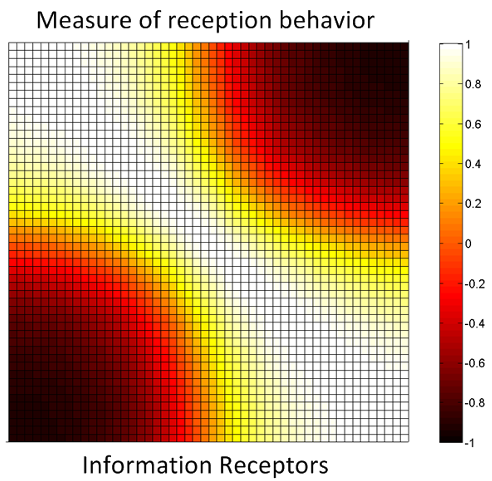 Figure 1: The high correlation coefficients demonstrate that the mathematical roles of dissemination and reception are grounded in real-world user activity.
Critical Analysis & Conclusion
Takeaway
This work shifted the focus from who you know (traditional SNA) to what you do (activity-based roles). By framing information flow as a latent factor that can be "factorized" out of raw activity data, it provided a scalable way to find the real needles in the social media haystack.
Limitations
While groundbreaking for its time, the model primarily assumes that influence is additive. In the modern era of algorithmic feeds (like TikTok or X), the "Information Receptor" role is often mediated by AI recommendation engines rather than purely organic user-to-user follows.
Future Outlook
The "Disseminator/Receptor" duality is more relevant than ever in the study of information echoes and misinformation. Modern researchers can use these roles to identify "super-spreaders" of fake news versus "authoritative voices" in niche communities.