
The Hidden Complexity of Social Circles: Why "Small Groups" Take So Long to Cooperate
Discrete Applied Mathematics
This paper investigates the convergence time of community formation dynamics in social networks modeled as coloring games. It utilizes a combinatorial reinterpretation through the dominance lattice of integer partitions to establish tight upper and lower bounds for the time it takes for users to reach a stable state.
In the digital age, social networks are defined by who we follow and who we block. Technically, this is a Community Formation Problem. A recent study by Bermond et al. provides a rigorous mathematical answer to a deceptively simple question: If users can switch groups to be with more friends and fewer enemies, how long does it take for the whole system to stop moving?
The answer reveals a shocking phase transition in the "time to stability" as soon as more than three people start coordinating their moves.
TL;DR
The paper proves that when users act selfishly or in small pairs (), they reach a stable community structure relatively quickly (). However, if groups of 4 can coordinate (), the time to reach stability explodes into super-polynomial complexity (). This disproves a long-standing conjecture that fixed-size cooperation always leads to polynomial-time convergence.
The Game: Friends, Enemies, and Utility
The researchers use a model where users are nodes in a Conflict Graph ().
- Friends: Share a group, utility = size of the group - 1.
- Enemies: Cannot share a group (infinite negative utility).
- The Move: A set of at most users can simultaneously jump to a new group if every member of that set strictly increases their individual utility.
Methodological Insight: The Lattice of Partitions
The brilliance of this paper lies in its abstraction. Instead of just looking at graphs, the authors translate the problem into Integer Partitions. When the conflict graph is empty (everyone is potential friends), a community structure is just a way to partition the integer (total users).
For , the authors prove that every move corresponds to a step in a Dominance Lattice. By using the theory of majorization, they find that the maximum length of a move sequence is exactly the length of the longest chain in this lattice.
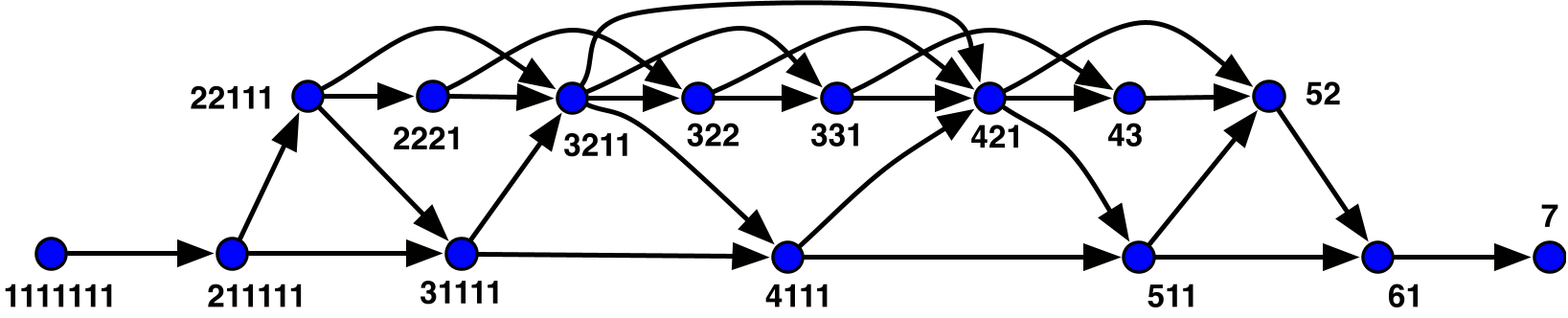 Figure: The Dominance Lattice for n=7 users. Every arrow is a potential selfish move.
The Breaking Point: Why Changes Everything
For years, theorists assumed that as long as was a fixed constant, the system would settle down in polynomial time. Bermond et al. shattered this by constructing "Cascades."
The "Nice Property" and Recursive Cascades
The authors designed a specific type of 4-deviation (labeled ) that actually decreases the total utility of the system while helping the individuals. By chaining these moves into recursive structures—cascades of cascades—they can force the system to take a massive "detour" through the state space before ever reaching stability.
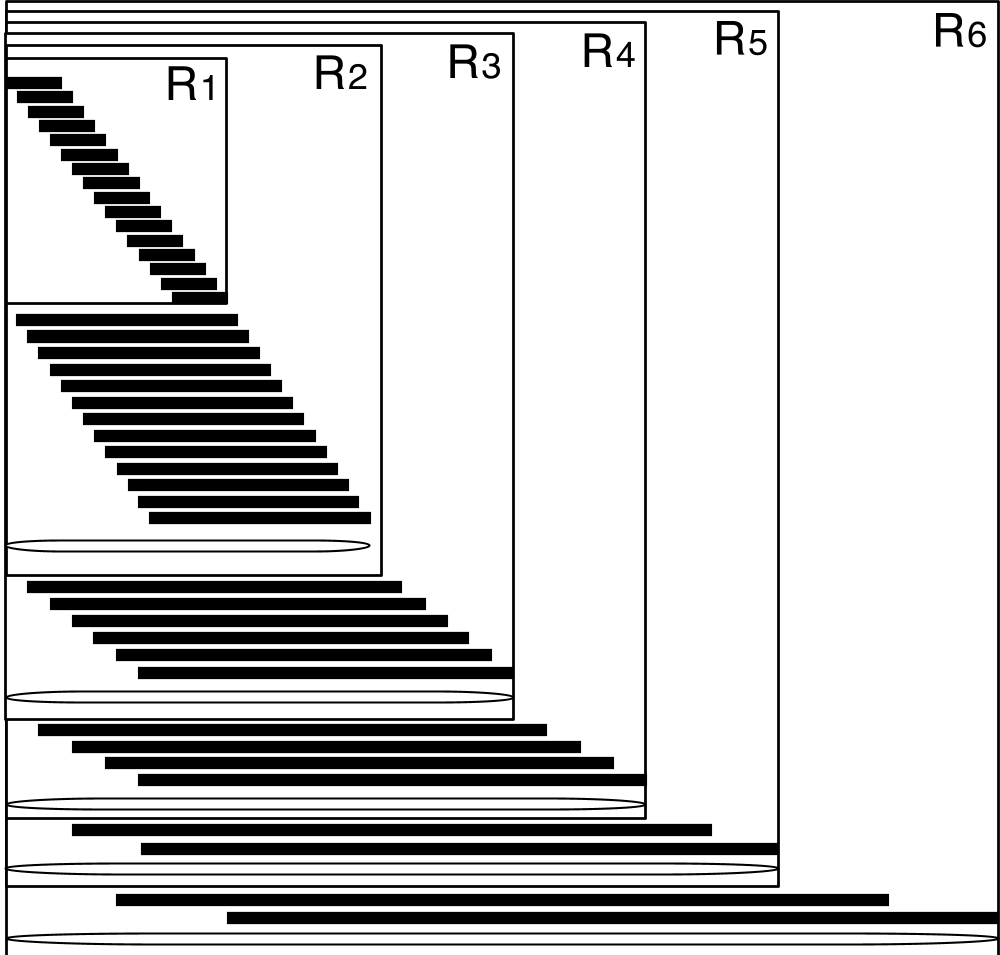 Figure: The recursive cascade structure. Each block represents a sequence of deviations that resets the state, forcing a super-polynomial path to convergence.
Experimental & Theoretical Results
The study's results are summarized in the following table, showcasing the "complexity jump":
| Cooperation Size () | Previous Upper Bound | This Paper's Achievement | Result Type |
|---|---|---|---|
| Tight Exact Value | |||
| Lower Bound Gap | |||
| Super-polynomial Disproof |
Critical Insight: The Sociological Implication
This isn't just about math. It tells us that fragmentation is easier to manage than coordination.
- When individuals act alone, the "chaos" resolves fast.
- When small cliques coordinate their migrations across communities, they can create "cycles" or extremely long paths of instability that prevent the network from ever settling down.
Limitations and Future Work
The super-polynomial bound is a "worst-case" scenario using a specifically constructed empty conflict graph. In real-world social networks with high "enemy" density (highly polarized), the number of valid moves would be significantly restricted, likely forcing faster (but potentially less optimal) stability.
The next frontier? Determining if finding a stable state for is PLS-complete, which would put it in the same complexity class as finding Nash Equilibria in complex games.