
Discrete Texture Traces: Rethinking Patch Representation via Topology
Discrete texture traces: Topological representation of geometric context
This paper introduces the Discrete Texture Trace (DTT), a sparse topological patch representation designed for quasi-invariance to smooth spatial deformations and robustness against occlusions in computer vision tasks. By modeling image patches as sets of topological relations rather than Euclidean configurations, the authors achieve state-of-the-art performance in incremental tracking and point matching.
Executive Summary
TL;DR: This paper proposes Discrete Texture Traces (DTT), a novel way to describe image patches by their internal topological connectivity rather than spatial coordinates. By treating an image as a set of navigable "paths" between texture landmarks, the method achieves extreme robustness against non-rigid deformations (like bending or twisting) and occlusions.
Context: This work sits at the intersection of classical geometry and modern tracking. It challenges the dominance of Euclidean-based descriptors (SIFT, SURF) by proving that topology—the science of "connectedness"—is a superior invariant for complex, real-world scene dynamics.
The Problem: The Euclidean Trap
Most computer vision descriptors are "Euclidean-centric." They assume that if you know a point is 10 pixels to the left of another, it defines the object's structure. However, when an object deforms—like a person bending their arm or a flag waving—Euclidean distances change drastically, even though the "texture neighborhood" remains the same.
The authors argue that we shouldn't rely on how far things are, but how they are connected. Like navigating a city by landmarks ("Turn left at the church") rather than GPS coordinates, topological traces remain valid even if the city map is stretched like rubber.
Methodology: From Continuous Profiles to Discrete Traces
The core innovation is the translation of a continuous topological ideal into a discrete, computable algorithm.
1. The Profile Trace
In a continuous domain, a "Profile Trace" is simply the sequence of intensities encountered along a path . Under a homeomorphism (a smooth stretching), the path changes, but the sequence of intensities (the "trace") remains identical.
2. Discretization (DTT)
To make this practical, the authors discretize the image into a graph:
- Nodes: Labeled texture landmarks (quantized SIFT descriptors).
- Edges: Fixed angular relations (e.g., "North," "South-East").
- The Trace: A sequence of (Label, Angle) pairs.
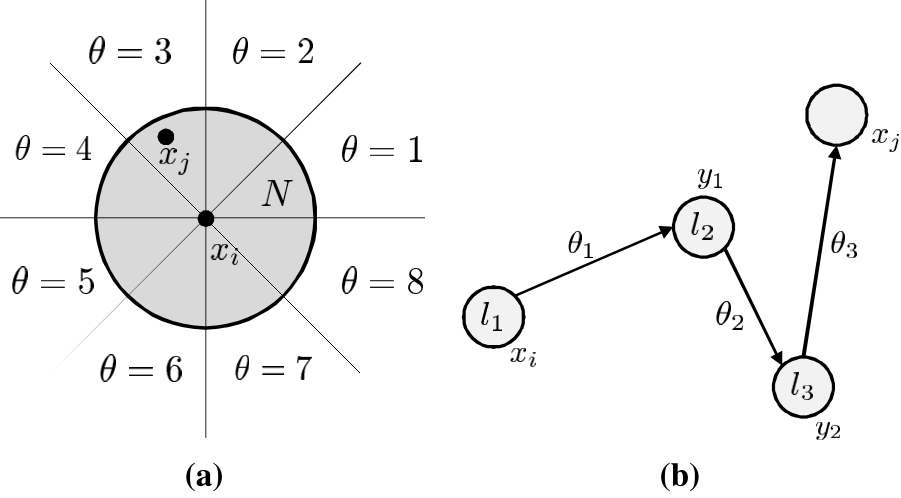 Figure 4: (a) Neighborhood angular relations; (b) A discrete trace connecting two locations through a sequence of labels.
The existence of a trace between two points is computed efficiently using sparse matrix multiplication. If is an adjacency matrix representing a specific label and direction, finding a valid trace of length is equivalent to checking if the product of such matrices has a non-zero entry at the target index.
Experimental Performance: The Power of One-Shot
The authors tested DTT against Geodesic Intensity Histograms (GIH) and several modern trackers.
Robustness to Noise and Occlusion
DTT showed exceptional resilience to salt-and-pepper noise and random occlusions. Because it uses a "voting" mechanism—where each trace is an independent piece of evidence—losing 30% of a patch due to an obstacle doesn't break the descriptor; it just reduces the confidence score slightly.
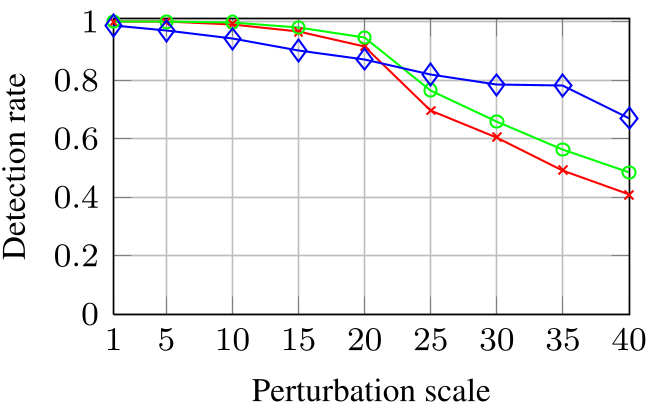 Figure 5: Performance under occlusion. DTT maintains high detection rates even as the object is significantly obscured.
The "One-Shot" Revelation
The most striking result is the One-Shot Tracking experiment. The researchers turned off the learning mechanism and asked the tracker to find the object in a 1,000-frame sequence using only the first frame.
- Result: DTT outperformed four out of six state-of-the-art trackers that were allowed to learn incrementally. This proves the inherent "quasi-invariance" of the representation—it naturally handles changes in view and shape without needing to "re-learn" what the object looks like.
Critical Insight & Conclusion
Takeaway
The Discrete Texture Trace succeeds because it moves away from the rigid "shape" of a patch and focuses on the contextual topology. It treats an image as a graph of navigable texture nodes.
Limitations
- Texture Dependency: The method requires "textured" regions. In smooth, untextured areas (like a blank wall), traces become ambiguous.
- Computational Cost: While highly parallelizable (GPU-friendly), the basic Matlab implementation shown in the paper was slow (~seconds per frame), though this is an engineering hurdle rather than a theoretical one.
Future Outlook
DTT represents a shift toward Geometric Context. By integrating other signals (like motion vectors or semantic segmentation) into the adjacency matrices, this framework could evolve into a universal descriptor for multi-modal scene understanding, far beyond simple 2D tracking.