
Beyond the F-Score: Re-evaluating Machine Learning through the Lens of Medical Diagnosis
Beyond Accuracy, F-Score and ROC: A Family of Discriminant Measures for Performance Evaluation
The paper introduces a specialized family of discriminant measures—Youden’s index, Likelihood Ratios, and Discriminant Power—borrowed from medical diagnosis to evaluate machine learning classifiers. These metrics prioritize class discrimination and failure avoidance in scenarios where classes are equally important, such as electronic negotiations.
TL;DR
In the quest for SOTA (State Of The Art), the ML community has become hyper-fixated on Accuracy and F-score. However, these metrics often mask the true strengths and weaknesses of a classifier in real-world scenarios like negotiation or sentiment analysis. This paper proposes a "Discriminant" family of measures—Youden's Index, Likelihood Ratios, and Discriminant Power—derived from clinical trial assessment. The key finding? An algorithm that wins on Accuracy might actually be inferior at "failure avoidance."
The "Accuracy" Trap: Why Standard Metrics Fail
Most ML benchmarks assume an Identically and Independently Distributed (IID) setting and often focus on the "Positive" class (especially in Tasks like Information Extraction). But what happens when the "Negative" class is just as vital?
In Electronic Negotiations, a "Failure" is just as informative as a "Success." Accuracy (Equation 1) treats all correct labels as equal, failing to distinguish between class-specific effectiveness. F-score (Equation 4) focuses on the positive class. While ROC/AUC (Equation 5) provides a curve, it often requires high data volume or threshold manipulation, which isn't always feasible in niche social-data studies.
Methodology: The Discriminant Framework
The researchers argue that we need to evaluate two specific neural/algorithmic traits: Confirmation Capability and Failure Avoidance.
1. Youden’s Index ()
Defined as , this index evaluates the model's ability to avoid failure. It treats positive and negative performance with equal weight.
2. Likelihood Ratios ()
- Positive Likelihood ():
- Negative Likelihood (): These ratios help determine if a model is better at confirming a "Success" or confirming a "Failure."
3. Discriminant Power (DP)
This evaluates how well an algorithm distinguishes between groups. A DP > 3 is considered "good," while < 1 is "poor."
Experiments: SVM vs. Naive Bayes
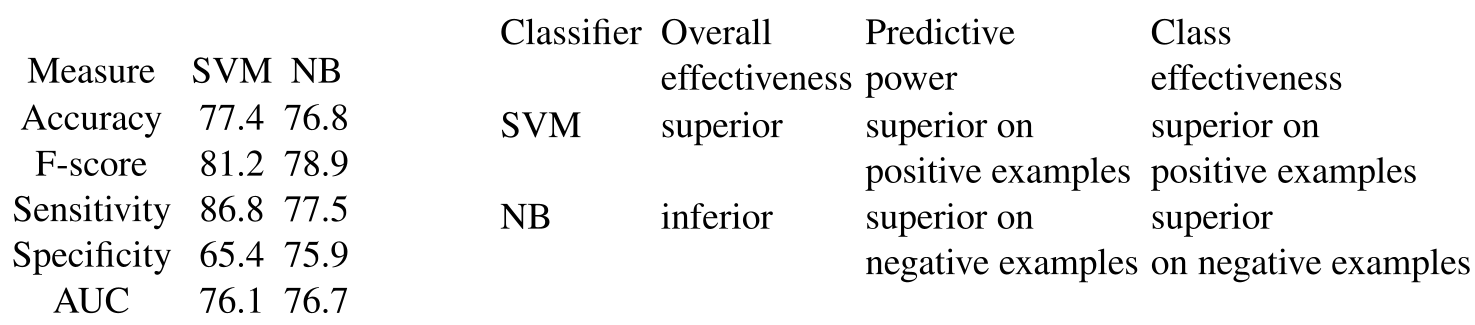
Using the Inspire Dataset (bilateral e-negotiations), the authors compared Support Vector Machines (SVM) and Naive Bayes (NB).
The conflict in results was striking:
- By Accuracy/F-Score: SVM appears superior (77.4% accuracy vs. 76.8%).
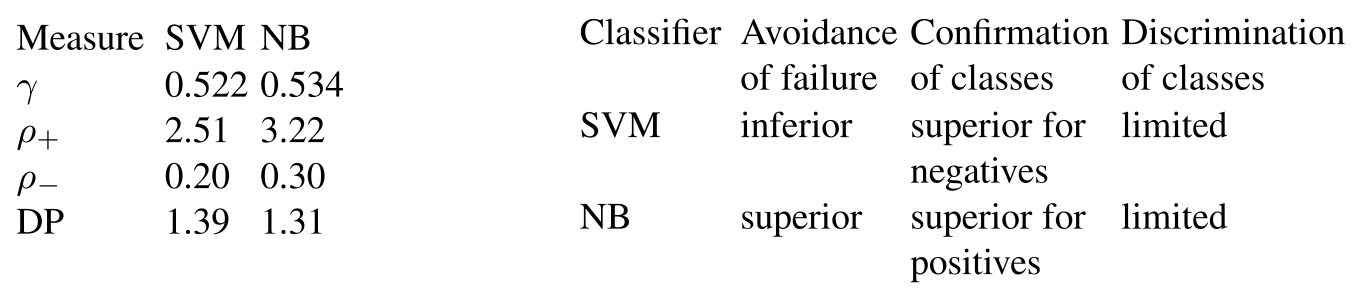
- By Youden's Index: Naive Bayes wins (0.534 vs. 0.522), suggesting it is actually better at avoiding failure.
- By Likelihood: NB showed a significantly higher (3.22 vs 2.51), making it a more reliable "confirmer" for certain classes.
Critical Insight: The "Why" Behind the Shift
Why does Naive Bayes perform better on these new metrics despite lower accuracy? It often comes down to the Inductive Bias of the models. SVMs maximize the margin, which can sometimes lead to "brittle" class boundaries in high-noise social data. Naive Bayes, despite its "naive" independence assumption, often produces more balanced class probabilities, leading to better "failure avoidance" scores.
Conclusion & Future Outlook
This work serves as a vital reminder that Performance is not a single number.
- If your task is Asymmetric (e.g., detecting rare cancer), use Precision/Recall.
- If your task is Symmetric (e.g., Success/Failure in Business), use Youden’s Index and Likelihood Ratios.
The future of ML evaluation lies in "Social Clinicalization"—applying the rigorous, high-stakes metrics of medical science to our algorithmic interactions.