
STULIG: Disentangling Identity from Motion in the Age of Location Privacy
Toward Discriminating and Synthesizing Motion Traces Using Deep Probabilistic Generative Models
This paper introduces STULIG, a deep probabilistic generative framework for the Trajectory-User Linking (TUL) problem. It utilizes a Semi-supervised Variational Autoencoder (VAE) with a Gaussian Mixture Model (GMM) prior to learn disentangled, interpretable representations of human mobility patterns for both user discrimination and synthetic trajectory generation.
TL;DR
STULIG is a novel deep generative framework that solves the Trajectory-User Linking (TUL) problem by viewing mobility through the lens of disentangled representation learning. By replacing standard RNNs with efficient CNNs and adopting a Gaussian Mixture (MoG) prior, the model can identify anonymous users while simultaneously generating synthetic, privacy-preserving trajectories that maintain the statistical utility of real movements.
Background: The TUL Problem and Its Privacy Paradox
In Location-Based Social Networks (LBSNs), identifying which user generated a particular sequence of check-ins is known as Trajectory-User Linking (TUL). While useful for personalized recommendations or suspect identification, TUL is a double-edged sword: it enables de-anonymization attacks that threaten user privacy.
Existing SOTA methods, primarily based on Recurrent Neural Networks (RNNs) like LSTM or GRU, face three major hurdles:
- Efficiency: RNNs are inherently sequential and slow to train on long trajectories.
- Interpretability: Latent spaces in standard VAEs are often "tangled," making it impossible to separate who the user is from how they move.
- Privacy: There is no mechanism to release "safe" versions of the data that still look real to machine learning models.
Methodology: Disentanglement via Gaussian Mixtures
The core innovation of STULIG (Semisupervised Trajectory-User Linking with Interpretable representation and Gaussian mixture prior) lies in its hierarchical probabilistic graphical model.
1. Structural Disentanglement
Unlike TULVAE, which uses a single unimodal Gaussian prior, STULIG assumes trajectories are generated by multiple latent factors:
- : The discrete user identity (observed in labeled data, inferred in unlabeled).
- : A unimodal Gaussian representing general styles.
- : A Mixture of Gaussians (MoG) that captures complex, multimodal mobility patterns.
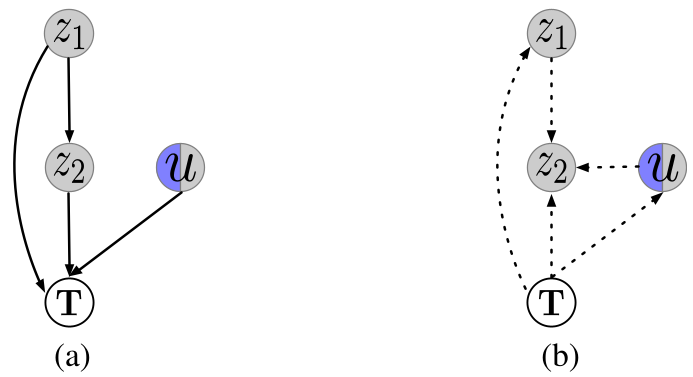 Figure 1: Comparison between Generative (a) and Inference (b) models. Note the conditional dependence that separates identity from style.
2. CNN-based Efficient Convolutions
The authors treat segments of trajectories (e.g., 6-hour intervals) as 2D matrices. By using Convolutional Neural Networks (CNNs) instead of RNNs, the model captures multi-level periodicity (daily/weekly patterns) much more efficiently through 2D filters.
3. Geographical Regularization
To handle unlabeled data without a massive computational explosion, the authors use DBSCAN to cluster users' historical regions. For an unlabeled trace, they only calculate the loss against a subset of users () who have historically frequented that specific geographical area, slashing training time.
Experiments & Results
The model was evaluated on three major datasets: Gowalla, Foursquare, and Brightkite.
Superior Discrimination
STULIG consistently outperformed hierarchical LSTMs and previous VAE models. For instance, on the Gowalla dataset (), STULIG achieved an ACC@1 of 47.98%, compared to TULVAE's 44.14%.
Plausible Trajectory Generation
Using Jensen-Shannon Divergence (JSD), the authors proved that STULIG generates trajectories that match real-world temporal and spatial check-in preferences better than GANs (T-WGAN) or Markov Chains.
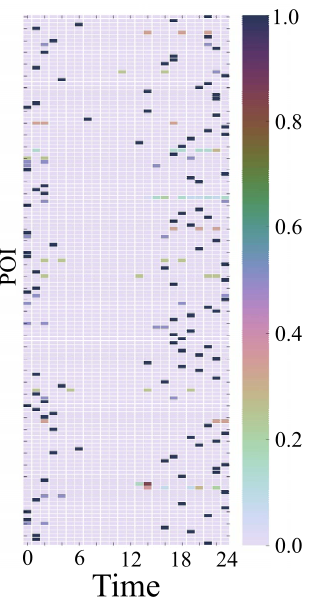 Figure 2: Visual Comparison. STULIG (red/yellow overlap) captures local clusters like Austin or Kansas City far more accurately than the sparse, erratic generations of TULVAE.
Critical Insights: Beyond Accuracy
The most striking takeaway from STULIG is its ability to handle "Posterior Collapse." In many VAEs, the decoder becomes so powerful it ignores the latent space entirely. By using a CNN-based Seq2Seq architecture and an MoG prior, STULIG forces the latent variables to remain informative.
Furthermore, the "Privacy-Preserving" aspect is a game-changer for data sharing. The authors demonstrate that a model trained on fully synthetic data can achieve performance comparable to one trained on real data, allowing researchers to share "safe" datasets that do not leak exact user geocoordinates.
Conclusion & Future Work
STULIG represents a significant step forward in making spatiotemporal AI both efficient and accountable. While the current model focus on check-in IDs, future iterations could incorporate richer context (POI categories like "ATM" or "Restaurant") or transport modes (Walking vs. Driving). For the industry, this provides a framework for scaling location-based services without compromising the privacy of the individuals who power them.