
Deciphering the Web of Comorbidity: A Network Analysis of Prostate Cancer Subpopulations
Identification of Disease-Disease Network Communities in Subpopulations of Patients with Prostate Cancer
The paper presents a network-based analysis of disease-disease interactions in prostate cancer (PCa) patients using SEER-Medicare claims data. It implements community detection (Louvain algorithm) and hierarchical clustering to identify distinct co-occurring complication subgroups across different cancer stages and survival statuses.
TL;DR
Researchers have moved beyond simple "list-based" comorbidity analysis to a "network-based" approach for Prostate Cancer (PCa). By analyzing Medicare claims, this study reveals that disease-disease interactions change significantly as cancer progresses from localized stages to metastatic (Distant) stages. The study identifies specific "communities" of co-occurring diseases that distinguish survivors from non-survivors.
Context: Why "Comorbidity" is a Network Problem
In oncology, we often treat comorbidities as static background noise. However, a patient with Prostate Cancer isn't just a patient with "one more disease"; they are a dynamic system where the cancer, the treatment (like androgen inhibition), and pre-existing conditions interact. Prior work often lacked the granularity to see how these interactions shift between a survivor and a non-survivor. This paper treats these relationships as a Disease-Disease Network, where nodes are ICD-9 codes and edges represent the probability of flying together in medical records.
Methodology: Mapping the Pathological Landscape
The researchers categorized patients into six cohorts based on Stage (Localized/Regional vs. Distant) and Survival Status, plus two control groups.
1. Network Construction
The strength of a connection between two diseases was calculated using a symmetric conditional probability formula: This ensures that the edge weight reflects a genuine mutual association rather than just the high frequency of a single common disease (like hypertension).
2. Community Detection & Similarity
The study used the Louvain Method to maximize modularity, effectively grouping diseases into "complication subgroups." They then used Cosine Similarity to compare these groups across different patient types.
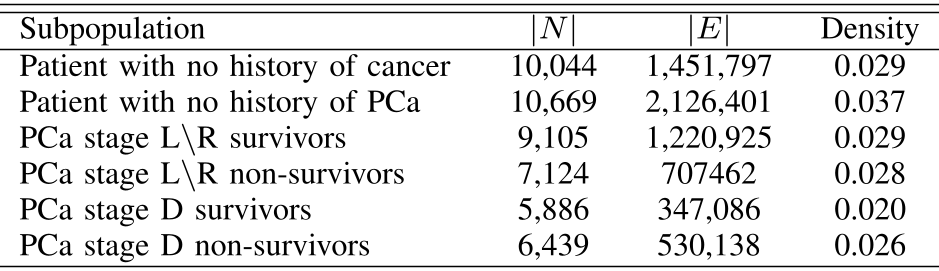 Table II: Network properties showing that while control groups have denser networks, the intensity of specific interactions is higher in PCa patients.
Key Insights from the Data
The "Survival" Signature
The researchers found that survivors at different stages share more similar complication patterns with each other than they do with non-survivors. This suggests that "survivorship" itself has a recognizable network fingerprint—possibly due to better management of systemic health or different treatment paths.
The Most Dissimilar Subgroups
A standout finding of the paper is the identification of "Most Dissimilar Subgroups" for Stage D (metastatic) patients.
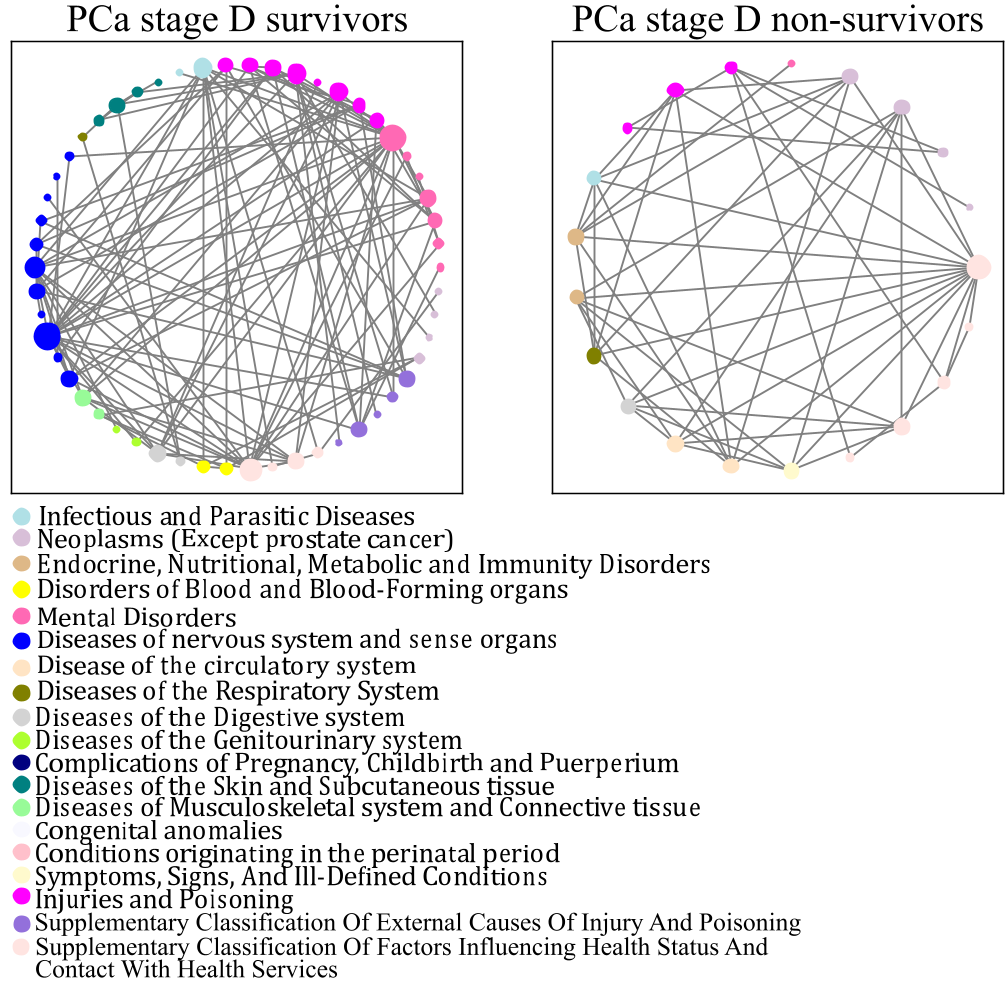 Fig 3: The networks of most dissimilar subgroups in PCa stage D survivors and non-survivors.
- Stage D Survivors: Showed strong clusters of blood/blood-forming organ disorders and genitourinary system diseases. Dementia with Lewy Bodies (LBD) emerged as a high-degree node, likely linked to long-term androgen deprivation therapy (ADT).
- Stage D Non-survivors: Featured clusters related to metabolic and endocrine disorders. Epistaxis (nosebleeds) was a key marker, often a clinical sign of progressed metastatic cancer.
Critical Analysis & Conclusion
Takeaway
This data-driven approach shifts the focus from "what" diseases a patient has to "how" those diseases are interconnected. By identifying stage-specific clusters, clinicians can move toward predictive comorbidity management—anticipating that a Stage D patient might be at risk for a specific cluster of metabolic failures before they become acute.
Limitations & Future Work
The study relies on Medicare claims, which can contain coding biases. Furthermore, the dataset is unbalanced (more survivors than non-survivors). The authors correctly point out that the next logical step—and the current frontier in this field—is the integration of Drug-Disease Networks to separate the effects of the cancer from the effects of the medication prescribed to treat it.
This research highlights that in the fight against cancer, understanding the "network" of the patient's overall health is just as critical as targeting the tumor itself.