
Distance Matters: How Geography Shapes Our Digital Emotions
Distance matters: an exploratory analysis of the linguistic features of Flickr photo tag metadata in relation to impression management
This research investigates the relationship between the geographic distance of a photo's location from the user's home and the linguistic features of its metadata. Using Flickr's geotagged dataset and LIWC analysis, the authors demonstrate that tagging behavior is a form of online impression management.
TL;DR
Why do we tag a photo of the Eiffel Tower differently if we live in Paris versus visiting from California? This paper reveals that as the distance from our home increases, our tags become less emotional and more informational. By analyzing over 22,000 Flickr photos, researchers found that "Photo Distance" is a key predictor of linguistic choice, serving as a primary signal for how we manage our online impressions to an "invisible audience."
The "Invisible Audience" and the Locality Effect
In the early 2010s, tagging was mostly seen as a way to help search engines. However, this paper argues that tags are actually a form of social communication.
The core insight is based on Impression Management:
- Near Home: Your friends and family (the "invisible audience") already know your context. You don't need to describe where you are; instead, you describe how you feel (e.g., "love," "joy").
- Far from Home: Your audience lacks context. You become a "reporter," using descriptive, relative words (e.g., "walk," "time," "space") to explain the novelty of the distant location.
Methodology: Mapping Linguistics to Coordinates
The researchers combined three distinct data streams to test their hypotheses:
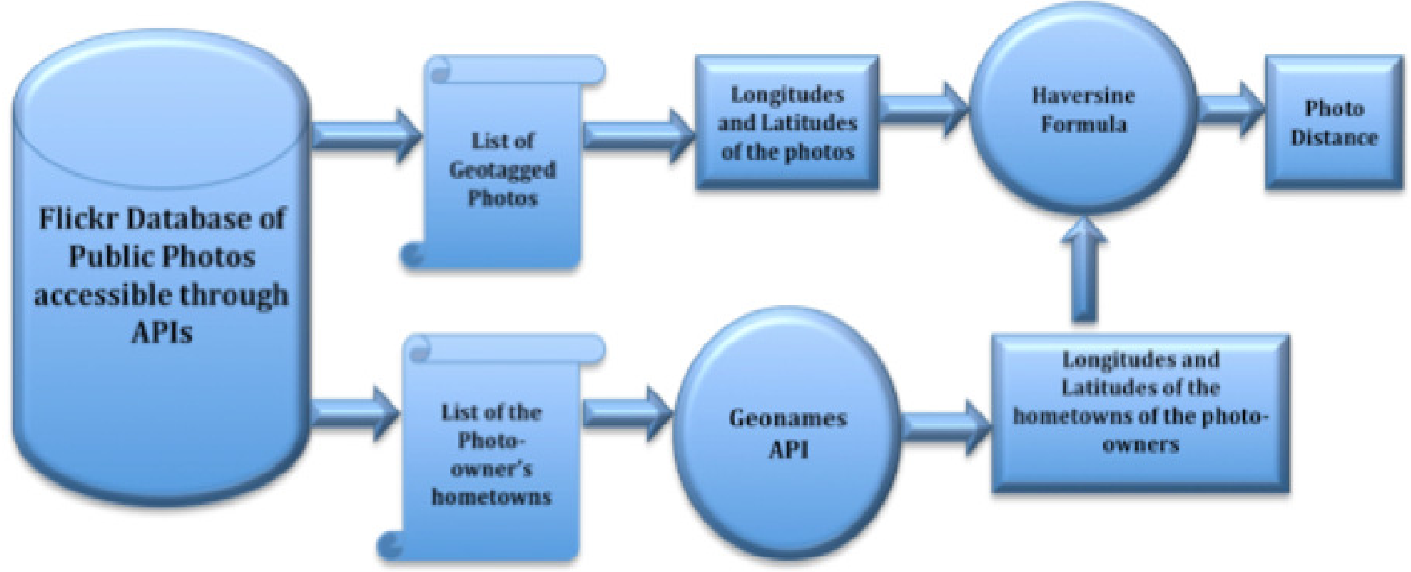
- Flickr API: To extract geotags (latitude/longitude) and user-generated text tags.
- Geonames API: To determine the user's "home" coordinates and calculate the Photo Distance (DP) using the Haversine formula.
- LIWC (Linguistic Inquiry and Word Count): To quantify the percentage of "Affective" (emotion-based) and "Relative" (space/time-based) words in metadata.
Core Findings: The Decay of Emotion
The study tested three main hypotheses using a multiple linear regression model:
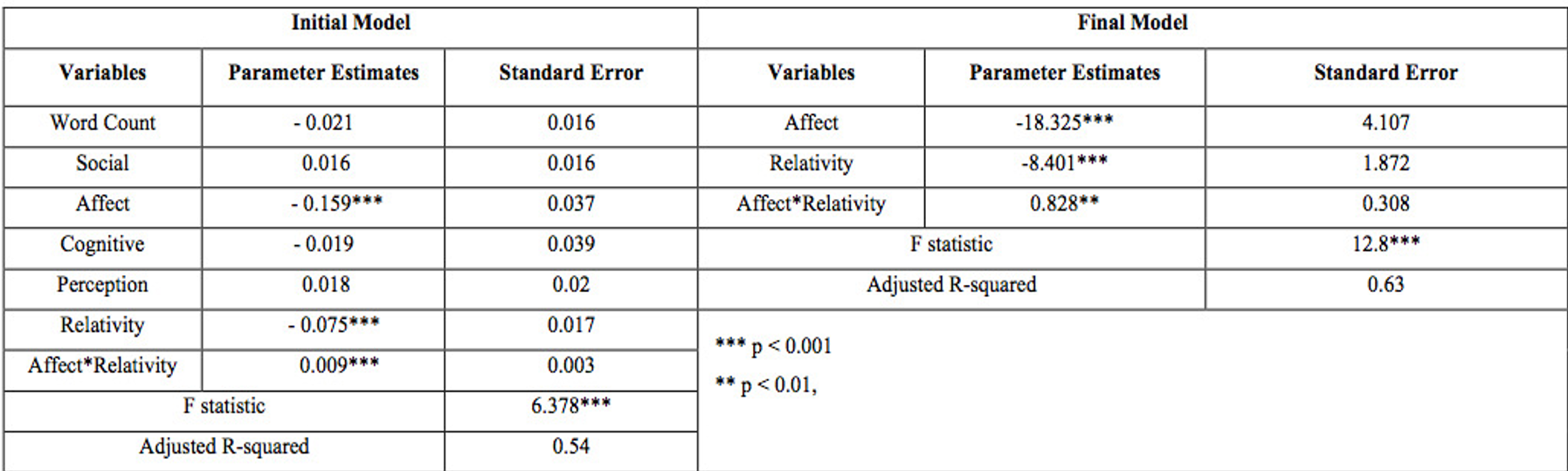
- H1 & H2 (Negative Correlation): As distance increases, the use of emotional (affect) and spatial (relative) words decreases. We become more "clinical" as we move away from our home turf.
- H3 (Interaction Effect): Interestingly, the interaction between affect and relativity increases with distance, suggesting a complex trade-off in how we balance emotion and information.
The Quantitative Result
The final regression model achieved an Adjusted R-squared of 0.63, indicating that distance, affect, and relativity explain a significant portion of the variance in tagging behavior.
Deep Insight: Why Does This Matter?
This work highlights that digital metadata is a proxy for human psychology. The "Locality Effect" suggests that the more familiar a setting is, the more internal (emotional) our descriptions become. Conversely, travel forces us into an external (informational) mode of communication.
Limitations & Looking Ahead
While the study provides a robust statistical foundation, it relies on the accuracy of self-reported home locations. Furthermore, the 2012 context focused on manual tags; in today's world of AI-generated captions and "stories," the way we manage impressions has shifted from static keywords to dynamic narratives. However, the fundamental truth remains: geographic distance dictates emotional proximity.
Conclusion
The paper successfully bridges the gap between spatial data and social psychology. It proves that a photo’s metadata contains a "linguistic fingerprint" of the user’s relationship with the location. For designers of social networks and recommendation engines, understanding this "Distance Matter" principle is crucial for personalizing content and understanding user intent.