
PCC: Decoding Social Influence Through Decentralized Spectral Analysis
A Distributed Algorithm for Identifying Information Hubs in Social Networks
This paper introduces Principal Component Centrality (PCC) and its generalized form for identifying top-k information hubs in social networks using only friendship graphs. By leveraging the Kempe-McSherry (KM) algorithm, the authors provide a fully distributed and privacy-preserving framework that outperforms traditional Eigenvector Centrality (EVC) by approximately 50% in accuracy.
TL;DR
Researchers have developed a distributed algorithm that identifies "Information Hubs" in social networks (like Facebook and Twitter) with 50% higher accuracy than standard methods. More importantly, it does so privately, without needing a central authority to see the entire network or track private user messages, by transforming the network's friendship structure into a multi-dimensional eigenspace.
Background: The Hidden Value of Hubs
In the digital economy, "Hubs" are the catalysts of information diffusion. Whether it's Samsung targeting dissatisfied iPhone users or public health agencies spreading vaccination awareness, identifying the top-k influential nodes is critical.
However, there's a catch: most current methods require Interaction Graphs (who talks to whom and when). This data is the "crown jewels" of social media giants and is rarely accessible to third-party advertisers or researchers due to strict privacy regulations and terms of service.
The Core Insight: Beyond the "Most Popular" Community
Historically, researchers used Eigenvector Centrality (EVC)—the idea that you are important if you are connected to other important people. Mathematically, EVC focuses on the principal eigenvector (the most dominant feature) of the network.
The Problem with EVC: In massive networks with disparate communities, the principal eigenvector usually gets "stuck" in the single largest community. If you are a king in a medium-sized community, EVC might ignore you because you aren't in the largest one.
The Solution: Principal Component Centrality (PCC): The authors suggest that instead of looking at just the 1st eigenvector, we should look at the top eigenvectors. This is akin to Principal Component Analysis (PCA) for graphs. By treating a node's position as a coordinate in a -dimensional space, PCC identifies hubs across multiple "poles" or communities simultaneously.
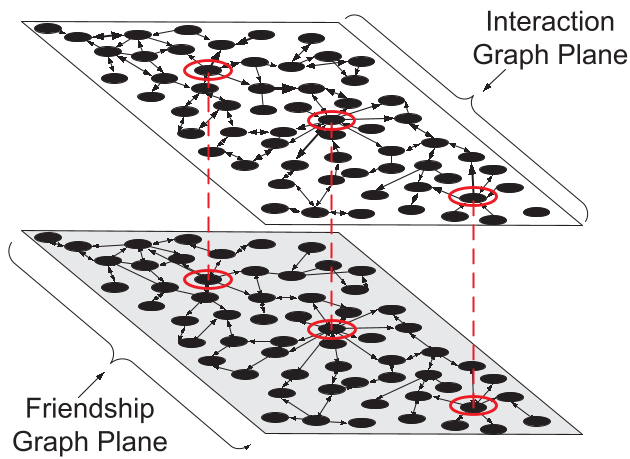 In the figure above, notice how PCC assigns significance to nodes across different clusters whereas traditional methods might focus only on the densest center.
Methodology: How to Compute Centrality Privately
The beauty of this research lies in its decentralized execution. The authors utilize the Kempe-McSherry (KM) algorithm, which allows each node (user) to calculate its own PCC score by only talking to its immediate friends.
- Local Iteration: Each user maintains a small vector representing their contribution to the top-P eigenvectors.
- Privacy-Preserving Exchange: Users exchange these raw numeric vectors with neighbors. These numbers are intermediate states and cannot be easily reverse-engineered to reveal the total network structure.
- Convergence: After several iterations, the scores converge to the global eigenvectors with high probability, as shown in the error analysis below.
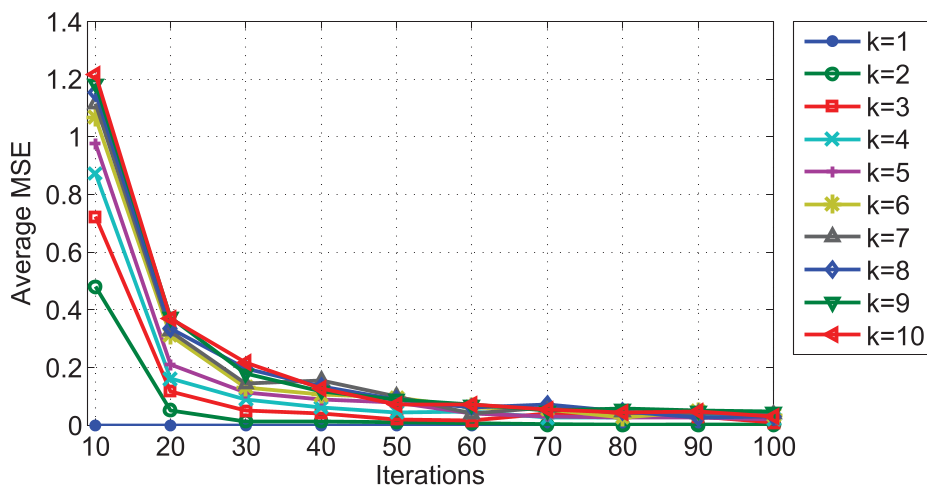 The Mean Squared Error (MSE) drops geometrically as iterations () increase, proving the algorithm is both efficient and accurate for massive scales.
Experimental Results: Proving the Theory
The team tested their algorithm on massive real-world datasets:
- Facebook: Over 6 million users and 40 million links.
- Twitter: 2 million users with directed "follower" relationships.
Key Findings:
- Higher Accuracy: PCC was roughly 50% more accurate than EVC in identifying the top-2000 hubs when compared against the "ground truth" (actual interaction logs).
- The "Long-Term" Effect: PCC predicts interaction much better over long spans (1 year) than short bursts (1 month), suggesting that the friendship graph dictates the "steady-state" flow of information.
- Optimal Dimensions: For social networks, setting the number of eigenvectors () to between 10 and 26 provided the best balance between computational cost and accuracy.
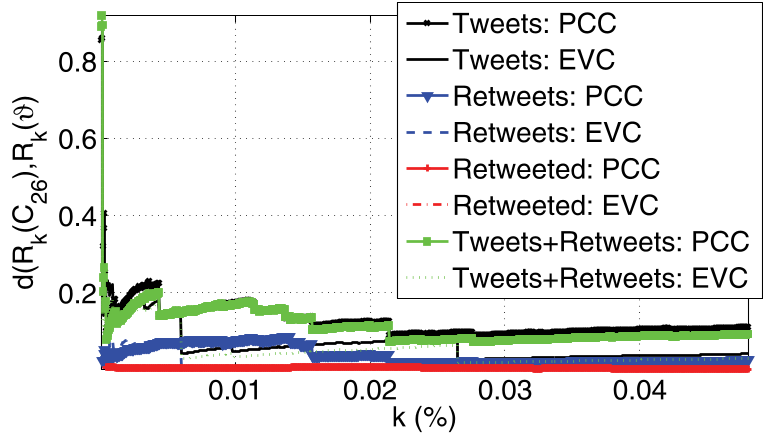 The chart demonstrates that as we increase the number of eigenvectors, the overlap with the actual top-k users (Intersection ) increases significantly.
Impact and Conclusion
This paper bridges the gap between theoretical graph spectral analysis and practical, privacy-conscious social computing. It proves that we don't need to spy on private interactions to know who the real influencers are; the architecture of our friendships already tells the story.
Limitations: The Twitter (directed graph) results were less dramatic than Facebook's, likely due to the shorter collection period (1 week) and the non-reciprocal nature of "following," suggesting that further tuning for directed Generalized PCC is a fertile ground for future research.