
ADRMonitor: Revolutionizing Drug Safety through Proactive Distributed Intelligence
12313_A distributed, collaborative intelligent agent system approach for proactive postmarketing drug safety surveillance.
The paper introduces ADRMonitor, a distributed multi-agent system designed for proactive postmarketing drug safety surveillance. It utilizes a fuzzy Recognition-Primed Decision (RPD) model to mimic human expert reasoning and proactively monitors electronic health records to detect Adverse Drug Reaction (ADR) signals significantly faster than current passive reporting systems.
TL;DR
Postmarketing drug surveillance is currently a "passive" game, relying on busy doctors to manually report side effects. This paper proposes ADRMonitor, a team-based intelligent agent system that uses a Fuzzy Recognition-Primed Decision (RPD) model to scan electronic patient records autonomously. The result? ADR detection rates up to 6.6 times higher than current standards and much faster identification of lethal drug risks.
The Problem: The Lethal Lags of Spontaneous Reporting
When a new drug hits the market, clinical trials have often only tested it on a few thousand people. Rare but deadly side effects (Adverse Drug Reactions or ADRs) often don't appear until millions use the drug.
The current gold standard—the FDA’s MedWatch—is tragically flawed:
- Gross Underreporting: Less than 10% of ADRs are ever reported.
- The "Passive" Trap: It depends entirely on a doctor’s memory, time, and willingness to fill out forms.
- Delayed Action: It can take 7+ years to identify a risk significant enough for a "Black Box" warning or market withdrawal.
The Insight: Proactive Agents & Naturalistic Decision Making
The authors argue that we shouldn't wait for reports. Instead, we should have "smart" software agents living inside hospital databases (EHRs).
To make these agents effective, they shouldn't just follow rigid "if-then" trees. They need to mimic how experts actually think. The authors utilize the Recognition-Primed Decision (RPD) model. Humans don't compare every possible option; they recognize patterns from experience and act. By combining this with Fuzzy Logic, the agents can handle the "vague" and "subjective" nature of medical data (e.g., determining if a reaction is "likely" or just "possible").
The Architecture of Collaboration
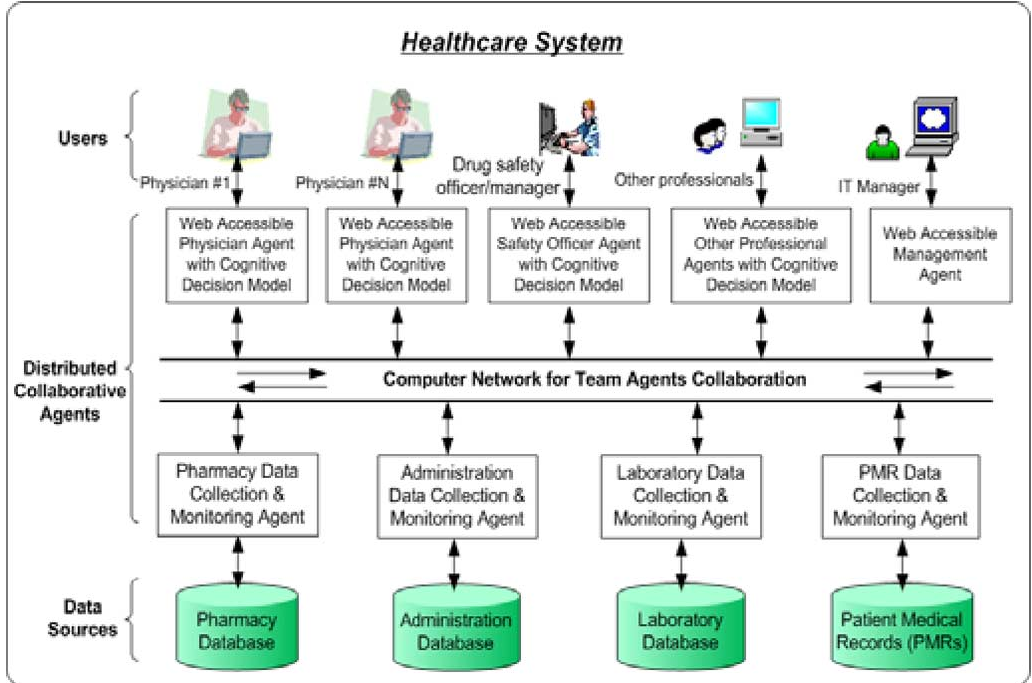
ADRMonitor isn't a single program; it's a distributed team.
- Local Level: Data collection agents monitor pharmacy, lab, and diagnosis codes.
- Professional Level: Physician agents evaluate signal pairs (Drug X + Reaction Y).
- National Level: FDA agents coordinate data from multiple hospital systems.
Methodology: Coding Intuition
The "secret sauce" is the Computational Fuzzy RPD Model. It breaks down medical "experience" into four components:
- Cues: Temporal associations, dechallenge (does it stop when the drug stops?), and rechallenge.
- Expectancies: What should happen next.
- Goals: The end state the agent is trying to confirm.
- Actions: Filing a report or alerting a safety officer.
By using Fuzzy Logic, the system maps these cues to degrees of causality (Very Likely, Probable, etc.), allowing the agent to "think" like a seasoned toxicologist.
Experimental Results: A 6.6x Leap
The team simulated 275,400 patient cases based on real data from Cisapride (a drug withdrawn in 2000 for causing cardiac issues).
Key Findings:
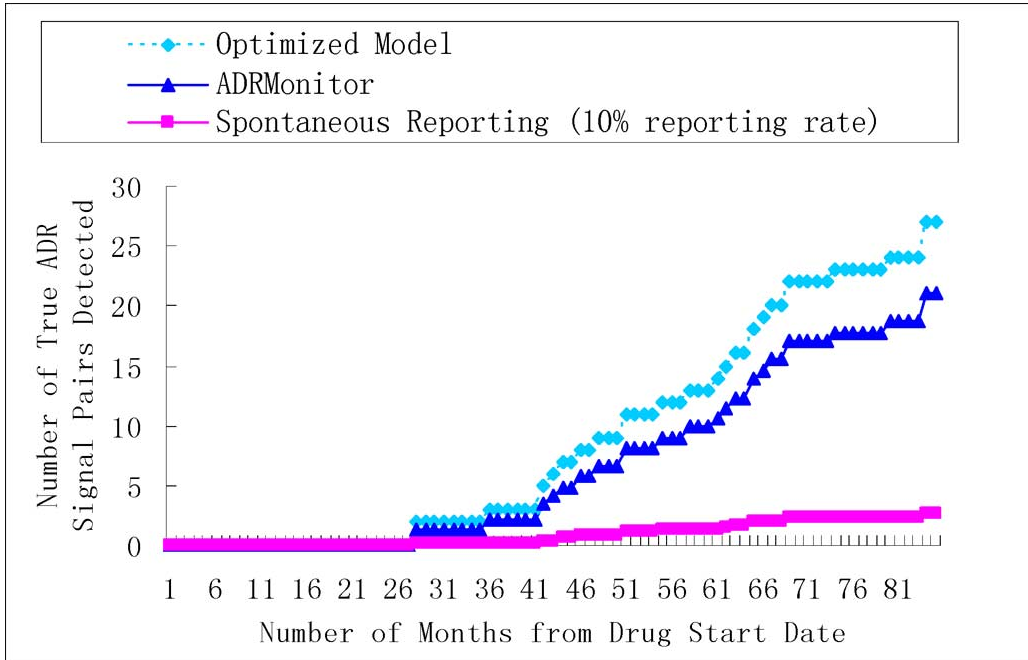
- Detection Rate: ADRMonitor achieved a 76.3% detection rate compared to just 10.7% for the spontaneous reporting strategy.
- Skill vs. Persistence: Even when agents were programmed with "moderate" skills (meaning they weren't as smart as top doctors), they still outperformed humans by 5x simply because they never forget to report.
- Network Effect: As more hospitals are connected, the time to reach a "statistical signal" drops drastically. If 70 hospital groups collaborate, a lethal drug can be identified 15 months earlier than with a smaller network.
Critical Insight & Future Outlook
This paper shifts the paradigm of pharmacovigilance from Data Mining (looking at aggregate reports) to Agent-Based Monitoring (looking at individual patient journeys).
The Takeaway: The genius of ADRMonitor isn't just in its AI "intelligence," but in its proactivity. In medical safety, an "okay" decision-maker that is 100% diligent is far superior to an "excellent" decision-maker who only reports 10% of what they see.
Limitations: The system relies on the quality of Electronic Health Records. If the data isn't digitized or is inaccurately coded, the agents are blinded. Furthermore, the "False Positive" rate of 42-61% (depending on skill level) suggests that while agents are great for signaling, human safety experts are still essential for the final verdict.
ADRMonitor represents a future where the software isn't just a tool, but a tireless member of the medical safety team.