
PHIDIAS: Scaling Educational Insight through Distributed Process Mining
Towards a distributed computation platform tailored for educational process discovery and analysis
The paper introduces PHIDIAS, a distributed computation platform designed for Educational Process Mining (EPM). By leveraging an SOA architecture and evaluating various clustering techniques—specifically identifying Sequence Clustering as the most effective—the authors provide a scalable solution for discovering and analyzing complex learning paths from massive educational event logs.
TL;DR
As education shifts toward personalized, non-linear curriculums, tracking student success requires more than just grade analysis—it requires Process Mining. This paper unveils PHIDIAS, a distributed platform designed to ingest massive educational logs, partition them using advanced clustering, and generate readable process models to guide educators and students alike.
Positioning: This work serves as a structural framework for scaling Process Mining from academic "toy" datasets to industrial-scale educational Big Data.
Problem & Motivation: The "Spaghetti Model" Trap
In modern e-learning, students choose their own paths, creating highly concurrent and variable data traces. Traditional Process Mining (PM) algorithms often fail in two ways:
- Computational Bottleneck: Algorithms like Alpha-miner or Heuristic-miner are often , making them stall on large logs.
- Conceptual Complexity: The resulting "Spaghetti Models" are so tangled they offer zero pedagogical value.
The authors argue that the only way forward is decomposition—breaking a big, messy log into small, clean clusters that can be analyzed in parallel.
Methodology: The PHIDIAS Architecture
The core of PHIDIAS is a Service-Oriented Architecture (SOA) built around an Enterprise Service Bus (ESB). This allows the system to remain "agnostic" to data sources (SQL, XML, CSV) while providing a unified bus for heavy-lift mining services.
The Clustering Engine
The paper conducts a critical comparative study of four clustering techniques:
- Trace Clustering: Distance-based, but often results in unreadable models.
- DWS (Disjunctive Workflow Schema): Fast but requires external miners to visualize results.
- Sequence Clustering: The "winner," using Markov Chains to focus on the sequential behavior of student actions.
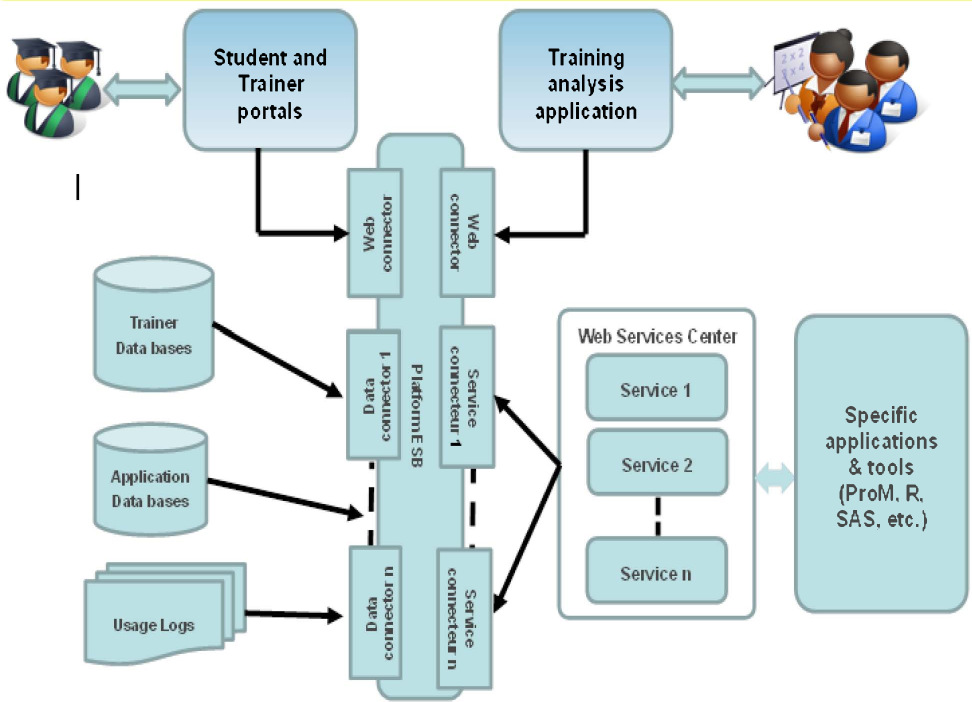 Fig 2: The PHIDIAS platform Architecture, showing the ESB core connecting diverse data sources to mining web services.
Experiments: Real-World Training Logs
The team tested their approach on Altran Institute data (2011-2013). By applying Sequence Clustering, they were able to isolate rare "noise" behaviors and generate clean, probabilistic models for different groups of learners.
Key Comparison
| Metric | Trace Clustering | Sequence Clustering | DWS |
|---|---|---|---|
| Process Model | User-defined (Manual) | Automatic (Markov) | External Only |
| Readability | Low/Complex | High/Simple | Complex |
| Max Log Size | ~1.9 MB | ~4.7 MB | ~1.9 MB |
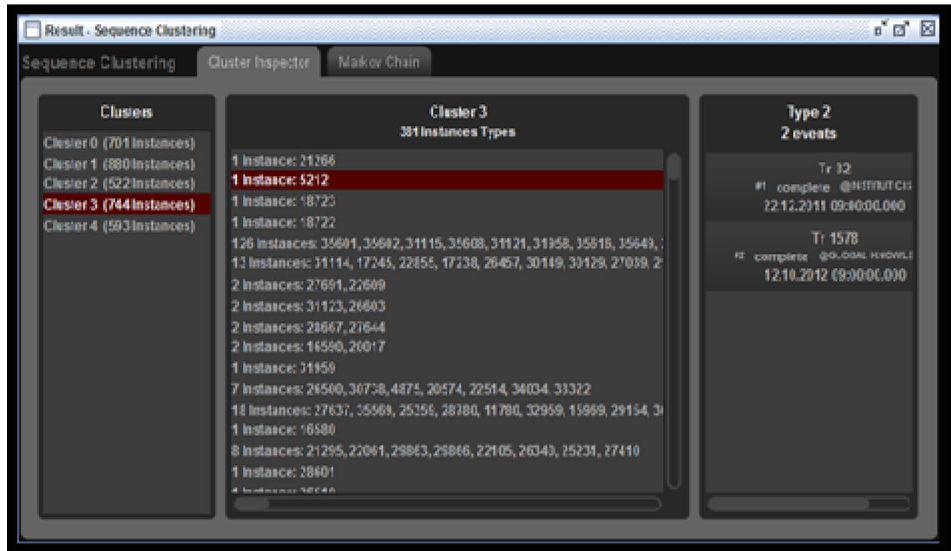 Fig 4: Inspection of five generated clusters. This visualization allows instructors to see frequent vs. atypical learning paths.
Deep Insight: Why Distributed Platforms Matter
The paper doesn't just stop at clustering; it proposes three ways to handle the "Heavy Lift":
- Multiprocessor: Using multithreading for localized speedups.
- Hadoop (MapReduce): Distributing log partitions across a cluster (HDFS), which the authors highlight as the most flexible for scaling.
- Instruction-level Distribution: A high-performance but less flexible approach for specific algorithms.
Critical Analysis & Conclusion
Takeaway
PHIDIAS bridges the gap between raw educational logs and "Decision Support." By choosing Sequence Clustering as the partitioning logic, the authors ensure that the resulting models (Markov Chains) are actually understandable by human educators.
Limitations
- Result Recombination: The paper notes that while partitioning is easy, "stitching" sub-models back together into a global view remains a challenge.
- User Expertise: Even with a platform, setting the right "thresholds" for Markov Chains requires technical knowledge that most teachers lack.
Future Outlook
The authors aim to integrate Semantic Annotations, allowing the system to cluster traces not just by "Event ID," but by the "Competency Level" or "Pedagogical Goal" those events represent. This moves Process Mining toward a more "Intelligent Educational Assistant" paradigm.