
ADMI: Bridging Siloed Healthcare Data with Intelligent Agent Federations
Distributed data mining from heterogeneous healthcare data repositories: towards an intelligent agent-based framework
The paper proposes the Agent-based Data Mining Info-structure (ADMI), a multi-agent framework designed for knowledge discovery within distributed and heterogeneous healthcare environments. It leverages autonomous, reactive, and proactive intelligent agents to automate data access, algorithm selection, and result visualization for clinical decision support.
TL;DR
Unlocking insights from fragmented hospital databases has long been a logistical nightmare. This paper introduces the Agent-based Data Mining Info-structure (ADMI), a framework that uses a "team" of intelligent software agents to autonomously navigate heterogeneous data repositories, perform complex mining, and deliver ready-to-use strategic reports to healthcare administrators.
Background & Positioning
In the landscape of Health Informatics, we have moved past the era of simply having "too much data." The modern challenge is distribution and heterogeneity. Data is scattered across different hospitals, formats, and networks. ADMI positions itself not merely as a new algorithm, but as a distributed meta-architecture that orchestrates existing Data Mining (DM) tools through the lens of Agent Technology.
The Problem: The "Silo" Constraint
Current healthcare data mining efforts often suffer from:
- Manual Overhead: The process of selecting data, cleaning it, and picking the right algorithm is labor-intensive.
- Lack of Holistic View: Mining happens in local pockets, missing the regional or national patterns critical for epidemic tracking.
- User Gap: Raw DM results are often too technical for a hospital manager who needs a strategy, not a coefficient.
Methodology: The Four Pillars of ADMI
The core innovation lies in the Agent Federation, where independent agents collaborate to transform a high-level user query into a structured service.
1. Interface Agent (IA)
The IA acts as the "translator." It takes a manager's goal (e.g., "Forecast the antibiotic sensitivity of this epidemic") and breaks it into technical tasks using Meta-pattern guided mining.
2. Data Collection Agent (DCA)
The DCA handles the "dirty work" of remote access. It negotiates protocols (SMTP, TCP/IP) and synthesizes data from multiple hospitals, ensuring the Data Mining Agent receives a unified dataset.
3. Data Mining Agent (DMA)
The DMA is the brain of the operation. It classifies the task (e.g., Prediction vs. Clustering) and selects the optimal script from its library to process the data retrieved by the DCA.
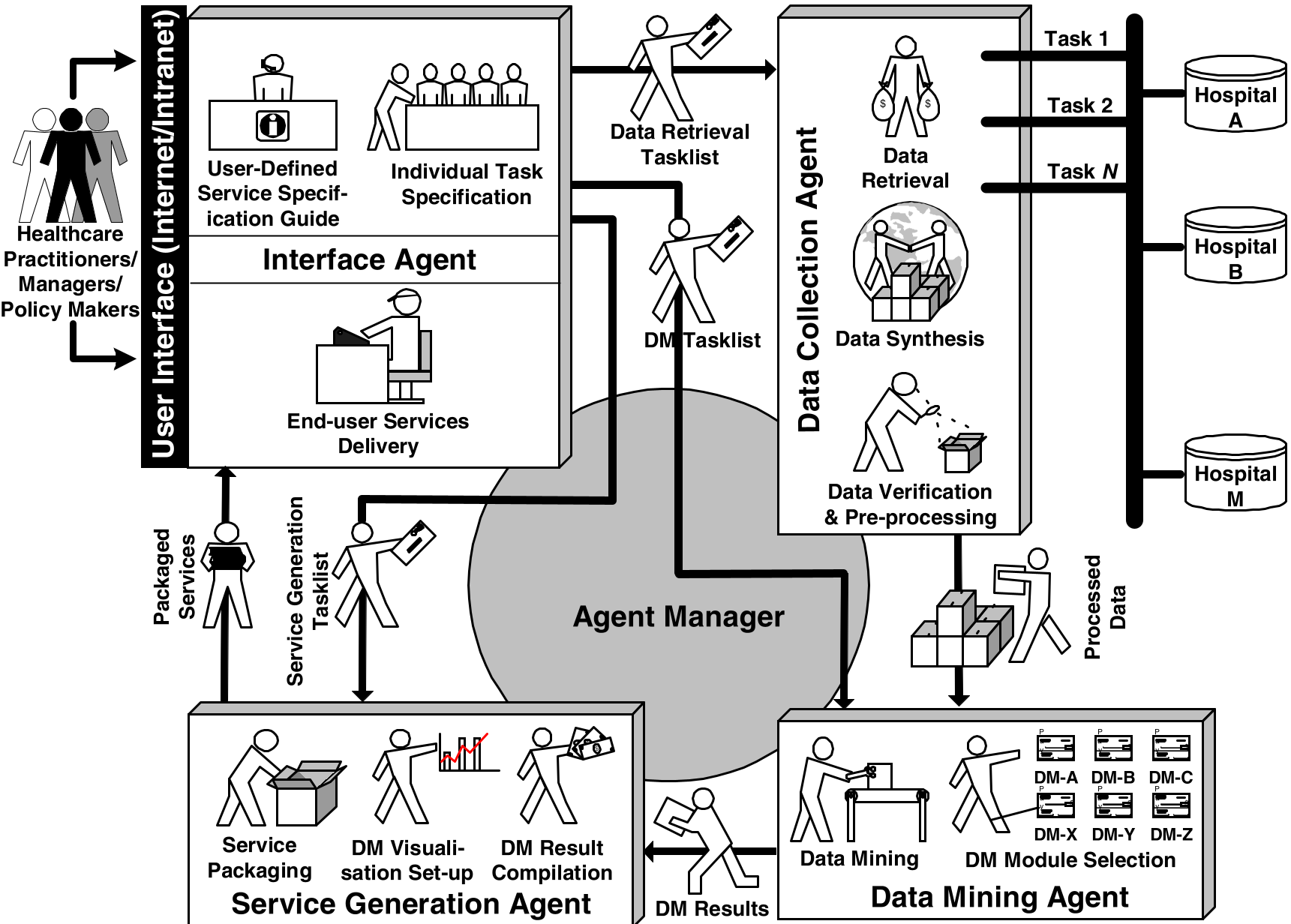 Figure 1: The ADMI architecture showing the interaction between the Interface, Data Collection, and Mining agents under a meta-agent manager.
4. Services Generation Agent (SGA)
The SGA focuses on User Experience. It doesn't just output numbers; it packages findings into visualization algorithms, providing "turn-key" decision-support services such as trend analysis or cost-effectiveness reports.
Deep Insight: Why Agents?
The authors argue that agents are the perfect fit for healthcare because they are:
- Autonomous: They operate without constant human intervention.
- Reactive: They respond to changes in the network or data availability.
- Proactive: They don't just wait for queries; they can be designed to monitor for emerging patterns (like a new disease outbreak).
Experiments & Future Services
The paper outlines several high-value "Service Packages" that the prototype ADMI is designed to deliver:
- Epidemic Forecasting: Analyzing geographical spread and antibiotic sensitivity.
- Strategic Planning: Analyzing cost-effectiveness and ambulatory care needs.
- Trend Analysis: Predicting hospital admission spikes to optimize staffing.
Critical Analysis & Conclusion
While ADMI provides a robust blueprint for distributed mining, its success in 2026 and beyond depends heavily on standardization (like FHIR) and privacy-preserving techniques (like Federated Learning), which are the logical successors to the "Data Collection Agent" concept.
Takeaway: ADMI represents a shift from "Data Mining as a tool" to "Data Mining as a Service." By abstracting the complexity of heterogeneous databases through an agent-based info-structure, it allows healthcare professionals to focus on the insights rather than the infrastructure.