
Multi-Agent referral: Redefining Trust in Social Service Discovery
A Distributed Decision Making and Propagation Approach for Trust-Based Service Discovery in Social Networks
This paper introduces a distributed, agent-based service discovery framework for Multi-Relation Social Networks (MRSN) using a referral system. It calculates a dual-dimensional trust measure—combining sociability and expertise—to identify trustworthy service providers without a centralized authority.
TL;DR
In the sprawling landscape of social networks, finding a reliable service—ranging from babysitting to technical consulting—is often more about who you know than just the service's price. This paper presents a decentralized approach where autonomous agents act as intermediaries, using a sophisticated "Global Trust" metric (Sociability + Expertise) to discover providers through a multi-relational social graph.
Background: The Limits of Functional Search
Traditional Service-Oriented Architecture (SOA) typically relies on "Yellow Pages" style registries. However, in a social network, we don't just want any service; we want one recommended by a trusted circle. Prior works often treated trust as a single dimension or required a central node to aggregate all network data—a requirement that contradicts the inherently distributed nature of modern social platforms.
The Logic of Professional Intuition: Why Sociability Matters
The authors argue that a provider’s value isn't just in their "Expertise" (can they do the job?) but also their "Sociability" (how do they fit into our social fabric?).
- Expertise is historical: Did it work before? Was it reliable?
- Sociability is topological: Are they well-positioned in the network? Do we share mutual acquaintances?
By combining these, the requester agent can bypass "strangers" and navigate the network through a chain of referrals.
Methodology: Decoupling Trust into Math
The core of the approach lies in the Global Trust formula, which balances two distinct vectors:
1. The Sociability Vector (ST)
This isn't a single number but a composition of:
- Social Position (SPo): Calculated via centrality degrees across different relationship types (e.g., family vs. colleague).
- Social Proximity (SPr): The "cost" of the path between agents.
- Neighborhood Similarity (NS): A Jaccard distance-based metric to see how many "mutuals" two agents share.
2. The Expertise Vector (ET)
This measures performance through Usability (success rate), Reliability (uptime), and Evaluation Rate (user ratings).
3. Distributed Propagation
The discovery isn't performed by a central crawler. Instead, an agent receives a query, checks its Personal Interaction Table (PIT), and autonomously decides whether to "refer" the query further down the graph.
 Figure: The Global Trust weighted sum formula combining ST and ET.
Experimental Evidence
The authors simulated their approach using the JADE (Java Agent DEvelopment) framework on graphs ranging from 500 to 10,000 agents.
The Power of the Chain
A fascinating finding is the "Provider-Recommender Chain Length." The researchers found that once the chain length exceeds 7, the discovery of new trustworthy providers plateaus. This effectively confirms the "Six Degrees of Separation" theory in a service discovery context.
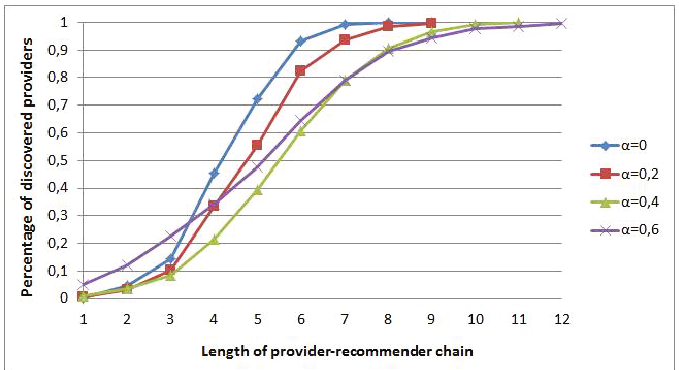 Figure 1(a): Impact of chain length on provider discovery. Reaching out up to 6 steps strikes the best balance between cost and results.
The Trust Threshold Trade-off
As the trust threshold () increases, the number of discovered providers drops sharply. This highlights a reality in social search: if you demand 100% trust, your options become extremely limited. Setting seems to be the "sweet spot" for balancing quality and quantity.
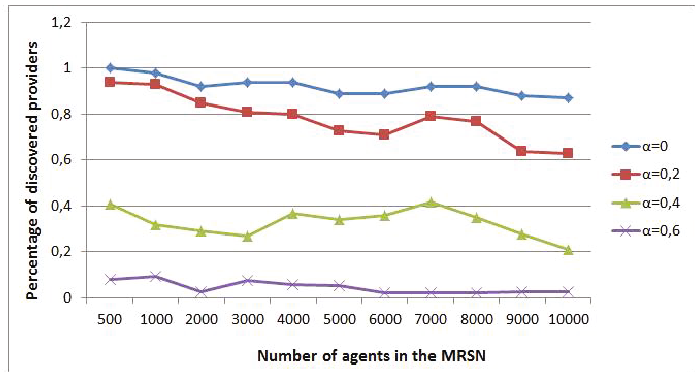 Figure 1(b): Higher trust requirements lead to a more selective, smaller set of candidates.
Critical Analysis & Future Outlook
Takeaway: This work effectively moves service discovery from a "cold" database query to a "warm" social referral process. By quantifying "sociability," it mirrors how humans actually make decisions in the real world.
Limitations:
- Cold Start: New agents with no history or few connections will struggle to be discovered, regardless of their actual expertise.
- Dynamic Topology: The paper assumes a relatively static graph during the discovery phase; real social networks are far more fluid.
Future Work: The authors hint at "Service Composition"—where discovered agents form coalitions to solve complex tasks. This could lead to a "Socially-Aware Automated Economy" where agents assemble teams on the fly based on established social trust.