
Distributed Learning via Social Sampling: Achieving Global Consensus with Minimal Talk
9664_Distributed Learning of Distributions via Social Sampling.
The paper proposes a message-passing protocol for the distributed estimation of discrete distributions in networks. Using "social sampling," where agents exchange randomized, quantized samples of their local beliefs, the authors prove that local estimates can converge almost surely to the global empirical distribution using stochastic approximation techniques.
TL;DR
How do you teach everyone in a network the "big picture" (a global histogram) if they can only share one opinion at a time? This paper introduces Social Sampling, a protocol where agents exchange randomized, quantized messages to estimate a global discrete distribution. By combining these samples with a stochastic approximation update rule, the authors prove that every node will eventually learn the exact global distribution almost surely, moving beyond simple scalar consensus to complex belief aggregation.
Problem & Motivation: The Overhead of "Complete Beliefs"
In classic distributed consensus (like DeGroot’s model), agents reach agreement by averaging. If agents want to learn a distribution (e.g., "What is the voting preference of the whole network?"), the naive approach is to have every node send their entire histogram to their neighbors.
The Pain Point: If there are 1,000 possible categories (), sending the whole vector is incredibly expensive. In real social networks, we don't exchange our entire belief system in every interaction; we share a single story, a single vote, or a single opinion. The authors ask: Can we reach global consensus on the whole distribution using only these single, randomized samples?
Methodology: The Social Sampling Protocol
The core innovation lies in the quantized message-passing model. Instead of sending a vector , node sends a single sample drawn from its current estimate.
1. The Interaction Model
Nodes maintain an internal estimate . At each step:
- Sampling: Node picks a category with probability proportional to its internal estimate.
- Communication: It broadcasts this single category (a unit vector ) to neighbors.
- Updating: Neighbors update their histograms using a weighted average of their current belief and the incoming social samples.
2. The Math of Convergence
The authors frame this as a Stochastic Approximation problem. The update rule is structured as:
- : The average network connectivity (the "Laplacian" effect driving consensus).
- : The martingale difference (the "noise" created by random sampling).
- : A correction term to handle the quantization bias.
By using a decaying step size (satisfying ) and a censoring mechanism (nodes don't talk about categories they have very little data on), the "noise" is eventually averaged out, leading the system to the true global mean.

Experiments & Results: Topology vs. Distribution Shape
The authors tested the protocol across various topologies (Grid, Star, Erdos-Renyi, Watts-Strogatz).
Key Findings:
- Topology Matters: Small-world networks (Watts-Strogatz) and preferential attachment graphs converge much faster than grids or stars because their "mixing time" is lower.
- Distribution Shape is King: Surprisingly, the number of categories () isn't the biggest bottleneck. If the global distribution is highly skewed (concentrated on a few popular items), the network reaches an accurate estimate of those popular items very quickly, even if is large. Convergence is slowest when the distribution is uniform.
- The 1/t Rate: The Mean Squared Error (MSE) decays at a rate of , which is standard for stochastic approximation but impressive given the minimal communication overhead.
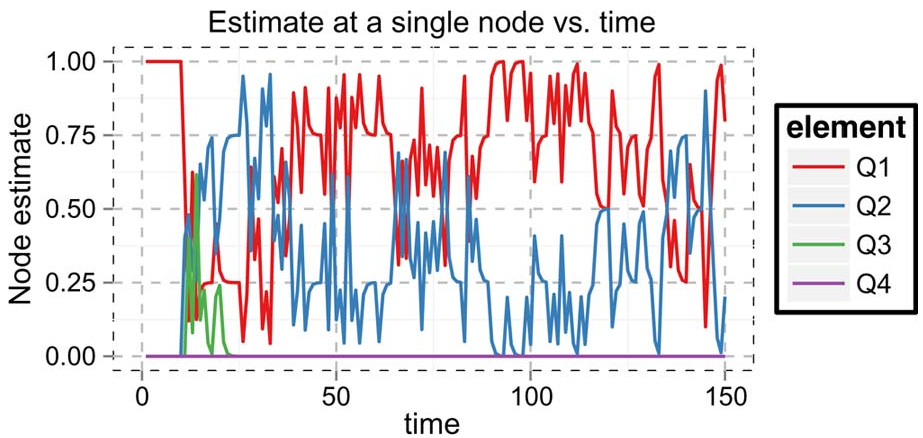 Above: Simulation showing the convergence of node estimates to the true distribution values over time.
Critical Insight & Conclusion
This work elegantly bridges social science intuition with rigorous signal processing. It proves that randomness is a feature, not a bug—by intentionally injecting sampling noise and controlling it through stochastic approximation, we can achieve massive communication savings.
Takeaway for Engineers: If you are designing a decentralized system (like a sensor network or a P2P ledger) that needs to track a global state, you don't need to sync the whole state every time. Randomized "social" sampling of parts of the state is mathematically sufficient to reach a global truth.
Limitations: The current model assumes an undirected, static graph. In highly dynamic social networks where nodes join and leave, maintaining the "mean-preserving" property would be significantly harder.