
Distributed Learning via Social Sampling: Convergence through Quantized Randomness
12417_Distributed Learning of Distributions via Social Sampling.
This paper introduces "Social Sampling," a message-passing protocol for distributed estimation of discrete probability distributions. By exchanging quantized messages sampled from local estimates, nodes achieve network-wide consensus on the empirical global distribution using stochastic approximation techniques.
TL;DR
How do you learn a global distribution across a network without sending massive histograms back and forth? This paper proposes Social Sampling, a protocol where agents exchange single, randomly selected opinions. By treating the resulting sampling noise as a stochastic approximation problem, the authors prove that nodes can converge to the exact global empirical distribution with minimal communication overhead.
Background & Motivation: The Cost of Consensus
In classical distributed inference, if agents want to know the distribution of their initial opinions over possible categories, they usually perform Average Consensus. This requires every node to send an -dimensional vector to its neighbors at every time step. As (the number of bins) grows—think of a large-scale voting system or a vast sensor array—this becomes a communication bottleneck.
The authors identify a fundamental tension:
- Full Exchange: Accurate but expensive.
- Quantized Exchange: Efficient but usually leads to "consensus error" or converges to a single "winning" opinion (atomic distribution) rather than the full spectrum of beliefs.
The "Social Sampling" insight is brilliant: Why not use the randomness of human-like social interaction—sharing one opinion at a time—and use the math of Stochastic Approximation to filter out the noise over time?
Methodology: The Mechanics of Social Sampling
The core of the algorithm is a linear update rule. Each node maintains an estimate . Instead of sending , it sends a message , which is an elementary vector sampled according to the distribution .
The Universal Update Rule
The update sequence follows a standard stochastic iteration form:
Where:
- : The step size. If , the system remains noisy. If (e.g., ), the system "cools down" and converges.
- : A correction/perturbation term.
- : A martingale difference representing the sampling noise.
The Three Regimes of Behavior
The paper identifies three distinct outcomes based on how the parameters are tuned:
- Atomic Consensus: If is constant, nodes eventually collapse onto a single identity (one bin takes all).
- Rough Consensus: With decaying steps but no censoring, nodes agree on a distribution, but it might not be the correct one.
- True Distribution Learning: By using "Censoring" (refusing to sample from bins with very low probability) and specific mass-exchange policies, the agents converge almost surely to the true global histogram .
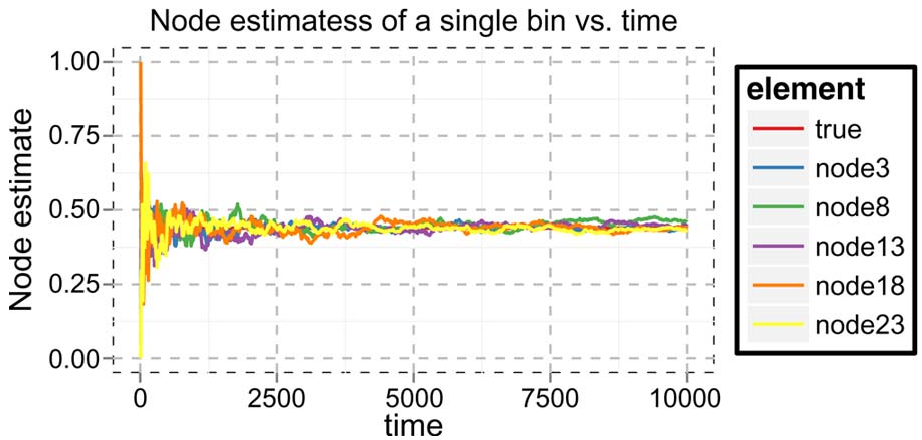 Fig 1: A trace showing how estimates converge to a random singleton when the step size is not decayed (Atomic Consensus).
Experimental Insights: Topology Matters
The authors tested the protocol on various graphs: Grids, Stars, Erdős-Rényi, and Watts-Strogatz (Small-World).
Key Findings:
- Convergence Rate: The expected squared error decays at , emphasizing that the choice of step-size schedule is more critical than the specific network graph for ultimate convergence.
- Topology Sensitivity: While all settled on the truth, "Small-World" and "Preferential Attachment" graphs converged significantly faster due to their smaller diameters and better expansion properties.
- Sparsity Advantage: Interestingly, the "shape" of the distribution matters more than the number of bins. If the distribution is sparse (heavy-tailed), the algorithm ignores the "empty" bins quickly, maintaining efficiency.
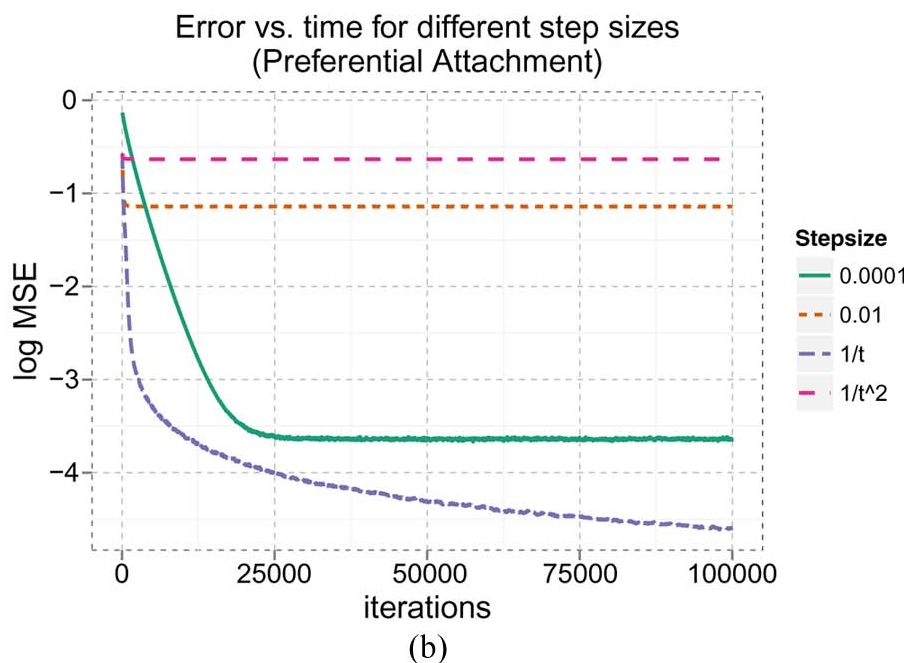 Fig 2: MSE convergence across different network topologies. Note the rapid descent in Watts-Strogatz graphs compared to Grids.
Critical Analysis & Conclusion
This work provides a rigorous theoretical bridge between Opinion Dynamics (how people change their minds) and Distributed Estimation (how machines compute averages).
Strengths:
- Communication Efficiency: It reduces the per-step bandwidth from to .
- Theoretical Rigor: Utilizing Kushner & Yin’s stochastic approximation theorems provides high confidence in the "almost sure" convergence.
Limitations & Future Work:
- Synchronicity: The current model assumes a degree of synchrony in updates. Extending this to fully asynchronous "gossip" settings with heterogeneous delays is the next logical step.
- Non-Stationarity: The paper assumes the initial distribution is static. In real social networks, the "ground truth" often shifts as the network evolves.
Takeaway: Social Sampling demonstrates that we don't need to be perfectly "loud" (sending full data) to be "accurate." By embracing the noise of random samples, we can achieve global consensus with a whisper.