
DMJSM: Optimizing Social Media Data Mining through Distributed Multi-Tasking Scheduling
A distributed multi-tasking job scheduling mechanism for web crawlers
The paper introduces DMJSM, a distributed multi-tasking job scheduling mechanism for web crawlers designed specifically for social networking sites. By utilizing a dynamic distributed architecture and hierarchy-based scheduling, it achieves stable data collection while bypassing website blocking mechanisms.
TL;DR
Social networking sites are notoriously difficult to crawl due to their complex hierarchies and aggressive anti-scraping mechanisms. This paper presents DMJSM (Distributed Multi-tasking Job Scheduling Mechanism), a system that significantly reduces crawler idle time and bypasses IP blocks. By replacing static centralized scheduling with a dynamic, multi-module cycle, the system achieved a 14.4% performance boost over Apache Nutch and attained a 98.3% precision rate in data retrieval.
Problem & Motivation: The "Idle Crawler" Bottleneck
Prior distributed crawler architectures followed a centralized model where a master node assigned large batches of URLs to worker nodes. However, social media sites present two specific challenges:
- Strict Blocking: High-frequency requests from a single IP or to a specific page level trigger anti-scraping defenses.
- Variable Page Depth: Some threads have thousands of comments (high depth), while others have none (low depth). In a centralized model, crawlers handling deep pages continue working while others finish early and sit idle, dragging down the overall throughput.
The authors recognized that to maximize efficiency, the system must be able to "context-switch" jobs and re-balance the load the moment a crawler discovers a new sub-link or encounters a block.
Methodology: The Distributed Cycle Architecture
The core innovation lies in the interaction between the Job Pool Module (JPM) and the Web Crawler Service (WCS). Unlike traditional crawlers that finish a page before asking for more work, DMJSM uses a "Depth-First Search" logic integrated with immediate feedback.
The Workflow
- WCS Action: A crawler fetches a URL. As soon as it finds a sub-link (e.g., a "Next Page" or "Comment" link), it doesn't just store it; it returns it to the JPM immediately.
- Dynamic Scheduling: The JPM assesses the workload and the "Blocking Time" of target sites. It then schedules that sub-link as a new, independent task to an available crawler.
- Redundancy (CCM): The Control Center Module monitors "Miss" statuses. If a crawler goes offline due to a crash or a hard block, the CCM triggers a backup mechanism to ensure the task is re-assigned instantly.
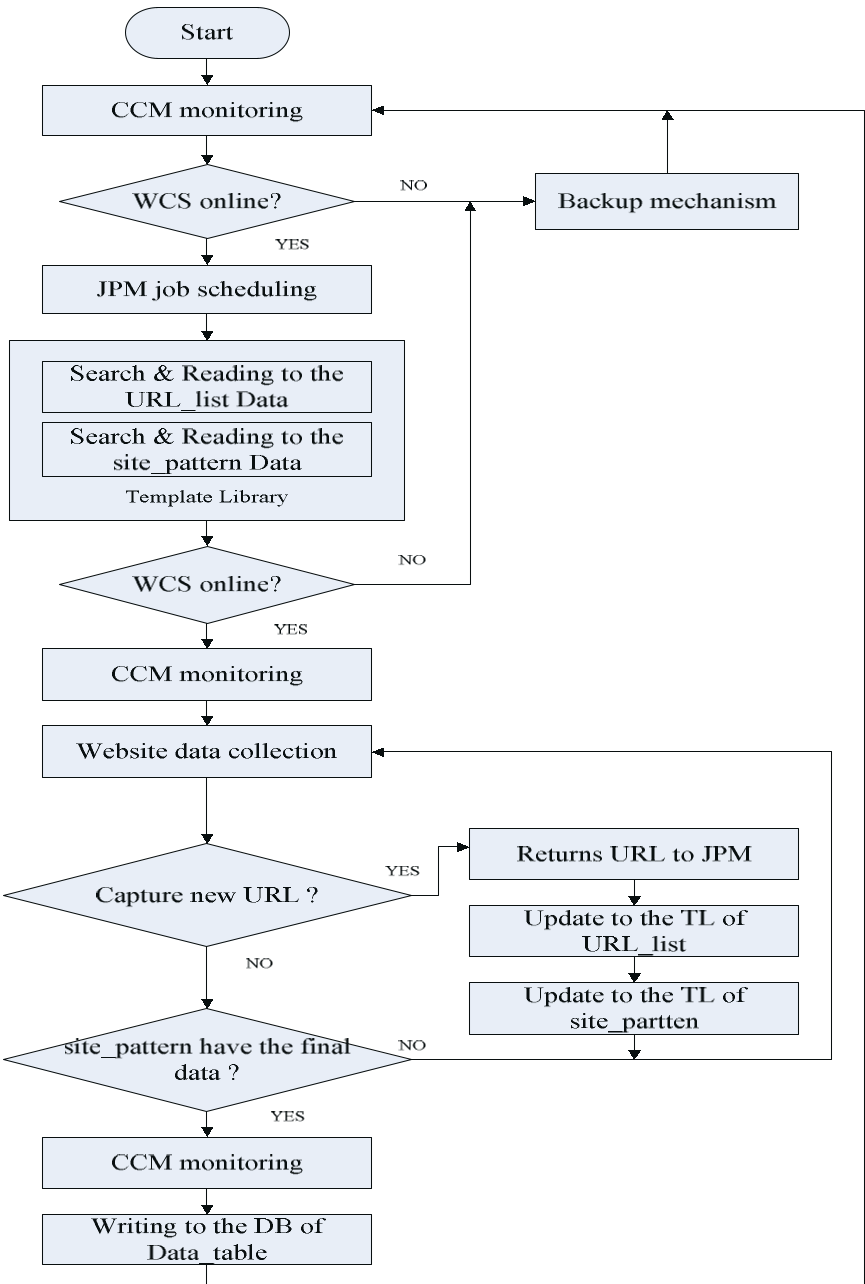 Figure 1: The system workflow highlighting the loop between WCS and JPM.
Template-Based Parsing
To speed up extraction, the system uses a Template Library (TL). Instead of analyzing the DOM on the fly, crawlers use pre-defined patterns (Site_Pattern) to "snipe" the exact data paths (CSS selectors for posts, authors, and comments), as seen in the table below:
 Table 1: Example of site-specific data paths for precision scraping.
Experiments & Results: Real-world Stress Test
The system was deployed on Amazon Cloud and tested against Nutch, a standard in the industry. Over a one-month period on four major platforms (Facebook, PTT, Forums, and News), DMJSM collected over 26.6 million items.
- Performance: DMJSM averaged 10.3 items per second, compared to 9 items per second for Nutch.
- Reliability: Manual verification of a 30-minute window showed that the system missed very few items, mostly due to moderators deleting posts in real-time or new posts appearing during the verification process itself.
 Table 2: Precision and Recall metrics across different social media types.
Critical Analysis & Conclusion
The DMJSM architecture proves that granularity of tasking is the key to distributed crawling. By breaking a single crawling session into multiple "micro-tasks" scheduled across a pool, the system avoids the "long tail" problem where a few heavy tasks keep the entire cluster waiting.
Takeaway: For developers building social intelligence platforms, the lesson is clear: don't build "crawlers"; build a "central nervous system" that can treat every single hyperlink as a dispatchable unit of work.
Limitations: While the paper addresses IP blocking through scheduling, it does not detail how it handles modern "JavaScript-heavy" rendered content (like React-based infinite scrolls), which often requires browser instrumentation rather than simple HTTP requests. Future work could focus on integrating these scheduling logic with headless browser farms.