
Breaking the Congestion: How Multistage Social Multicast Accelerates Content Sharing
8866_Distributed Multistage Cooperative-Social-Multicast-Aided Content Dissemination in Random Mobile Networks.
This paper proposes a distributed multistage cooperative-social-multicast protocol for content dissemination in random mobile networks. It leverages geographic social relationships to offload traffic from centralized infrastructure to ad hoc networks, achieving total content delivery to all users in as few as two transmission frames in high-density scenarios.
TL;DR
Mobile traffic in crowded venues often chokes centralized base stations. This paper introduces a Multistage Cooperative-Social-Multicast protocol that treats every mobile user as a potential relay. By mathematically modeling social ties alongside wireless physics, the authors prove that even with strict "social constraints," a network can reach total consensus—meaning every user gets the content—in just two frames if the crowd is dense enough.
The Motivation: Why Centralized Systems Fail in Crowds
Imagine a football stadium with 50,000 fans trying to download a replay at once. Centralized Infrastructure (CI) collapses under this load. However, fans often have common interests and sit near their friends. The researchers noticed a gap: most ad hoc protocols assume everyone broadcasts to everyone (Indiscriminate Broadcasting), ignoring that real people only share data with their social contacts.
The challenge was to answer: Can we achieve rapid content dissemination if users only communicate with their "social circles"?
Methodology: Marrying Sociology with Wireless Physics
1. The Social Wireless Link
The authors define the probability of a connection () through Geographic Social Strength.
- Regular Contacts: If you are within range , you are a 100% social contact.
- Opportunistic Contacts: Beyond , the probability drops following a power law (where is the social exponent).
The "Social Unicast Throughput" () is the product of this social probability and the physical success probability (), which accounts for path loss and Rayleigh fading.
2. The Pure-Birth Markov Chain
To solve the "How long will it take?" question, the process is modeled as a Discrete-Time Pure-Birth-Based Markov Chain (DT-PBMC).
- States: The number of "Content Owners" (COs).
- Transitions: As more users (Content Seekers) receive data, they "give birth" to new COs, expanding the multicast group in the next frame.
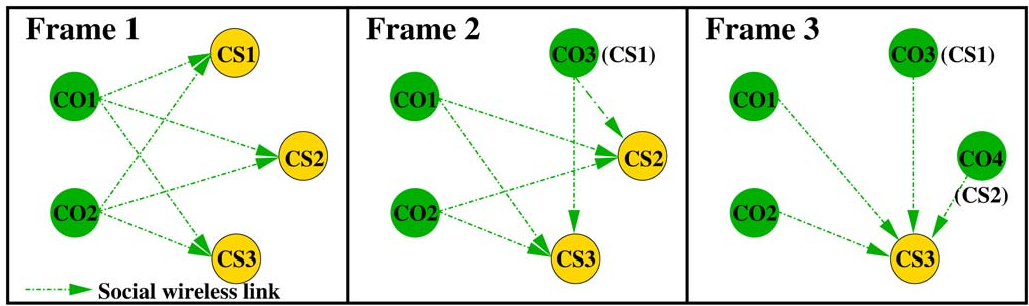 Figure: The Multistage Cooperative Social Multicast Protocol in action across three frames.
Performance: The "Power of Two"
The most striking finding from the experiments is the Convergence Property.
- SOTA Comparison: The proposed protocol leaves "Gossip-based Unicast" and "Non-cooperative Multicast" in the dust. While other protocols see delays increase linearly with the number of users, this protocol's delay actually decreases and then stabilizes as the network gets denser.
- The Two-Frame Limit: For a high number of MSs (e.g., ), the delay converges to roughly 2 frames. This happens because as the number of COs grows, the "diversity gain" becomes so massive that it overcomes the limitations of any single weak social tie or fading channel.
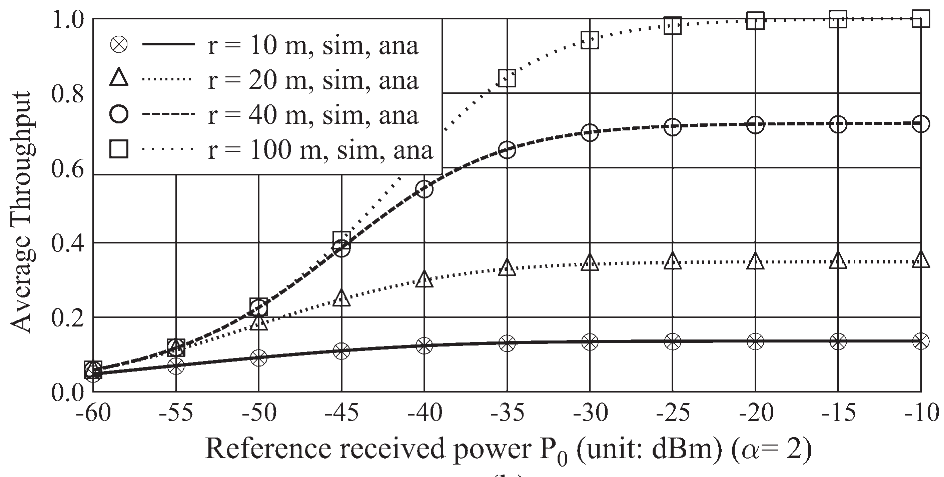 Figure: Average dissemination delay converging to 2 frames as the number of MSs increases.
Critical Analysis & Takeaways
This work is a masterclass in using Markovian analysis to solve networking problems. By deriving closed-form expressions for delay, it removes the "black box" of simulation-only studies.
Key Insights:
- Denser is Faster: Counter-intuitively, more users make the dissemination faster because the pool of potential cooperative relays grows larger.
- Social Constraints aren't Dealbreakers: Even if people only share with friends, the "small world" effect ensures the whole network is covered almost instantly.
Limitations: The model assumes a Information Controller (IC) for TDMA synchronization. In a purely decentralized, "wild" ad hoc network, the overhead of the IC might become a bottleneck itself. Future work should look at asychronous, contention-based social multicasting.
Conclusion
The paper proves that multi-stage cooperation is the "silver bullet" for local content sharing. It turns the "crowd problem" into a "crowd solution," leveraging high user density to offload CI traffic with near-constant latency.