
Political Coalitions in Wireless Networks: A New Blueprint for Stable Multi-Relay Selection
A Distributed Political Coalition Formation Framework for Multi-Relay Selection in Cooperative Wireless Networks
This paper proposes a distributed multi-relay selection framework for one-to-many cooperative wireless networks using a political coalition formation game. The core method, the Distributed Coalition Formation Algorithm (CFA), identifies a stable and self-enforcing "ultimate ruling coalition" (URC) of relays that maximizes network sum-rate while ensuring no member has the incentive to split.
TL;DR
In the chaotic environment of ad-hoc wireless networks, relays are often "selfish" actors. This paper moves away from idealistic centralized models, instead proposing a Political Coalition Formation Game. By treating relays like political parties that must form a stable majority, the authors achieve a distributed system where the selected relay set is both high-performing and "self-enforcing"—meaning no relay wants to walk away from the deal.
Background: Beyond Altruism
Most literature on Multi-Relay Selection (MRS) assumes nodes are happy to help for the greater good. In reality, nodes in vehicular or D2D networks prioritize their own power consumption and utility. While game theory has been used before, previous models often missed a crucial point: Stability. An optimal relay set is useless if a subset of those relays realizes they can get a better "payoff" by excluding others and forming their own mini-group.
The Motivation: Why Politics?
The authors cite a "conflict of interest." Adding relays improves the total network rate but dilutes the individual reward (payoff) for each relay. This mirrors a political scenario where there is no central police force, only the Rule of Majority.
- Coalitional Strength (RSS): A relay’s "voting power" is its SNR contribution to all destinations.
- Stability Constraint: The chosen set must be an Ultimate Ruling Coalition (URC). It must be powerful enough to win a majority vote and internaly stable so that no sub-coalition can "overthrow" it.
Methodology: The Three-Phase Strategy
The framework operates through a sophisticated distributed pipeline:
- Redundant Relay Elimination: To save on complexity, any relay whose SNR is below the local average is pruned. This significantly narrows the search space for the game.
- Party Formation: Relays can form "Parties" to consolidate power. This introduces a Stability-Performance Tradeoff: Parties reduce communication overhead and increase sum-rate but can be more "fragile" if members decide to betray the binding agreement.
- Dynamic URC Formation: Using an iterative, non-recursive algorithm, nodes propose coalitions and vote. The game is proven to converge to a unique Nash Equilibrium.
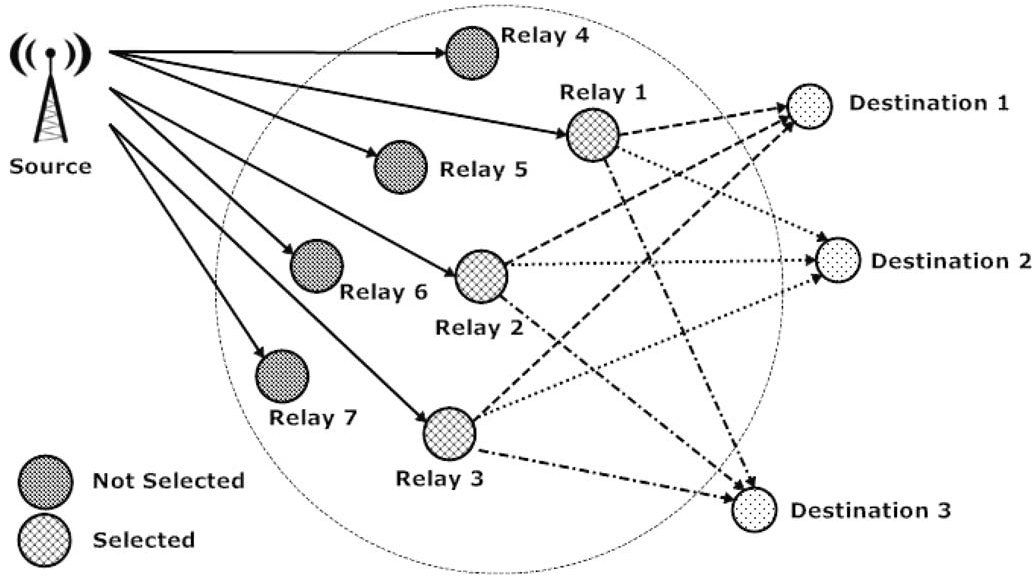 Figure 1: A typical ad-hoc topology where only a stable subset of relays is chosen to bridge the source and multiple destinations.
Experimental Insights
The authors tested their algorithm against Centralized MINLP (the "Golden Standard") and Relay Ordering (RO) baselines.
- Sum-Rate Efficiency: The CFA (Coalition Formation Algorithm) stays within 0.2 bits/sec/Hz of the centralized optimal, which is impressive given its distributed nature.
- The Alpha () Factor: The "Degree of Majority" acts as a tuning knob. When is low (0.5), the network is "lean and mean" (high rate, low stability). When is high (0.9), the system selects more relays to ensure a dominant, unshakeable majority, trading off some spectral efficiency for robustness.
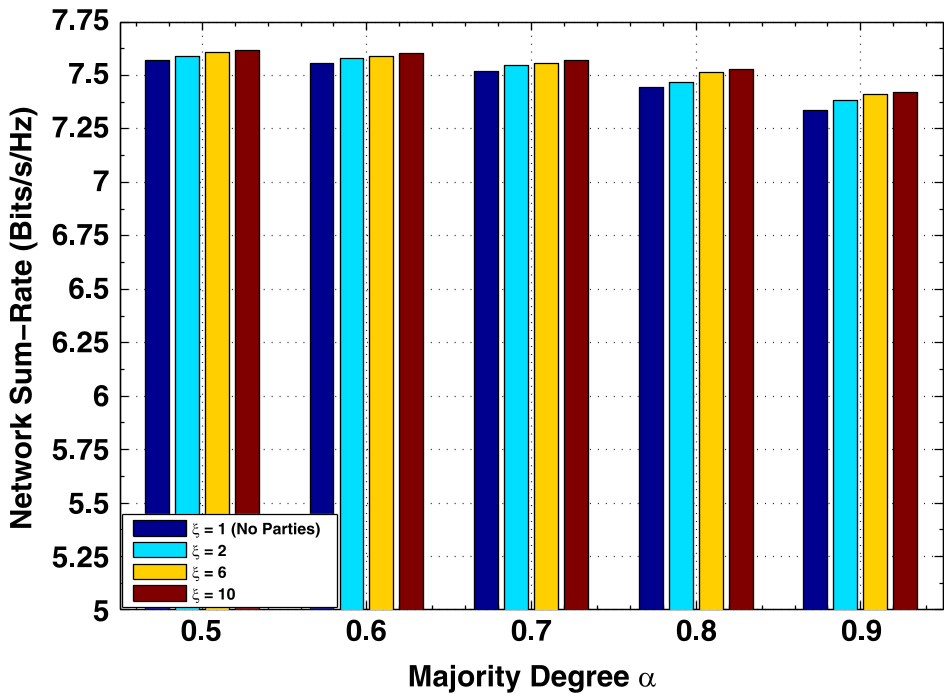 Figure 2: Performance comparison showing the negligible gap between the proposed distributed game (CFA) and the centralized optimal.
Critical Analysis: The Price of Stability
The authors admit that the URC-inducing process is inherently complex ( in the worst case). However, their introduction of Party Formation is a clever technical hedge. By grouping relays, the "number of players" decreases, making the exponential complexity manageable for real-time ad-hoc deployments.
Future Outlook: While this paper focuses on Decoded-and-Forward (DF) relays, the political model is flexible enough to be applied to Slicing in 5G/6G or even distributed edge computing, where "stability" of service providers is just as important as the speed of the connection.
Conclusion
The move from "Cooperation by Instruction" to "Cooperation by Negotiation" is a maturation of wireless network theory. By proving that political stability can lead to near-optimal technical performance, this paper provides a robust path forward for autonomous, decentralized communication systems.