
Identifying Social Media Hubs: High-Accuracy Influence Mapping Without Privacy Intrusion
A distributed and privacy preserving algorithm for identifying information hubs in social networks
This paper introduces a distributed and privacy-preserving algorithm for identifying the top-k information hubs in social networks using Principal Component Centrality (PCC). By leveraging friendship graphs and the Kempe-McSherry (KM) algorithm, the method identifies influential users without requiring access to sensitive interaction logs or centralized graph data.
TL;DR
Researchers have developed a breakthrough distributed algorithm that identifies the top "information hubs" in social networks—the users most critical for spreading information. Unlike previous methods that require a "god-view" of private user interactions, this system uses only the public-facing friendship graph and decentralized computation. It achieves 50% higher accuracy than baseline methods by looking at the multi-community structure of networks through Principal Component Centrality (PCC).
The "Centralization" Trap in Social Data
In the world of viral marketing and propaganda monitoring, identifying top-k hubs is the holy grail. Traditionally, this required access to the Interaction Graph—a detailed, time-stamped log of every "like," comment, and message.
However, there are two massive hurdles:
- Privacy Barriers: Social media giants (Meta, X, etc.) cannot and will not share interaction logs with third-party advertisers due to GDPR and TOS restrictions.
- Structural Complexity: Simple metrics like "degree" (number of followers) are deceptive. A user might have many followers but sit in a stagnant bubble.
Methodology: The Power of Multi-Polar Eigenspaces
The authors argue that a user's true influence is better reflected by their position across multiple "communities." They move beyond Eigenvector Centrality (EVC), which tends to fixate on the single largest cluster of a network, ignoring influential figures in smaller but active sub-communities.
Principal Component Centrality (PCC)
PCC computes the Euclidean distance of a node from the origin in a P-dimensional eigenspace. By using the top P eigenvectors instead of just the first one, the model captures the "multi-polar" nature of modern social networks.
Fully Decentralized Privacy
To solve the privacy problem, the authors employ the Kempe-McSherry (KM) algorithm. Instead of sending a friendship list to a central server, nodes only exchange abstract numerical intermediate scores with their immediate neighbors.
- No PII leaked: Neighbors never see each other's full friend lists.
- Scalability: Communication overhead grows linearly with the number of friends, making it feasible for users with thousands of connections.
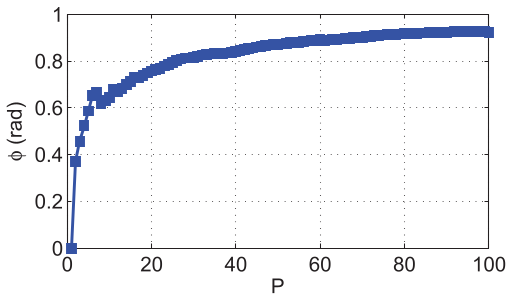 Fig 1: Selection of 'P' (number of eigenvectors). The phase angle plateaus around P=10, indicating that 10 eigenvectors are sufficient to capture the network's influence structure.
Experiments: Validating on 3.1 Million Facebook Users
The team tested their algorithm against a massive real-world dataset. While they used friendship graphs for the calculation, they used the actual interaction data as the "ground truth" to see if the hubs they predicted were actually the ones talking the most.
Key Findings:
- Accuracy Boost: Compared to EVC (the previous industry standard), PCC's intersection with the actual top users was 50% higher.
- Stability: The "Phase Angle" analysis confirmed that even in a network of millions, you only need about 10 eigenvectors to reach peak accuracy.
- Long-term Predictive Power: The correlation between the friendship-based PCC and actual interactions improved as they looked at longer time scales (1 year vs. 1 month). This suggests friendship structures define the "steady-state" pipeline of information flow.
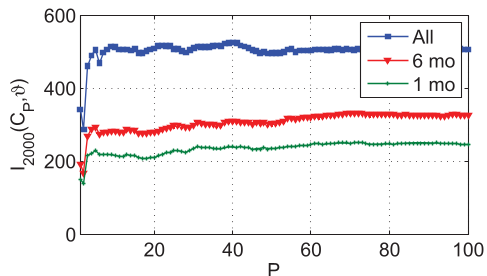 Fig 2: Correlation coefficients showing that as more eigenvectors (P) are used, the algorithm's prediction aligns more closely with real-world information flows.
Critical Insight & Conclusion
This paper shifts the paradigm of social network analysis from "Centralized Surveillance" to "Collaborative Computation." By demonstrating that hub identification can be done privately and locally, it opens the door for brand ambassadors and analysts to work within social platforms (via groups or apps) to identify key figures without violating user trust.
Limitations: The convergence time of the KM algorithm depends on the "mixing time" of the graph. In highly fragmented networks with isolated "echo chambers," the algorithm might take longer to settle.
The Takeaway: If you want to find the true movers and shakers of a social network, don't just look at who has the most friends. Look at who bridges the most communities—and you can do it without ever seeing a single private message.