
SoCS: Flattening the Social Manifold for Distributed Link Prediction
Distributed social graph embedding
The paper introduces SoCS (Social Coordinate Systems), a fully distributed force-based graph embedding algorithm designed for link prediction in Peer-to-Peer (P2P) social networks. By mapping nodes into a low-dimensional Euclidean space where social proximity reflects community structure, SoCS achieves SOTA-level predictive accuracy (AUC up to 0.90) while maintaining scalability and privacy.
TL;DR
SoCS (Social Coordinate Systems) is a decentralized algorithm that embeds social graphs into Euclidean space to predict future friendships. By moving away from "Big Brother" centralized architectures, it uses a gossip-based force model to group communities together. The core insight: ignoring distant nodes (local repulsion) actually makes the predictions more accurate and the system more resilient to users joining or leaving the network.
The Problem: Scalability and the "Big Brother" Syndrome
Link prediction—the engine behind "People You May Know"—usually requires a global view of the social graph. Centralized entities process millions of edges to calculate shortest paths or common neighbors. This faces two walls:
- Scalability: Computational costs explode as the graph grows.
- Privacy: Users are increasingly reluctant to hand over their entire social circle to a single corporation.
Previous P2P attempts tried to decentralize these metrics but struggled with the "noise" of global graph distances and the high cost of maintaining global state in dynamic networks (Churn).
Methodology: Social "Gravity" and Gossip
SoCS transforms the graph into a physical simulation. Imagine every user is a particle in a 2D or 10D space:
- Attraction: If you are friends with someone in the graph, a "spring" pulls your coordinates together.
- Repulsion: Every node pushes others away to prevent the system from collapsing into a single point.
The Innovation of Local Repulsion
While traditional Force-Based Embedding (FBE) calculates repulsion between all pairs of nodes (), SoCS only considers the closest neighbors in the social space. This isn't just a shortcut; it's a feature. By focusing on local "neighborhoods," the system acts like a Non-linear Dimensionality Reduction tool, uncovering the local manifold of the community while ignoring the noise of distant, unrelated clusters.
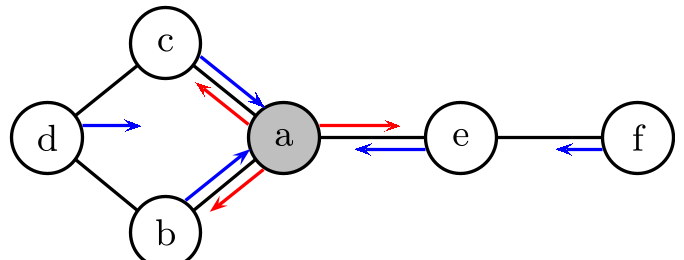 The SoCS iteration loop: Nodes calculate forces based on their local view and adjust their "Social Coordinates" accordingly.
Experiments: Why "Less is More"
The researchers tested two force models: LinLog (mathematically optimized for clustering) and HC (Hooke-Coulomb, based on basic physics).
Key Findings:
- HC Model Wins: Surprisingly, the simpler Hooke-Coulomb model was more robust. It converged in just 8 cycles compared to 40 for LinLog under "cold start" conditions.
- The Accuracy Paradox: Using fewer repulsion points ( instead of ) actually yielded a higher Area Under Curve (AUC) in link prediction tasks on real-world datasets like DBLP.
- Churn Resilience: Because the forces are local, a user leaving the network only causes a small "ripple" in their immediate community rather than a global recalibration.
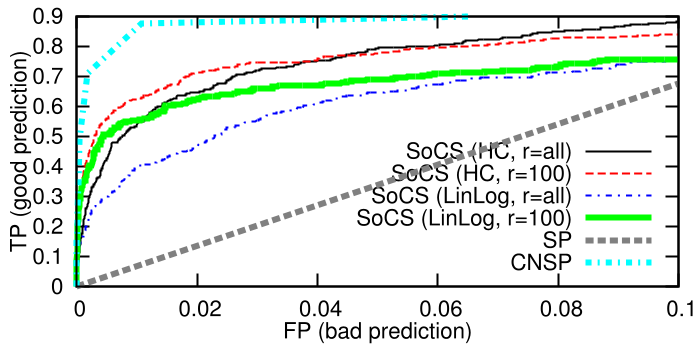 Performance Comparison: SoCS (HC) maintains high AUC even as the graph becomes more sparse (more edges removed).
Deep Insight: Beyond Isometric Embedding
Most embedding techniques try to be isometric—they want the distance in the 2D map to perfectly match the "hop count" in the graph. SoCS argues that this is the wrong goal for social networks.
A social network is a collection of dense communities bridged by rare "long links." An isometric embedding would treat a long-distance bridge the same as a close friendship if the hop count were similar. SoCS purposefully distorts the space to "shrink" communities and "stretch" the gaps between them, making it trivial to see who should be friends: they are the ones who are geographically close in the social space but don't have a link yet.
Conclusion and Future Outlook
SoCS provides a blueprint for a privacy-preserving recommender system. It proves that you don't need a central server to understand the complex community structure of millions of users.
Limitations: While resilient to churn, the system still requires an initial "anchor" (barycenter of neighbors) for new nodes to prevent them from drifting into social "voids." Future work could look into how malicious nodes (Sybil attacks) might try to manipulate their social coordinates to infiltrate specific communities.
Takeaway: In distributed systems, locality is your best friend. By ignoring the "global" picture, SoCS achieves better accuracy and higher efficiency—a rare win-win in algorithm design.