
The Divergency Model: Redefining "Typical" in UX Research for Stigmatized Populations
The Divergency Model: UX Research for and with Stigmatized and Idiosyncratic Populations
This paper introduces The Divergency Model, a UX research and design methodology specifically engineered to include stigmatized and idiosyncratic populations (e.g., people with disabilities or mental illness). It maps participants onto a 2D coordinate system of Stigma/Conformity and Apathy/Motivation to better represent non-normative user groups.
TL;DR
In the world of User Experience (UX), "outliers" are often ignored, but for millions with disabilities or stigmatized conditions, these "outliers" are the users. This paper introduces The Divergency Model, a framework that uses stigma and motivation as key metrics to ensure marginalized voices aren't just included, but understood. It moves UX from a "one-size-fits-all" approach to a nuanced mapping of human diversity.
The "Normative" Trap: Why UX Often Fails the Marginalized
Most UX tools—think surveys, focus groups, and think-aloud protocols—implicitly assume a "standard" user: someone with normative cognitive functions, a specific command of language, and the social safety to speak freely.
The Problem? This creates a massive research bias. People with "invisible disabilities," different belief systems, or mental illnesses often feel that participating in research puts them at personal risk. They are either:
- Excluded because they can't perform standard tasks (e.g., eye-tracking for those with certain neurological conditions).
- Self-censoring due to the social stigma associated with their condition.
- Dismissed as statistical noise in the data.
The authors argue that we need to stop trying to "fix" the user and start fixing the research methodology.
Methodology: The Divergency Model
To solve this, the authors developed a 2D mapping system. Instead of looking at "ability," they look at Stigma and Motivation.
The Two Axes of Diversity
- The Y-Axis (Conformity vs. Stigma): Measures how much a user's experience aligns with the cultural norm versus how much they feel socially or emotionally "othered."
- The X-Axis (Apathy vs. Motivation): Measures the user's drive or interest in the specific stimuli or system being tested.
1. The Quadrant System
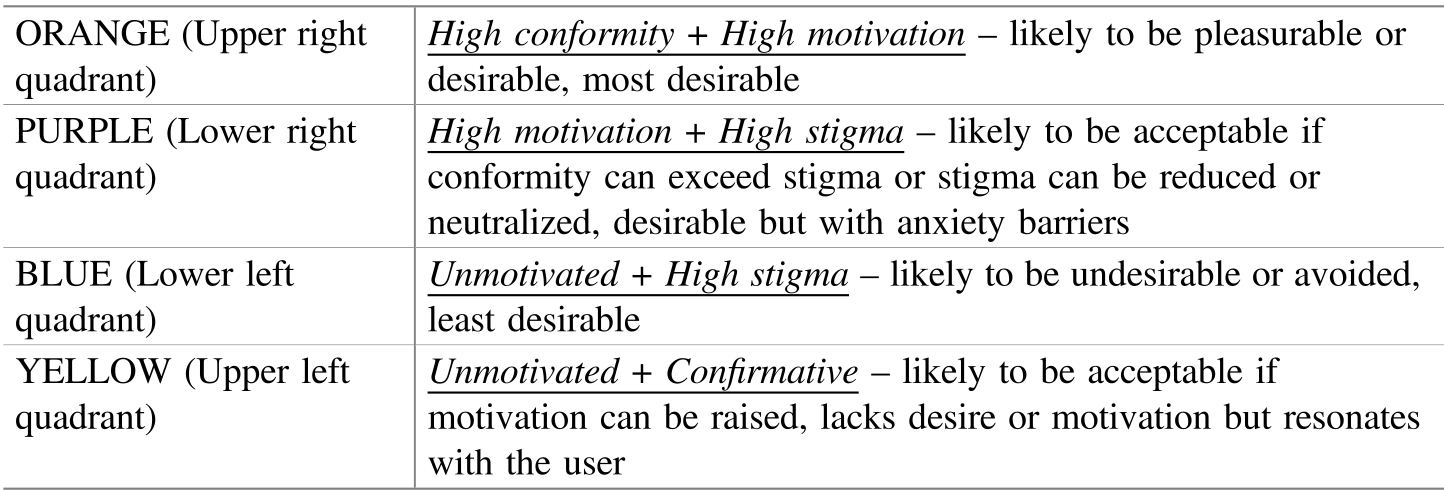
By plotting users on these axes, researchers can categorize the user experience into four actionable zones:
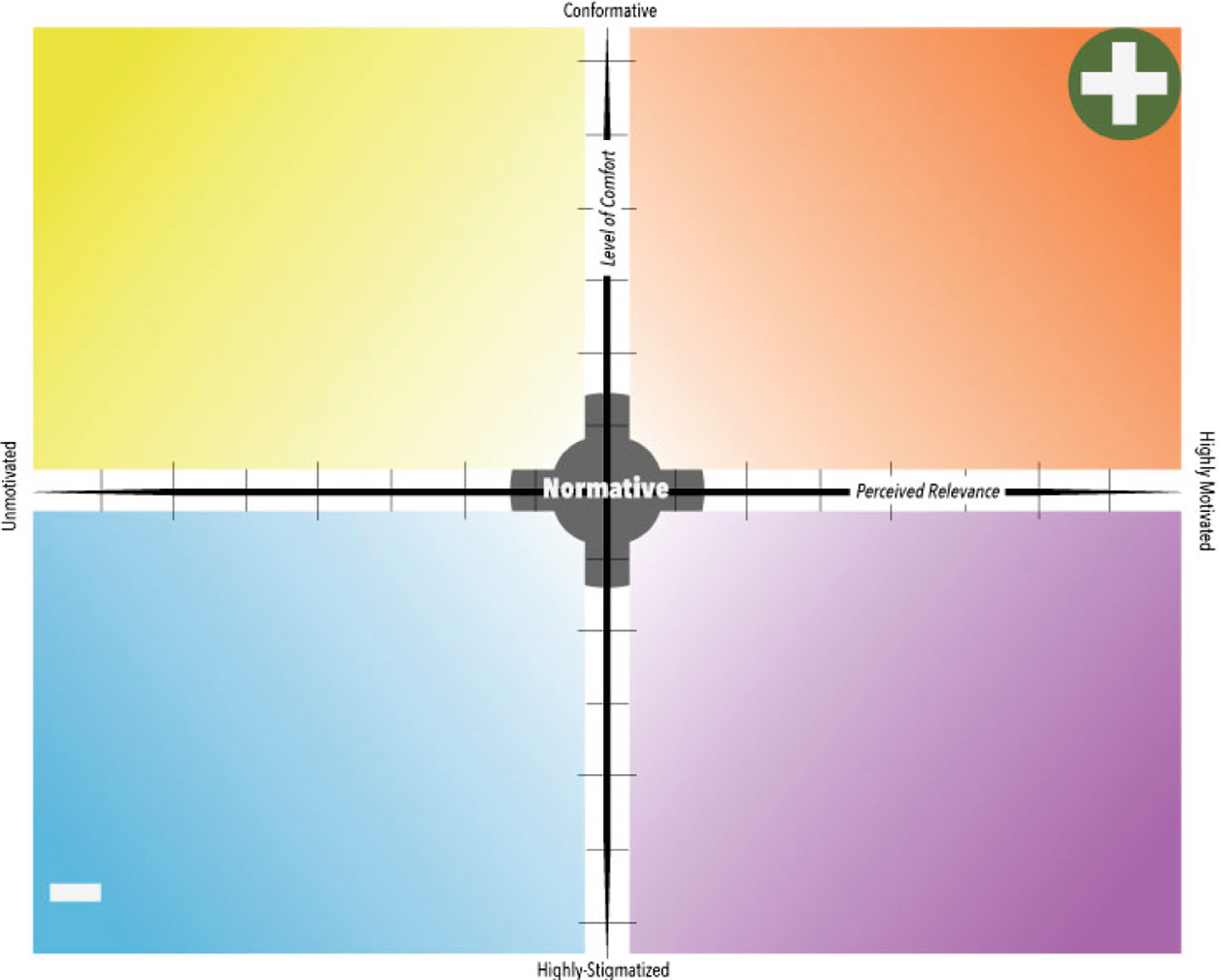
- Orange (High Conformity/High Motivation): The "Gold Standard" of current UX—pleasurable and easy to design for.
- Purple (High Stigma/High Motivation): The "Desirable but Anxious" zone. Users want the product but face significant emotional or physical barriers.
- Blue (High Stigma/Unmotivated): The "Avoidance" zone—the least desirable experience.
- Yellow (Conformity/Unmotivated): The "Neutral" zone. Users fit the mold but lack the spark to engage.
Measuring the "Unmeasurable"
The model doesn't just guess where people sit. It uses the Connectivity Model framework—evaluating Social, Emotional, Physical, and Behavioral (SEPB) categories. This allows for non-verbal ethnographic observation. For example, a researcher might observe an individual with Autism Spectrum Disorder (ASD) and map their reactions without requiring a spoken interview, thus reducing the stress (and stigma) of the test environment.
Critical Insight: Beyond Accessibility
The most profound takeaway from this work is the critique of "Design for Disability." Traditionally, design in this space tries to be "unremarkable" or "discreet"—essentially trying to hide the disability.
The Divergency Model suggests that designers should use Cultural Relativism. Instead of judging a stigmatized population by normative standards, we should measure their proximity to their own needs and motivations. Success isn't making a disabled person "normative"; it's reducing the "proximal distance" between their motivation and their ability to enjoy the product.
Conclusion and Future Outlook
The Divergency Model is a call to action for UX researchers to stop over-sampling the "easy" users. By quantifying stigma and motivation, we can identify why certain groups are under-represented and create targeted strategies to bring them into the fold.
Future Research Directions:
- Developing specific survey questions to quantify the X and Y axes accurately.
- Expanding the model to IRB-protected populations, such as prisoners or those with diminished capacity.
- Integrating biofeedback (eye tracking, skin sensors) to provide more objective data for non-verbal participants.
In an era of "Inclusive Design," the Divergency Model provides the mathematical and logical framework to turn a buzzword into a rigorous scientific practice.