
Beyond Simple Predictions: Building a Profitable Multi-Agent Forex Strategy
A Diversified Investment Strategy Using Autonomous Agents
The paper introduces a multi-agent autonomous trading architecture for the Forex market, utilizing an ensemble of classification and regression models (the Intuition Module). By diversifying across five currency pairs (EUR/USD, USD/JPY, etc.) and integrating Case-Based Reasoning and Expert Systems, the strategy achieved a 55.70% prediction accuracy and turned previously loss-making models into a profitable system with an 18% return.
TL;DR
Predicting market direction is only half the battle. This paper proves that even "accurate" models can go broke due to commissions and poor risk management. By wrapping machine learning ensembles in a multi-agent framework—combining Case-Based Reasoning for money management and Rule-Based Systems for risk—the authors transformed a losing predictive model into a robust investment strategy with an 18% return and a 90% reduction in drawdown.
The "Profit Paradox" in Financial Data Mining
Many researchers claim to achieve high accuracy in predicting whether a currency pair like EUR/USD will go up or down. However, in real-world trading, the bid-ask spread and commissions are the silent killers. The authors found that their initial "Intuition" models were actually correct more than 53% of the time, yet they lost tens of thousands of dollars because they traded too frequently.
The problem wasn't the AI's "brain"; it was the lack of a "business manager" and a "risk officer."
The Architecture: Three Pillars of Autonomy
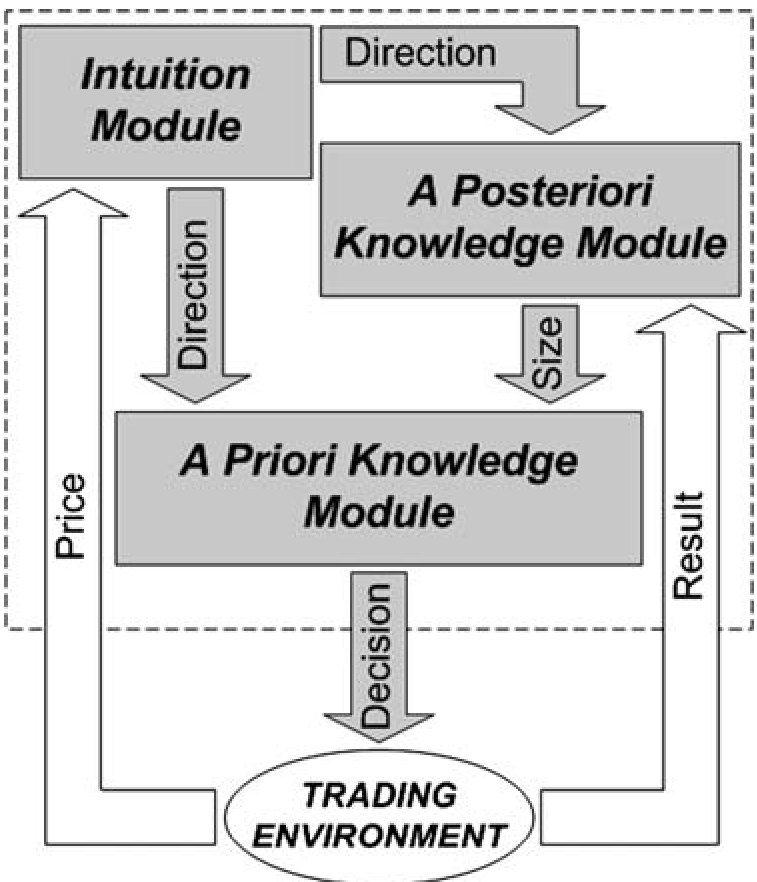
The paper proposes a sophisticated modular architecture to solve this. Instead of one giant model, they split the intelligence into three distinct roles:
- The Intuition Module (The Analyst): Uses an ensemble of algorithms (Naive Bayes, SVM, RBF Networks) to predict price movement every 6 hours. It filters its own members, only keeping models that have been profitable in the last 100 trades.
- The A Posteriori Module (The Accountant): Uses Case-Based Reasoning (CBR). It looks at the current market "case" and compares it to past performance. If similar past setups were profitable, it allocates more capital; if not, it sits the trade out.
- The A Priori Module (The Risk Officer): A rule-based engine that enforces "Stop-Loss" and "Take-Profit" targets. It ensures that even if a 6-hour prediction is wrong, the agent can exit early if a profit target is hit mid-window.
Turning Losses into Gains: Experimental Evidence
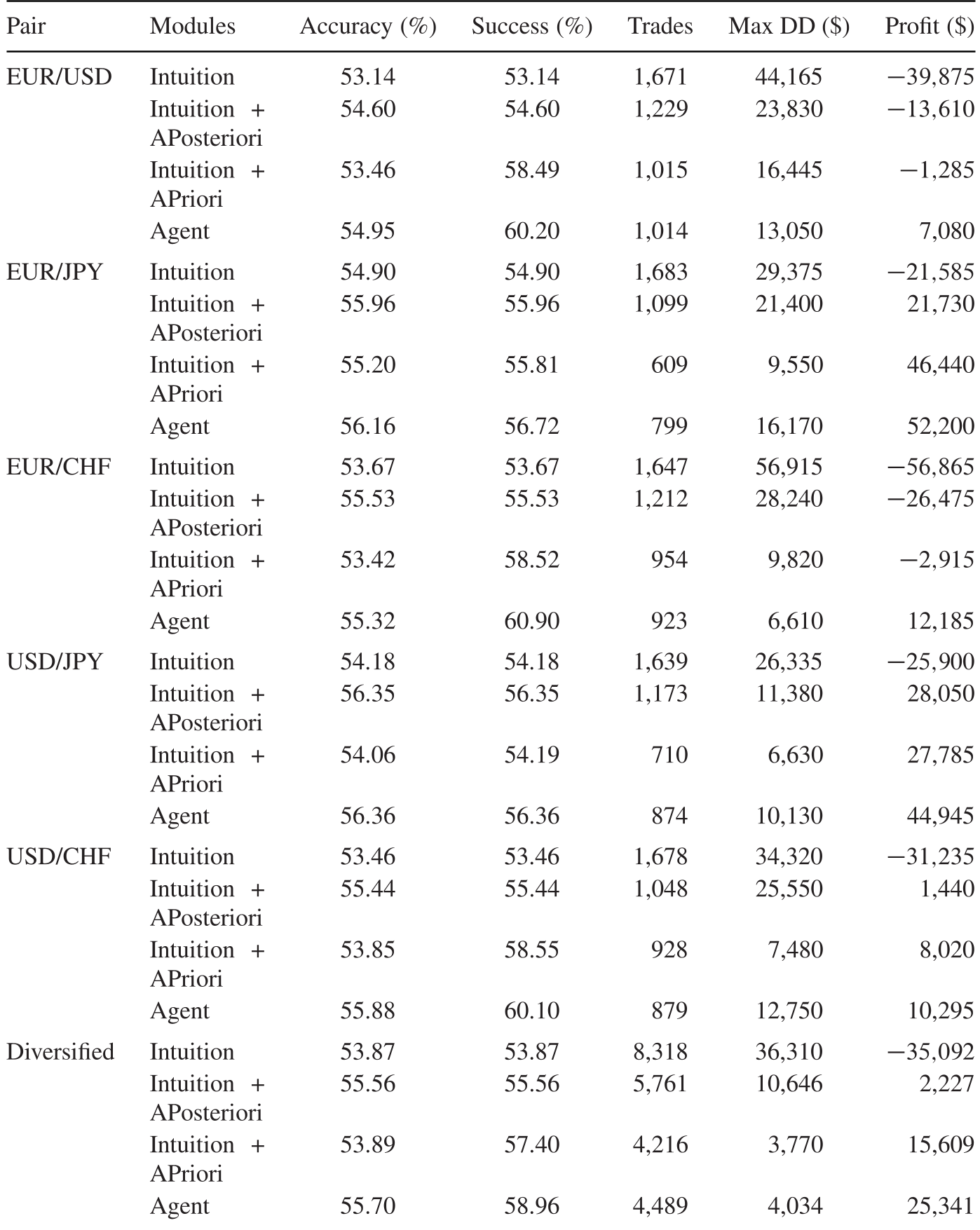
The results from the 18-month out-of-sample simulation are striking. Looking at the Diversified row in the results table, we see the evolution of the strategy:
- Intuition Only: -$35,092 loss (Drowned by transaction costs).
- Full Agent (Intuition + A Posteriori + A Priori): +$25,341 profit.
The combination of all three modules didn't just increase profit—it radically slashed risk. The Maximum Drawdown (Max DD), which measures the "pain" or the largest peak-to-trough decline, dropped from 4,034.
Why It Works: The Power of Diversification
The paper highlights a classic financial wisdom: "Don't put all your eggs in one basket." While the EUR/JPY agent alone was the most profitable, the Diversified Strategy (spread across 5 pairs) had the lowest risk profile. In the world of institutional trading, a lower drawdown is often more valuable than a higher raw profit because it allows for the safe use of leverage.
Critical Insight & Future Outlook
The genius of this work isn't in the specific ML models (which are dated by today's Standards, e.g., using Weka/SVM), but in the Systemic Logic. It treats a trading bot as a pipeline of filters:
- Prediction -> Confidence Adjustment -> Risk Constraint.
The authors acknowledge a remaining weakness: Redundancy. Because currency pairs are correlated (e.g., EUR/USD and USD/JPY often move in relation to the EUR/JPY cross), the agents occasionally place redundant trades. Their future work aims to implement a Multi-Agent Negotiation layer where agents talk to each other to optimize the total portfolio exposure.
Conclusion
This paper serves as a vital reminder for AI practitioners in finance: A high F1-score or Accuracy does not equal a profitable P&L. Robustness comes from the layers of domain knowledge and risk management built around the machine learning core.