
Beyond the Echo Chamber: Balancing Accuracy and Diversity in Social Recommenders
Diversity and Novelty in Social-Based Collaborative Filtering
This paper investigates the impact of social-based collaborative filtering on recommendation diversity and novelty, introducing a new method that utilizes SimRank for social regularization. Extensive evaluations on the Douban dataset demonstrate that the proposed SX model significantly outperforms standard Matrix Factorization (MF) and existing social models in accuracy while maintaining or improving diversity.
TL;DR
Is your social circle trapping you in a recommendation "filter bubble"? While social-based recommenders use your friends' tastes to predict your own, there's a growing fear that this creates narrow-minded algorithms. This paper proves the opposite: by using structure-aware regularization (SimRank), we can actually make recommendations more accurate and more diverse simultaneously.
Background: The Social "Echo Chamber" Risk
Traditional Social-Based Recommenders rely on two principles: Homophily (we hang out with similar people) and Social Influence (we become like our friends). To model this, researchers use Social Regularization, forcing a user's latent factors in Matrix Factorization to stay close to their friends' factors.
The intuitive fear? If the algorithm forces you to be like your friends, you’ll only see what they see—creating a digital echo chamber with zero novelty.
A Structural Insight: Enter SimRank
Dimitris Sacharidis argues that the way we regularize matters. Previous SOTA methods used Local or Pearson Correlation Coefficient (PCC) weights. This paper introduces the SX method, which uses SimRank.
Why SimRank? Unlike simple adjacency matrices, SimRank provides a global view of the social structure. It measures similarity based on the intuition that "two objects are similar if they are related to similar objects." By applying this global context to the regularization term, the model gains a deeper understanding of user positioning within the network.
The Methodology: Average vs. Pairwise
The paper compares two regularization styles:
- Average Social Regularization (The Winner): Constrains a user's features to be similar to the average of their friends.
- Pairwise Social Regularization: Forces a user to be similar to each friend individually.
 The SX model formula: Regularizing user against the SimRank-weighted average of their social circle.
Revolutionary Metrics: Measuring Social Groups
The paper moves beyond individual diversity. It proposes Group Diversity (GDIV) and Group Novelty (GNOV). These metrics treat a user's "ego network" (the user + their direct friends) as a single unit, measuring how varied the recommendations are for the entire group.
Experimental Showdown: Accuracy AND Diversity
Using the Douban dataset, the results were striking. The proposed SX model dominated the charts:
- Accuracy: RMSE dropped (improved) from 0.952 (MF) to 0.835 (SX).
- Diversity: Individual Diversity (I-Diversity) rose from 0.370 (MF) to 0.410 (SX).
 Table 1: Note how SX (SimRank Average Regularization) maintains the highest NDCG scores while outperforming MF in diversity metrics.
The data reveals a critical trade-off: Pairwise regularization (the "p" variants like SQp and SXp) actually reduces diversity. However, average regularization acts as a smoothing factor that captures sufficient social signal for accuracy without narrowing the user's horizon.
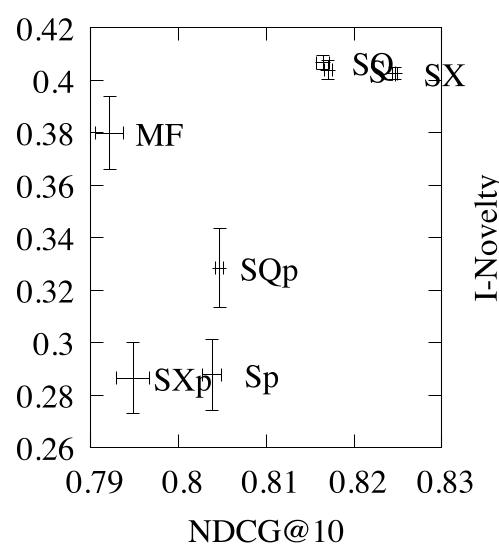 The top-right position of SX indicates the best balance of low RMSE (high accuracy) and high diversity.
Final Insights
This research challenges the "Common Sense" assumption that social algorithms always limit our exposure. The key takeaways for engineers and researchers are:
- Architecture Matters: "Average" regularization is superior to "Pairwise" if you care about diversity.
- Global vs. Local: SimRank's structural view provides a much stronger signal for accuracy than local similarity (PCC).
- Fairness: By measuring Group Diversity, developers can assess whether specific social communities are being "trapped" by the algorithm.
Conclusion: TheSX model proves that we don't have to trade off precision for variety. We can have our social context and our novelty too.