
Divide and Conquer: Revolutionizing Document Digitization via Task Atomization
Divide and Conquer: Atomizing and Parallelizing a Task in a Mobile Crowdsourcing Platform
This paper introduces a "divide and conquer" strategy for digitizing historical documents via the Knowxel mobile crowdsourcing platform. By recursively atomizing complex document segmentation into micro-tasks, the authors achieve high-precision word extraction and parallel execution on mobile devices.
Executive Summary
TL;DR: This paper presents a novel methodology for digitizing ancient documents by breaking down the complex task of word segmentation into a series of simple, parallelizable micro-tasks on a mobile platform called Knowxel. By shifting from a monolithic desktop-based workflow to a mobile "divide and conquer" strategy, the researchers achieved a 55% reduction in processing time while improving accuracy through intuitive touch-screen interactions.
Positioning: This work is a pioneering study in Mobile Crowdsourcing (MCS), demonstrating that task formulation is just as critical as the technology platform in achieving efficient distributed human computation.
The Bottleneck: The Fatigue of Monolithic Tasks
Historical document recognition, particularly the generation of "Ground Truth" for training AI, has traditionally been a bottleneck. Existing tools typically required a single expert (or volunteer) to sit at a PC and manually segment hundreds of words on a single page. This approach suffers from:
- High Cognitive Load: Users become fatigued quickly when faced with large, complex pages.
- Zero Parallelism: A page is locked to one user until completion.
- Device Constraints: Desktop tools are not ubiquitous; they don't capture the "spare moments" of a global mobile workforce.
Methodology: Recursive Atomization
The core insight of this paper is that task formulation determines efficiency. Instead of delivering a whole page to a user, the authors implement a recursive pipeline:
1. The Decomposition Pipeline
- Layout Extraction: The first set of users identifies columns (page layout).
- Horizontal Slicing: Columns are automatically split into small boxes containing roughly 6 lines of text, perfectly sized for smartphone screens (3.4" to 10.1").
- Coarse Segmentation: Users draw bounding boxes around individual words.
- Fine Atomization: In the final stage, a user is presented with a singular box containing one word for precise segmentation.
 Figure 1: Conceptual flow of the crowdsourcing platform interface.
2. Why it Works: The "Micro-Moment" Advantage
By atomizing the task, the platform eliminates the need for users to manually zoom or pan across a high-resolution image. The task becomes "stateless" and "bite-sized," allowing users to contribute effectively during a commute or a short break.
Experimental Results: Faster and More Precise
The trial was conducted on the Marriage Licenses Books from the Barcelona Cathedral—a massive archive of 500,000 unions from the 15th to 19th centuries.
- Efficiency: The desktop software took 20 minutes per page. The atomized mobile platform took only 9 minutes per page.
- Input Quality: Unlike a mouse, the touch screen offers a more natural "drawing" interface for segmentation, leading to higher precision in word boundaries.
- Scale: Because the tasks were atomized, dozens of users could work on different parts of the same page simultaneously, effectively parallelizing the digitization of a single document.
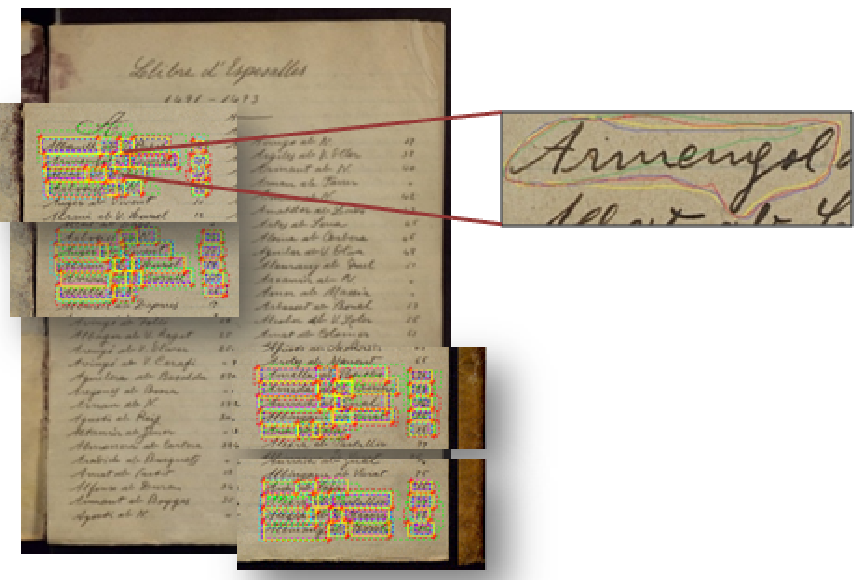 Figure 2: Examples of segmented words and the mobile UI results.
Critical Insight & Conclusion
The significance of "Divide and Conquer" lies in its Inductive Bias toward the platform. The authors didn't just port a desktop app to mobile; they redesigned the logic of the work to fit the medium.
Takeaway: As we move toward more complex AI training requirements, the "atomization" of human intelligence will be the key to scaling data labeling.
Limitations: While the results are impressive, the paper does not extensively discuss "Truth Inference" (how to handle conflicting inputs from different users) or the potential for "Gold Standard" injects to filter low-quality contributors. Future work should integrate robust quality-assurance mechanisms into this parallelized flow.