
Do You Write What You Are? Unlocking Employee Psychometrics through ESN Analytics
Do You Write What You Are in Business Communications? Deriving Psychometrics from Enterprise Social Networks
This study investigates the feasibility of deriving Big Five personality traits from Enterprise Social Networks (ESN) using automated linguistic analysis via IBM Watson Personality Insights. Analyzing data from a professional services firm, the authors demonstrate that ESN posts provide sufficient linguistic differentiation to create unique, stable psychometric profiles for employees.
TL;DR
Can your "corporate" social media posts reveal who you really are? This research explores whether text from Enterprise Social Networks (ESNs) can be used to automatically map employees to the Big Five personality traits. Using IBM Watson's NLP service on data from a major professional services firm, the study confirms that even in a business context, your writing style is a unique and stable fingerprint of your personality.
Context & Positioning
In the world of Human Resources (HR) and Knowledge Management (KM), personality is a "holy grail" for decision-making. High Conscientiousness is linked to top management performance, while Agreeableness and Openness drive knowledge sharing. However, getting 6,000 employees to fill out personality surveys is a logistical nightmare. This paper positions itself at the intersection of Big Data Analytics and Organizational Psychology, testing if ESNs provide a "naturalistic" alternative to the traditional questionnaire.
The Core Challenge: The "Corporate Filter"
The central question of this research was: Are business communications too sterile for psychometrics? In public spaces like Twitter or personal blogs, people express themselves freely. In a professional setting (like Deloitte Australia, the case study here), there is a risk that "professionalism" forces everyone into a similar linguistic style, rendering NLP-based personality detection useless due to lack of variance.
Methodology: From Text to Traits
The researchers analyzed text corpuses from 72 unique users who posted at least 3,500 words per year. They leveraged the IBM Watson Personality Insights API, which relies on coefficients derived from comparing linguistic patterns (via LIWC) to validated personality scores.
The Distribution of Personality
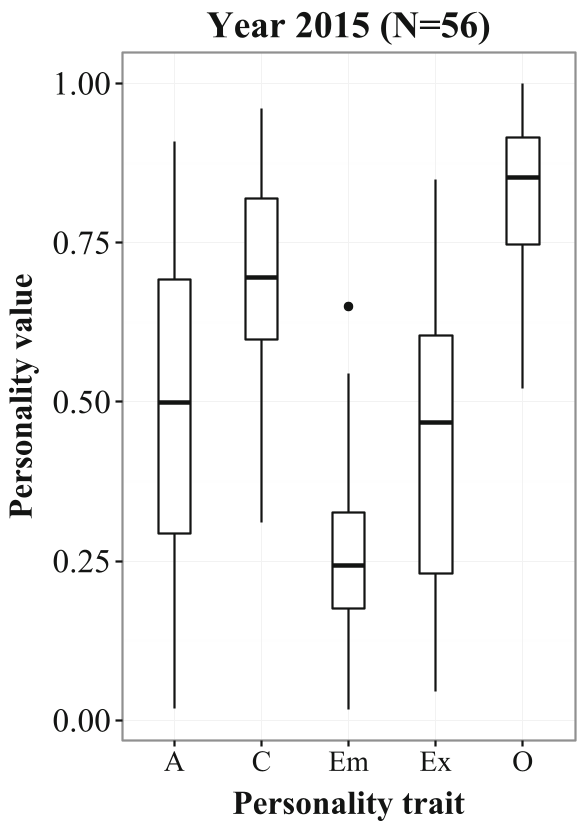
The study proved that ESN users do indeed express a wide range of traits. As shown in the data below, while "Openness" leaned higher (likely because those who post frequently are naturally more open), "Extraversion" and "Agreeableness" showed wide distributions.
Key Findings: Stability and Discriminability
The most impressive part of the study is the Stability Analysis. If the NLP tool was just picking up random "noise" from professional jargon, the scores for a single person would fluctuate wildly between 2013 and 2015.
Instead, the researchers used Lift Charts to show that a user's personality profile in one year was the best predictor of their profile in the next year.
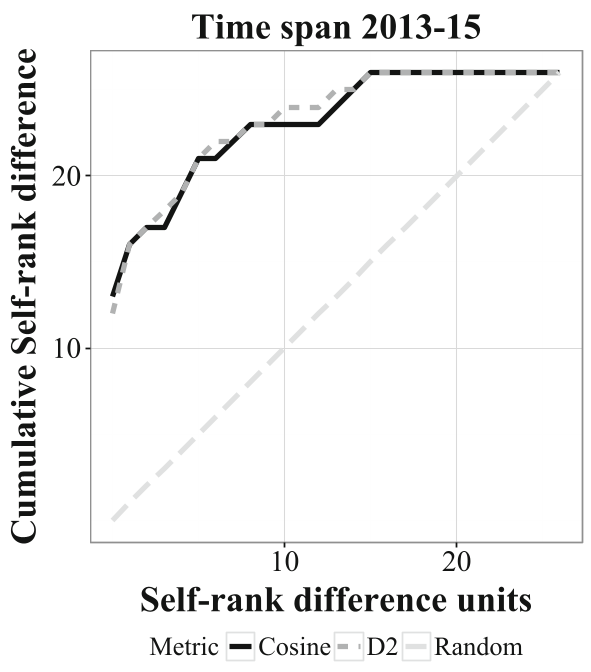
- Uplift Percentages: The results showed an uplift of over 80% compared to a random model.
- Discriminability: Combining all five dimensions resulted in a unique "personality signature" with high standard deviations in distances, meaning users are easily distinguishable from one another.
Deep Insight: Beyond "What" to "Why"
Why does this work? The study suggests that ESNs are inherently informal. Despite being a business tool, they serve as a space for "knowledge-intensive work," which thrives on authentic collaboration. Employees don't actually "filter" their personality as much as we might assume; their innate trait-driven vocabulary—such as the frequency of selfless words for Agreeableness or energetic adjectives for Extraversion—persists even in a professional newsfeed.
Conclusion & Limitations
This work validates ESN text as a rich data source for Author Profiling.
Takeaways for Leadership:
- Automated Mentoring: Identify highly agreeable/open employees to lead knowledge-sharing initiatives.
- Team Balancing: Assemble teams with complementary traits (e.g., balancing high-neuroticism analysts with high-extraversion leaders).
Caveats: The main limitation is the lack of a "ground truth" (i.e., comparing the AI results directly to the participants' actual survey results). While the profiles are stable and distinct, the authors admit that a future step must involve direct validation against a Big Five questionnaire.
For now, though, it seems your digital traces at work speak volumes about who you are.