
The Applied Doctorate: Decoding Industry-Driven Research Trends in Computing
Doctor of Professional Studies in Computing: A Categorization of Applied Industry Research
This paper presents a comprehensive study of the Doctor of Professional Studies (D.P.S.) in Computing at Pace University, a program tailored for mid-career IT professionals. The study utilizes NLP and Machine Learning (K-means clustering) to categorize 114 dissertation abstracts, identifying key research trends driven by industry needs.
TL;DR
This study examines the landscape of the Doctor of Professional Studies (D.P.S.) at Pace University, the first of its kind in the US for IT professionals. By applying Machine Learning (NLP) to 114 dissertation abstracts, the authors reveal that applied doctoral research focuses heavily on software development, security compliance, and biometrics—areas typically driven by the immediate needs of the corporate world rather than theoretical abstraction.
Background: The Gap Between Industry and Academia
In the fast-evolving tech landscape, a traditional 5-year full-time PhD is often incompatible with the lives of mid-career executives and senior engineers. This creates a "theory-practice" rift. The Pace University D.P.S. program was designed as a "bridge" for professionals with 5+ years of experience, allowing them to remain in their roles while conducting rigorous, relevant research.
Analyzing "Professional" Intelligence via Machine Learning
The core methodology of this paper moves away from subjective manual categorization. To understand what these "pracademics" are actually studying, the authors treated 114 dissertation abstracts as a corpus for a K-means clustering task.
1. The Clustering Logic
The researchers used TF-IDF to convert textual abstracts into numerical vectors. To find the "sweet spot" for how many categories exist in this field, they plotted heterogeneity against the number of clusters (K).
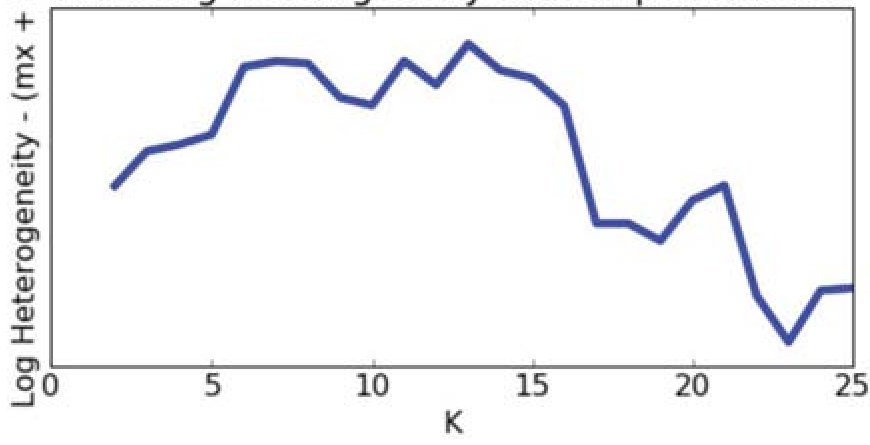 Fig 1: Using the log heterogeneity plot to identify K=6 as the optimal balance for interpretability.
2. The Six Pillars of Applied Computing Research
The clustering results unveil a specific "Industry Map" of computing research:
- Software Development (Cluster 0): Heavily focused on Agile, outsourcing, and usability.
- Network/Data Security (Cluster 1): Driven by the enterprise need for Cloud security and compliance.
- Education (Cluster 2): Reflecting the many students who transition into adjunct or administrative academic roles.
- Algorithms (Cluster 3): Core CS topics including genetic algorithms and cloud optimization.
- Project Management (Cluster 4): A rare topic in traditional PhDs but vital for IT executives.
- Biometrics (Cluster 5): Specialized research in keystroke dynamics, representing the host university's specific expertise.
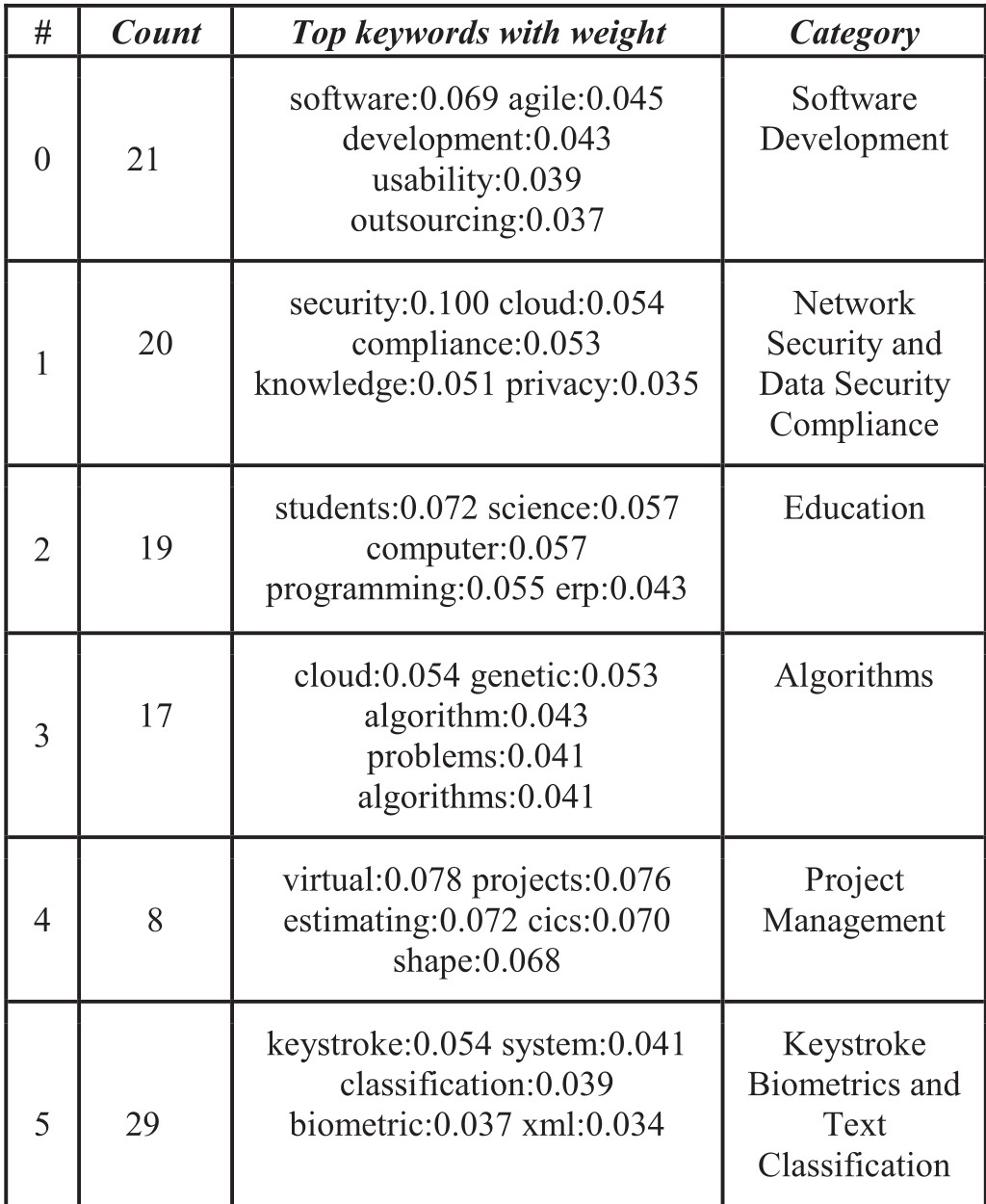 Table 1: Cluster distribution showing Keystroke Biometrics and Software Development as high-density research areas.
A Changing Demographic
The paper also highlights a macro-shift in US education. Notably, graduate enrollment in Computer Science nearly doubled (78.65% increase) between 2007 and 2015. Moreover, since 2011, women have begun earning more doctoral degrees overall in the US than men, although the paper notes that physical sciences and engineering still lag behind in this gender parity.
Critical Insight: Why This Matters
The value of the D.P.S. dissertation lies in its groundedness. Unlike traditional PhD students who may look for gaps in the theoretical literature, D.P.S. students look for gaps in their company's performance or security protocols.
Key Takeaways for the Future:
- Standardization: As more professional doctorates emerge, the methodology of using ML to map research topics will be essential for monitoring program effectiveness.
- Industry Synergy: Higher education must continue to adapt to the "lifelong learner" model, where the workplace becomes the laboratory.
Conclusion
This study proves that the research generated by working IT professionals is not just "watered-down" computer science; it is a highly specialized, applied discipline that tackles the pragmatic complexities of modern enterprise computing.