
PyNetSYM: Bridging the Gap in Agent-Based Social Network Simulation
A Domain Specific Language Approach for Agent-Based Social Network Modeling
The paper introduces PyNetSYM, an agent-based modeling (ABM) framework specifically tailored for social network simulations. It utilizes an internal Domain-Specific Language (DSL) built on Python to simplify model specification for non-programmers while leveraging gevent-based coroutines to achieve high-performance concurrency.
Executive Summary
TL;DR: PyNetSYM is a specialized framework designed to simplify the creation of large-scale social network simulations. By combining a Python-based internal Domain-Specific Language (DSL) with a high-performance coroutine-driven engine, it allows researchers—both programmers and social scientists—to model complex interactions with up to a million agents efficiently.
Background: Historically, Agent-Based Modeling (ABM) has been a cornerstone for social sciences. However, toolkits like NetLogo are often restricted by visualization-heavy architectures, while RePast or Mason require complex Java/Objective-C knowledge. PyNetSYM enters the field as a focused, performance-oriented alternative specifically for social networks.
Problem & Motivation
Current ABM tools face a "usability vs. power" trade-off. Social scientists need tools that resonate with their domain logic (e.g., "link to," "activate"), whereas large-scale simulations (billions of edges) require professional-grade software engineering to handle memory and CPU constraints.
The author identifies two major gaps:
- Lack of focus: General ABM tools try to solve every problem (grids, 3D spaces), making specialized social network modeling unnecessarily verbose.
- Concurrency Bottlenecks: Standard threading models consume significant kernel resources, limiting the number of agents to a few thousand before performance degrades.
Methodology: The DSL and Runtime Engine
PyNetSYM’s core innovation lies in its Internal DSL and its Concurrency Model.
1. The Power of Pythonic DSL
By hosting the DSL within Python, PyNetSYM provides a declarative interface. Users can define simulation logic (Activators, Nodes, Configurators) using high-level syntax that reads like pseudo-code but executes as robust object-oriented code.
2. The Semantic Model
The architecture separates the Simulation Engine (concurrency), the Model (logic), and the Network Database (storage). This modularity allows the system to switch between in-memory graphs (for speed) and disk-based storage (for massive datasets) transparently.
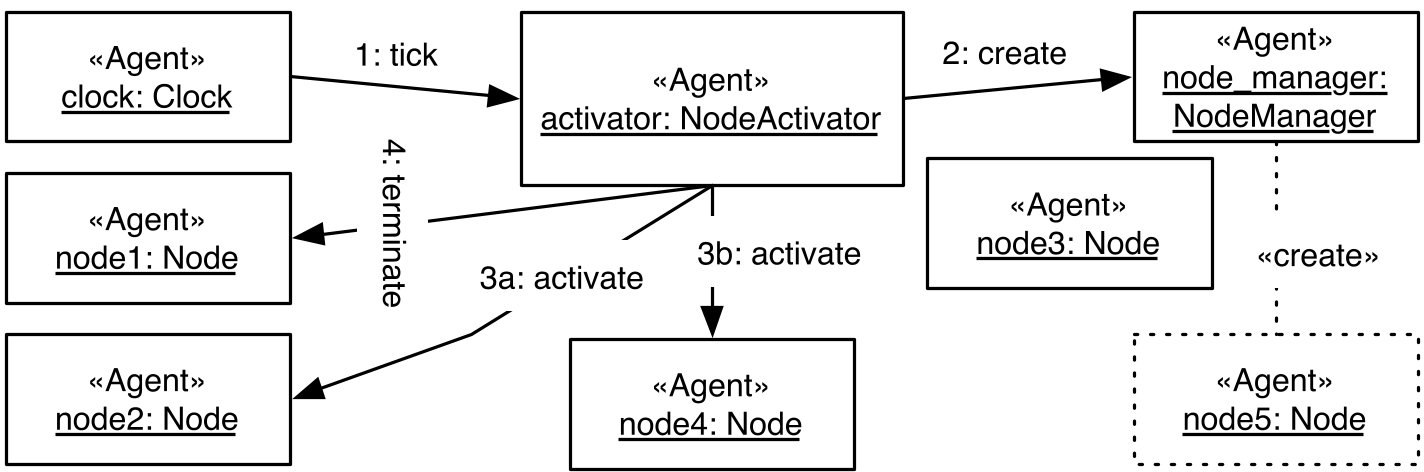 Fig 1: Interaction diagram showing how the Activator drives Node behavior through the Node-Manager.
3. Lightweight Concurrency via Greenlets
Moving away from traditional threads, PyNetSYM uses gevent coroutines (greenlets).
- Efficiency: Context switching happens in user-space, making it dramatically cheaper than kernel-space thread switching.
- Scale: The number of agents is limited only by RAM, not by the operating system’s process/thread limits.
Experiments & Results
The author benchmarked the system by spawning varying numbers of agents to measure execution latency. The results are definitive: greenlets outperform threads across all scales.
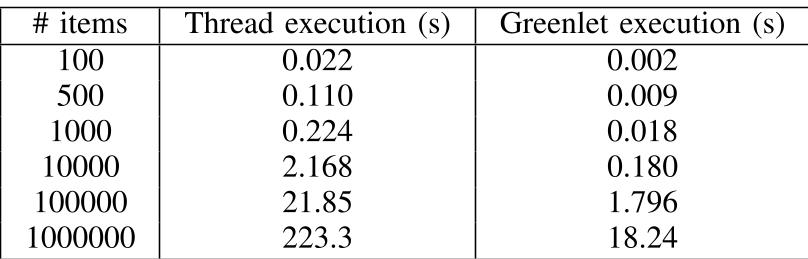 Table 1: Execution times (seconds) for Thread vs. Greenlet implementation.
Key findings:
- At 1,000,000 agents, the greenlet execution was 18.24s, while threads took 223.3s.
- The speedup factor remains consistently around 10x, confirming that coroutines provide a superior Inductive Bias for message-passing architectures in simulations.
Critical Analysis & Conclusion
Takeaway
PyNetSYM successfully demonstrates that social network modeling can be both accessible and high-performing. Its use of an internal DSL preserves the developer's ability to use standard Python libraries (like NetworkX or SciPy) while providing a cleaner abstraction for social science logic.
Limitations & Future Work
- CPU Bound Tasks: Since Python’s Global Interpreter Lock (GIL) affects coroutines, the current model excels at I/O and message-heavy simulations but might struggle with heavy local CPU computation per agent.
- Distributed Execution: While the paper mentions remote deployment, a truly distributed "Multi-Worker" model for multi-billion node graphs remains an area for further validation.
Ultimately, PyNetSYM represents a significant step toward "Generative Social Science," where the barrier to simulating global-scale social phenomena is no longer the complexity of the code, but the imagination of the researcher.