
DoS-WGAN: Turning AI Against AI to Breach Network Defenses
Automatically synthesizing DoS attack traces using generative adversarial networks
The paper introduces DoS-WGAN, a framework that leverages Wasserstein Generative Adversarial Networks with Gradient Penalty (WGAN-GP) to synthesize DoS attack traces. The generated traffic is designed to be statistically indistinguishable from normal traffic while maintaining its destructive capabilities, effectively bypassing deep learning-based Network Intrusion Detection Systems (NIDS).
TL;DR
Researchers have developed DoS-WGAN, a generative framework that "camouflages" Denial of Service (DoS) attacks. By using Wasserstein GANs with Gradient Penalty, they can synthesize attack traffic that looks so much like normal user behavior that it drops the detection accuracy of top-tier AI NIDS by nearly 50%, all while ensuring the attack still actually works.
Background: The Illusion of Security
Deep learning models, especially Convolutional Neural Networks (CNNs), have become the gold standard for detecting network intrusions. However, these models often rely on statistical patterns that can be spoofed. While adversarial attacks on images (making a cat look like a dog to an AI) are well-studied, network traffic is harder because you can't just change random "pixels." If you change the wrong field in a network packet, the attack fails to execute.
The Problem: Structure and Malice
The authors identify a critical gap: existing evasion attacks focus mostly on malware files. Network traffic classification is more complex due to:
- Highly-structured samples: Rigid protocols must be followed.
- Functional Constraints: The "malicious" part of the traffic must remain intact.
- Training Instability: Standard GANs often suffer from "mode collapse," where they keep generating the same type of traffic, making them easy to spot over time.
Methodology: The DoS-WGAN Architecture
The core innovation lies in the DoS-WGAN structure, which focuses on stability and functional preservation.
1. The Stability of Wasserstein-GP
Instead of using standard GAN loss (which often fails when distributions don't overlap), the authors use the Wasserstein distance. This provides a smooth gradient for the generator to learn even when it's performing poorly. To satisfy the necessary mathematical constraints (Lipschitz continuity), they utilize Gradient Penalty (GP) instead of weight clipping, leading to a much more stable training process.
2. The Convertor: The Bridge to Reality
The "Convertor" is arguably the most vital module. It classifies the 41 features of the KDDCup 99 dataset into two categories:
- Unchanged: Basic features (Protocol, Service) and temporal traffic features that define the DoS attack.
- Changed: Content features and connection window stats that can be manipulated to fool the discriminator.
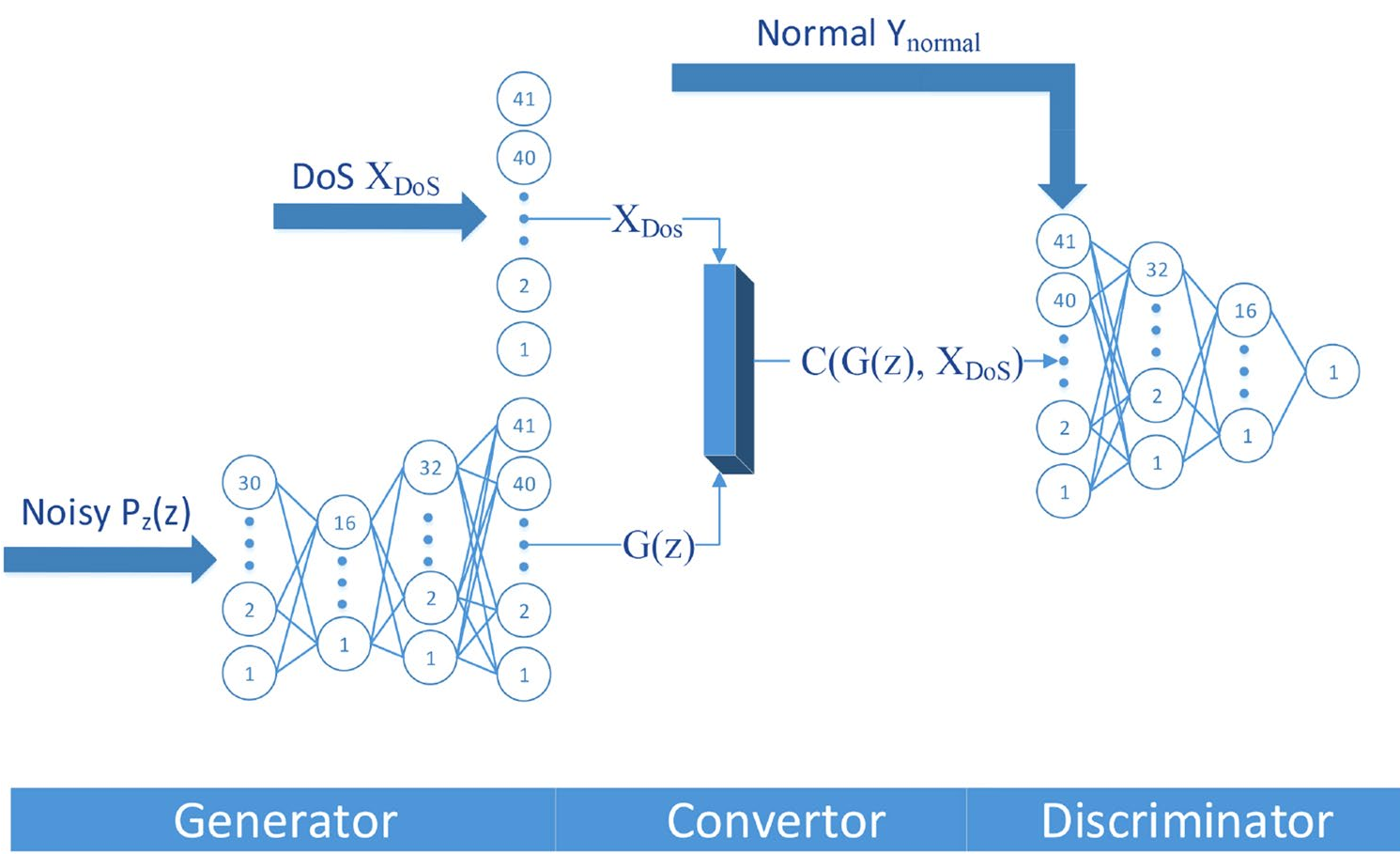 Figure: The DoS-WGAN architecture showing the interaction between the Generator, Convertor, and Discriminator.
Experiments and Results
The authors pitted their generated samples against a CNN-based detector.
- Detection Drop: The True Positive Rate (TPR) plummeted from 97.34% (original attacks) to 47.63% (WGAN-GP synthesized attacks).
- Diversity Check: Using Information Entropy, they proved that WGAN-GP creates a wider variety of attack signatures than traditional GANs, making it harder for defenders to create a single "patch."
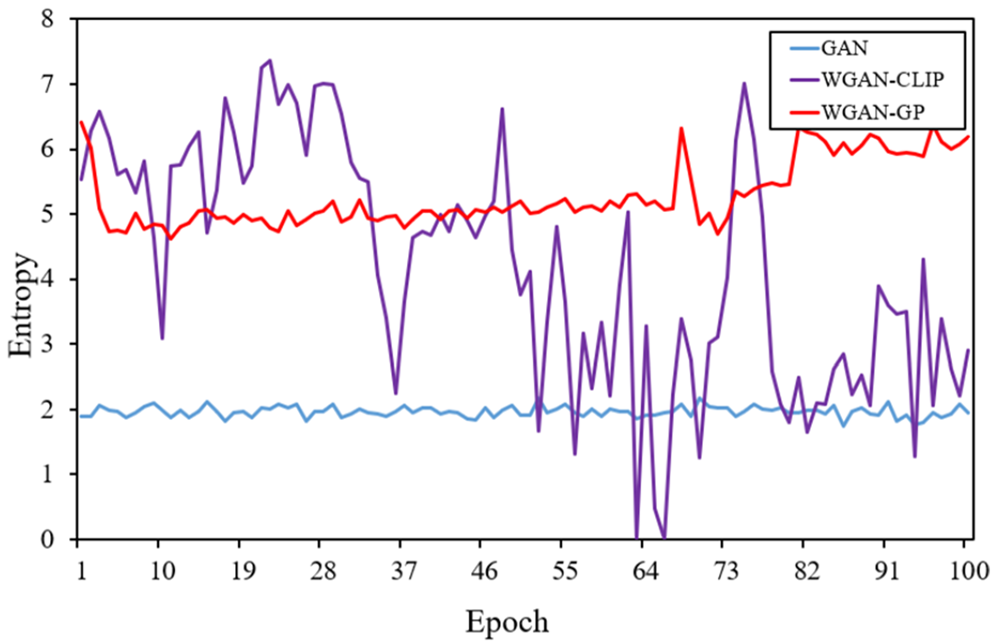 Chart: Detection rates over time. WGAN-GP (Green) consistently achieves a lower detection rate (better evasion) than standard GANs and WGAN-CLIP.
Deep Insight: Why This Matters
This paper shifts the perspective from "AI as a protector" to "AI as a liability." The fact that Information Entropy was used to monitor training is a brilliant move—it allows researchers to quantify the "creativity" of the attacking AI.
Limitations & Future Work
The study relies on the KDDCup 99 dataset, which is a classic benchmark but may not reflect the complexities of modern encrypted traffic (TLS/SSL). Future iterations would need to address how to manipulate encrypted payloads without breaking the handshake.
Conclusion
DoS-WGAN is a wake-up call for cyber-security architects. If our defense models aren't trained against adversarial AI, they are essentially "sitting ducks" for the next generation of automated exploits. The era of the "AI vs. AI" arms race in network security has officially arrived.